Votebeat is a nonprofit news organization reporting on voting access and election administration across the U.S. Sign up for Votebeat Arizona’s free newsletter here.
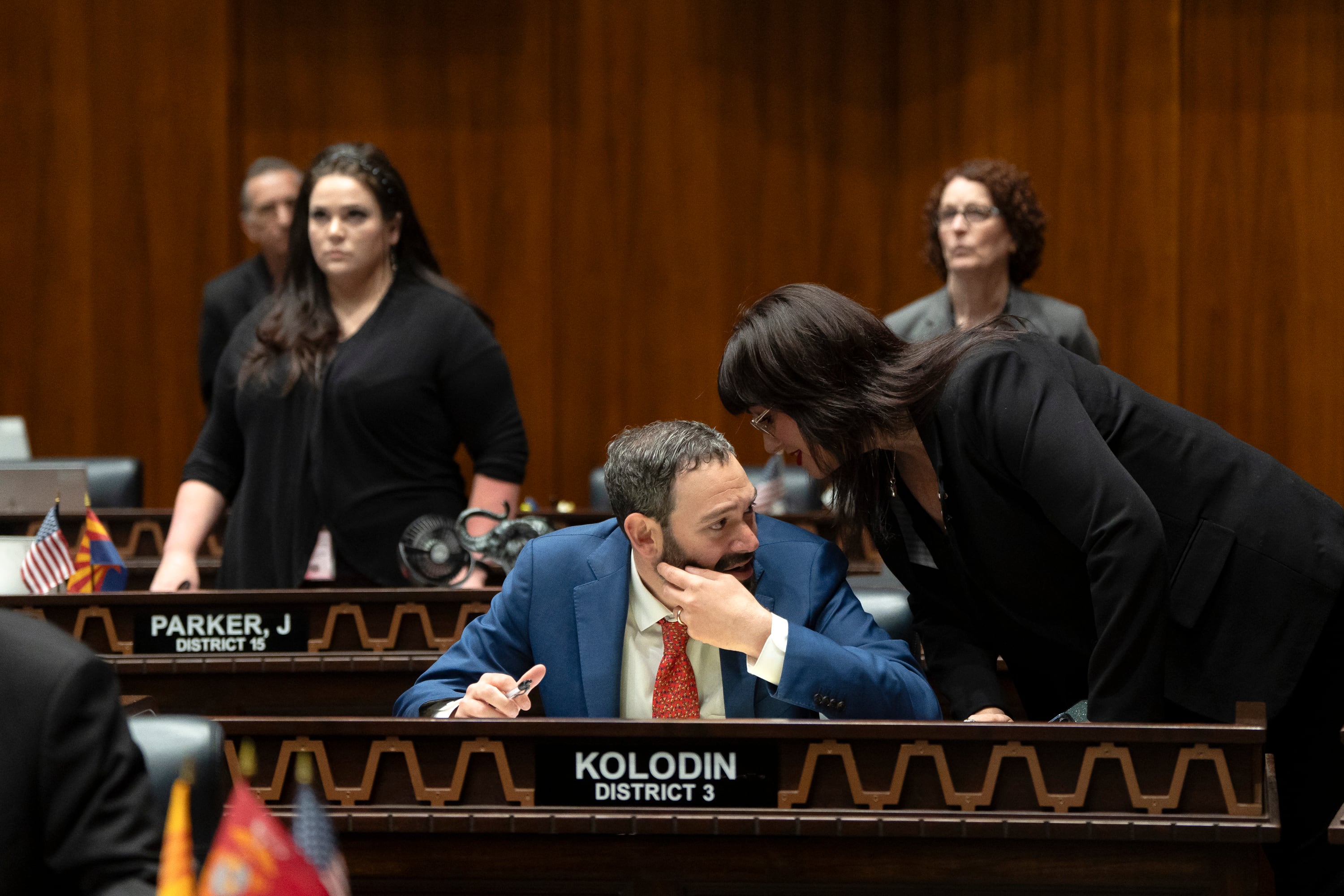
The Associated Press has called the Republican primary for Arizona secretary of state for state Rep. Alex Kolodin, setting up a high-stakes general election between him and Democratic incumbent Adrian Fontes.
As of Tuesday at 9 p.m. MST, with 65% of the expected vote reporting, Kolodin had 58% of the vote, while his primary opponent, former Arizona GOP Chair Gina Swoboda, had 42%.
The secretary of state is the top election official in Arizona. They play a critical role in issuing guidance to county election offices and dictating how voting must be run via the state’s election rulebook. They also typically act as a spokesperson for elections in the state and are on the front lines of election-related interactions with the federal government. Most notably, the winner of this year’s election will oversee the pivotal 2028 presidential election in the key swing state.
Kolodin’s victory in the primary suggests that unproven claims of widespread election fraud continue to have a strong hold on GOP voters in the state. Kolodin, an election attorney from Scottsdale, was part of a lawsuit in the aftermath of the 2020 election that alleged that year’s presidential race was stolen from President Donald Trump. On the campaign trail this year, he repeatedly said that voters don’t trust elections. He also heavily criticized local election officials and lambasted the state’s voting systems as dysfunctional.
As a legislator, Kolodin has supported bills to ban vote centers, shorten the early voting period, and require voters to recertify their address each election cycle to vote by mail. He led the charge to put a measure on the November ballot that would require mail voters to provide ID, among other changes to state election law.
Swoboda, by contrast, has largely defended Arizona’s election systems. She argued throughout the campaign that Kolodin’s hardline conservative positions would make him unelectable in the general election. In June, she told Votebeat that Kolodin had a “negative zero” chance of beating Fontes.
But as Kolodin celebrated his win, he was quick to reach out to general election voters. In a statement, he said his campaign was about “protecting every vote, regardless of Party.”
At the same time, he took aim at Fontes, saying his victory showed Arizonans were “sick and tired of Adrian Fontes’ mismanagement of our election system.”
“Tonight, Arizona voters spoke up decisively for lawful, transparent, honest, and fair elections,” Kolodin said, adding that he aimed to run “world-class elections that Democrats, Republicans, and Independents alike can be proud of.”
Fontes did not immediately respond to a request for comment.
The secretary of state race is unfolding as the Trump administration attempts to exert unprecedented influence on elections in swing states across the nation, including Arizona. Fontes has resisted the federal government’s efforts to scrutinize Arizona’s voting process, including by refusing to hand over the state’s voter roll to the Department of Justice. Kolodin has sided with the Department of Justice in that dispute, and also said that, if elected, he would require county recorders to run their full voter lists through an unreliable federal data tool known as Systematic Alien Verification for Entitlements, or SAVE, to check for noncitizens.
Sasha Hupka is a reporter for Votebeat based in Arizona. Contact Sasha at shupka@votebeat.org.