

Votebeat is a nonprofit news organization reporting on voting access and election administration across the U.S. Sign up for Votebeat Michigan’s free newsletter here.
This story was produced with support from the Pulitzer Center.
ANTRIM COUNTY, Mich. — In the middle of March, Barb Mullaly wasn’t thinking much about elections.
She was thinking about how it was allegedly going to be spring any day now, and yet it was still 30 degrees outside in Elk Rapids, her village on the shore of Grand Traverse Bay in Northern Michigan. She was thinking about the upcoming village council meeting in which she and her fellow council members would be criticized about a short-term rental ordinance.
And now she was distracted, thinking about a postcard that was, excuse her French, “crappy” because it threatened her voter registration. (She had wanted to use stronger words, but she didn’t want to be bleeped out at the council meeting.)
Mullaly had no way of knowing at the time that that postcard would reignite a charged debate about election integrity in Antrim County, a beautiful summer vacation destination miles away from the bustle of a big city — and the epicenter of one of the most persistent conspiracy theories from the 2020 presidential election.
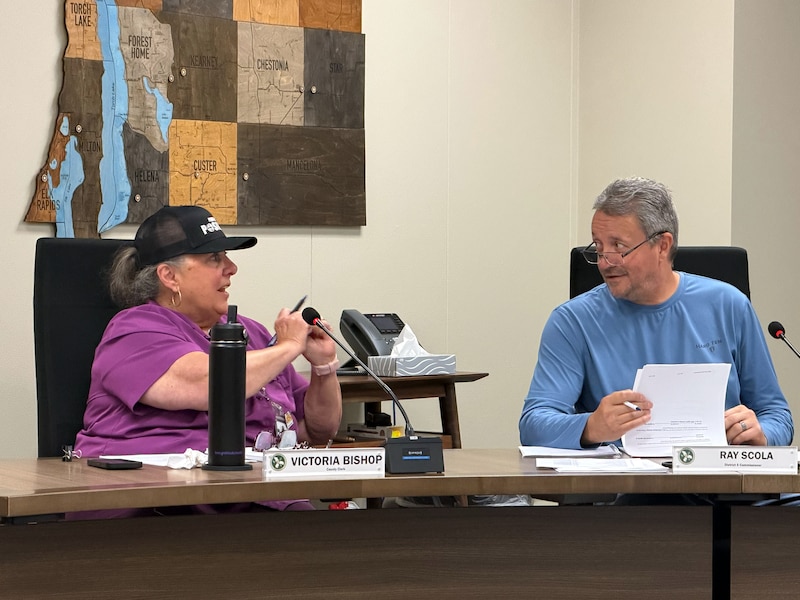
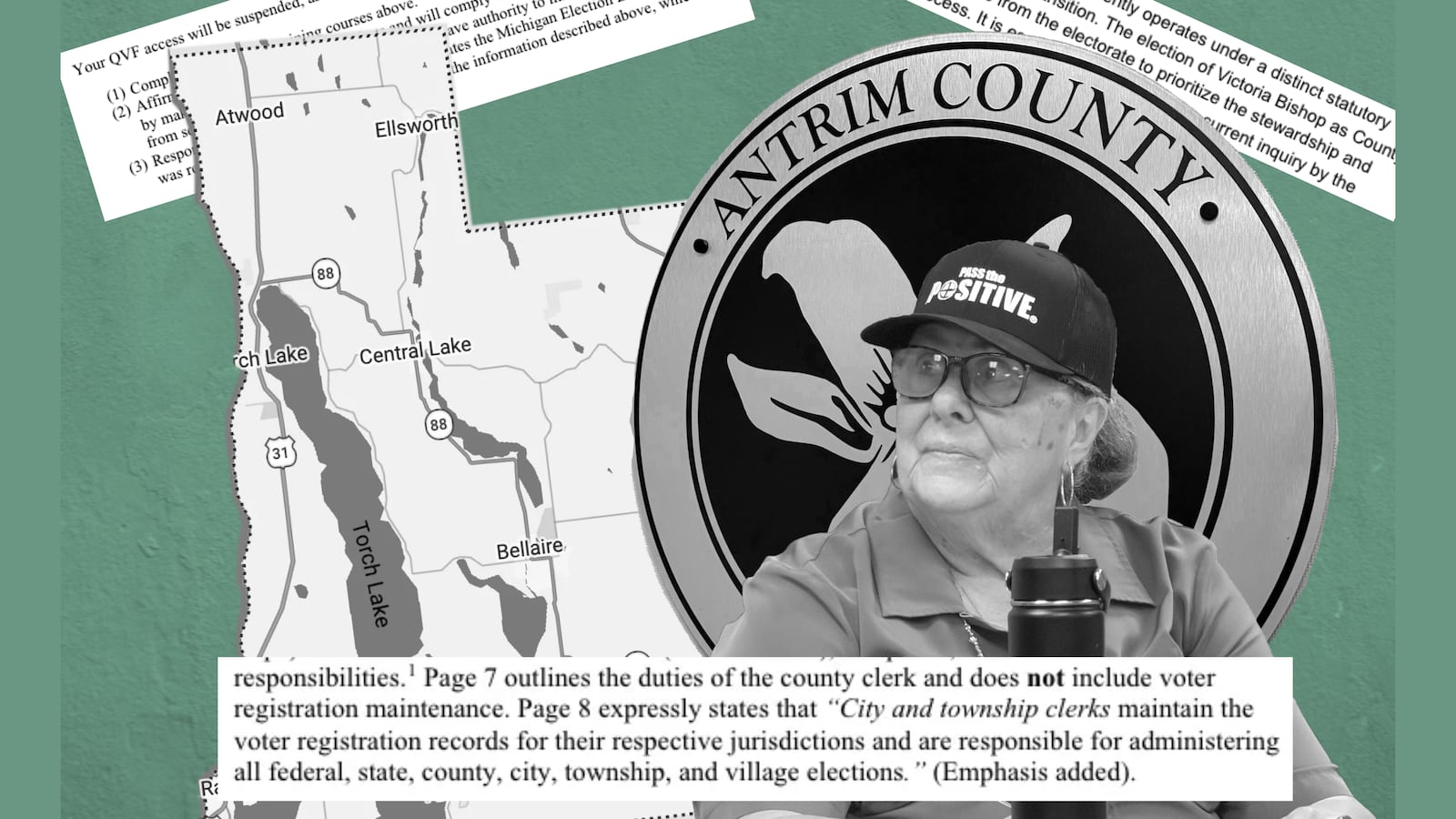
It was the first sign that Victoria Bishop, the Republican clerk elected in 2024 on promises to clean up the county voter roll, was beginning to aggressively pursue that goal — in a way that the Michigan Bureau of Elections said failed to comply with state law. For much of her term as county clerk, Bishop took steps to remove more than 1,600 of Antrim County’s 21,000 registered voters, sometimes on inaccurate grounds. In several cases, she warned residents they were poised to lose their right to vote in the county because they had moved or stopped voting. That included Mullaly, who had done neither.
Across the country, the vast majority of election officials are committed to running fair elections, operating within the boundaries of state and federal law. Occasionally, though, someone goes rogue. After 2020, there was Tina Peters, the Colorado clerk whose belief that the election was stolen led her to compromise her county’s voting equipment. In 2022, there were the two county supervisors in Arizona who refused to certify the election. And in 2026, there is Victoria Bishop.
Bishop’s crusade was, in the eyes of a certain group, a noble one. But in the time since, it has blown up in her face — implicating a slew of legitimate voters, incurring the wrath of the state’s Bureau of Elections, and featuring a CBD-peddling radio host known as Trucker Randy — all culminating in an organized effort to get Bishop out of office.
The saga shows how lingering mistrust from 2020 still hangs over elections six years later — not only on the national level, but even from the local officials who sit at the heart of the system.
But it also shows the system’s resilience. In Antrim County, municipal clerks and ordinary voters were quick to react to the postcards. The state took action too, flagging Bishop’s changes and ultimately suspending her access to the state’s voter rolls. Affected voters have been reinstated and will be able to vote in the midterm election.
For those concerned about interference in the 2026 midterms, Victoria Bishop’s story is a warning. But it’s also reassuring: It is a story of how the elections system stops an internal threat.

‘Restore Election Integrity in Antrim County!’
A whole lot of people never actually wanted Victoria Bishop to be Antrim County clerk.
When she first ran, it was four years after Antrim County became a household name for how it conducted the 2020 election — at least in households that believed that election was stolen. Due to human error, unofficial results initially suggested Joe Biden had won the heavily Republican county instead of President Donald Trump. Although the error was corrected (Trump ultimately won Antrim with more than 61% of the vote), the county became Exhibit A for Trump’s claims that voting machines nationwide were rigged against him.
It appears that election changed Bishop’s outlook on elections. It’s impossible to know for sure — Bishop declined to comment for this story. But a decade ago, as an Antrim County canvasser, she went on the record at her county’s conservative union meeting saying that election processes are secure, according to minutes from that meeting. Then in 2018, minutes from the board of canvassers show she helped certify that year’s primary election without issue. But by 2021, she was signing letters referring to Antrim’s 2020 error as “the election fraud case,” encouraging people to donate money to support legal proceedings against Antrim County’s handling of the election.

By the time of Trump’s third presidential run, she too was seeking elected office. With the backing of the county Republican Party, Bishop ran in a five-way primary for clerk with bright yellow signs promising to “Restore Election Integrity in Antrim County!”
During the campaign, she told the Antrim Review in a candidate questionnaire that she would work with township and village clerks to “clean up our [voter file] before the 2026 election.” Bishop claimed that 125% of Antrim’s adult population had voted in the 2020 general election (which is untrue — the county had just over 16,000 voters in 2020, compared to about 19,600 adults, per Census Bureau data). She further wrote that “we still have dead people and people who no longer live in Antrim County” on the voter roll.
She took just 37% of the vote, but it was enough for her to become the Republican candidate in November 2024. With no Democrats running against her, it was all but a guaranteed win.
Julie Woods, who ran against Bishop in that primary, said a lot of people were won over by Bishop’s flashy signs and her husband, local radio host and conservative darling Trucker Randy — who, by his own estimate, has logged more than 11,000 hours on his microphone in the last 14 years touting right-wing values alongside patriot-themed CBD products and a special discount on MyPillow merchandise offered by show supporter Mike Lindell.
Randy has been a staunch supporter of Trump for a decade, and after the 2020 election, he appeared alongside a number of people touting debunked theories about elections at a rally to demand a “transparent forensic audit” of the race. He unsuccessfully sued county officials, including the previous clerk, for allegedly erasing information from voting machines in 2020.
Woods said Randy was “definitely a catalyst” in his wife’s rise to the clerk’s office. It wasn’t just his local celebrity, though. Antrim County was embarrassed by its turn on the national stage, and voters wanted change. They sought it in the form of a right-wing politician promising the things they wanted, even if it was well outside the scope of the job she was running for.
It’s why people bought into what Woods, who used to work as a deputy county clerk in Kalkaska County, called “the old drain-the-swamp kind of thing.” The idea that someone unconnected to the government could come in, shake things up a little, and let Antrim County go back to being best known as a summertime vacation paradise was very appealing.
Those involved in elections were more nervous, even before Bishop took office. The sitting clerk, a Republican named Sheryl Guy, had been planning to retire from the job after three terms, but decided she didn’t want to leave Antrim with “somebody that might be crazy.” By September, she had mounted a write-in campaign for the November election, taking 38% of the vote in an election where Democrats didn’t run anyone.
It wasn’t enough to stop Bishop, who was sworn in as clerk in January 2025. She took office with what she later referred to as a “decisive directive from the electorate to prioritize the stewardship and accuracy of the democratic process.”
As clerk, Victoria Bishop took matters into her own hands
It didn’t take Bishop long to get to work. According to records, at some point between April and July 2025, she began changing some voters’ statuses in the Qualified Voter File, Michigan’s central database of registered voters. By June of this year, she had tinkered with the records of at least 123 voters, mostly to cancel or challenge their eligibility because she believed they were dead or did not live where they said they did.
Votebeat independently used obituaries and death notices to confirm that at least 22 of the 26 people Bishop marked as deceased had in fact died, usually only a few days before she changed their status. The problem was, as a county clerk, Bishop had little authority to challenge voters’ statuses on the roll. Unlike many other states, Michigan has clerks on both the county level and the municipal level, and it is the municipal clerks — those who work in cities and townships — who are supposed to maintain voter registration records. If, instead of changing statuses herself, Bishop had gone to municipal clerks and asked them to look into those voters, which is standard procedure in Michigan, no one would have batted an eye.

But it was the postcards that really drew attention.
In mid-March 2026, Bishop’s office sent out notices informing voters that there was reason to believe they had moved. If they did not respond to the notice or vote “by the second November general election following this notice,” it said, their registration would be canceled.
This time, the number of affected voters was much larger. According to records obtained by Interlochen Public Radio, at least 1,577 people were sent a notice — about 7% of the county’s registered voters. Bishop flagged at least a few dozen more to township clerks, although it does not appear postcards were sent to those voters.
Not many people were happy with the postcards. Many of the voters who received them, like Mullaly, had not moved at all, leaving them to wonder why they had been singled out. It didn’t seem to be by political affiliation (Michigan does not have party registration) or any other obvious identifier.
Mullaly said she called Bishop to ask why she had received the notice and was told it was “obviously” because she hadn’t voted in the past two elections. That offended Mullaly: She knew for a fact she had voted in nearly all of the last several elections.
“This is why we lack trust in government,” Mullaly said in an interview from the back of her art gallery in Elk Rapids, light reflecting off the glasswork as tourists milled around outside.

Julie Chellis, the Banks Township clerk, told Votebeat earlier this year that at least one of the postcard recipients was an 18-year-old family friend — someone too young to have voted in both of the past elections.
The postcards worked their way to municipal clerks through phone calls from voters who received them — and those who hadn’t but worried they might. Much of Antrim County is either water, forest, or farmland. Those who know their neighbors know them well, if only because there aren’t a ton of other people around. People know each other, and people talk. Mullaly’s frustration at the council meeting wasn’t the only conversation about the postcards, although that certainly elevated the issue — it came up at local coffee shops and grocery stores as well. Word of the postcards didn’t take long to reach the county’s 15 township clerks.
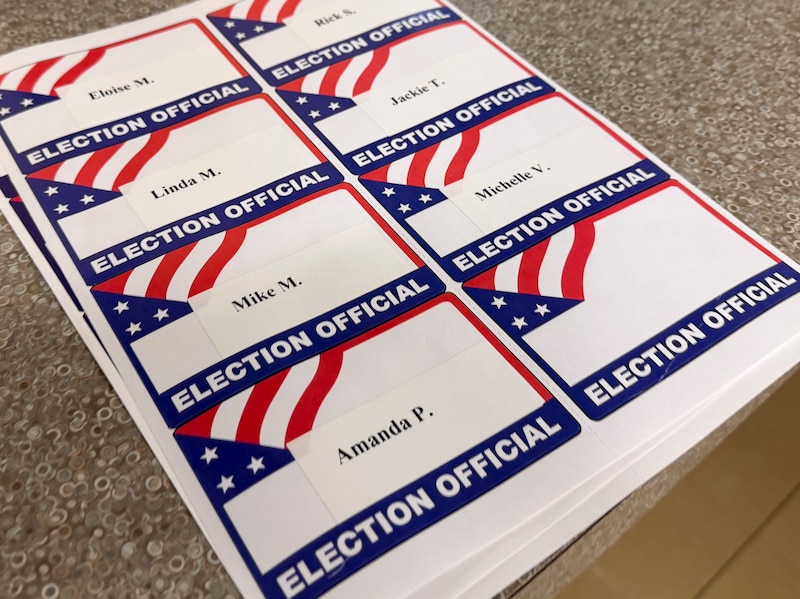
The clerks, largely Republicans themselves, worked to figure out what was going on and why. Much of their understanding was pieced together at an informal dinner they’ve been having bimonthly for years. The dinners, casual affairs at this local restaurant or that one, serve as a sanity checkpoint for the often-difficult work of managing elections, particularly in communities where election budgets are regularly smaller than the cost of a used car.
Janet Beebe, the clerk of Milton Township, said the postcards went out just before one of those meals, where clerks collectively figured out the affected townships — Banks, Chestonia, Custer, Echo, Elk Rapids, Forest Home, and Star — were mostly clustered near the beginning of the alphabet.
“We all felt a little blindsided,” Beebe told Votebeat in an interview at a tiny bakery on Torch Lake. “It would have been nice to have some communication there.”
Because it seemed like perhaps Bishop’s work wasn’t yet done, Beebe reached out to her and asked her not to touch Milton Township’s voter roll. Beebe had spent much of her time since the 2024 election cleaning it up — the job of a municipal clerk. She didn’t want that work interrupted.

She would have accepted help, though. Beebe liked Guy, whom she described as a personable figure, and had expected a similar relationship to form with Bishop. It didn’t, and now her help isn’t welcome.
“If you’re going to just confuse my voters, no thank you,” Beebe said.
Beebe’s loyalty to the voters is the reason she and her fellow township clerks do what they do; for most of them, it’s a part-time role they assume in retirement or juggle with another job. And the voters appreciate her back. As Beebe talked about her work as clerk, a customer approached and thanked her for what she does. She politely thanked them before blushing. Beebe has a number of family members who have served in the military, so it sits strangely to hear her job admired in a similar way.
People put their lives on the line “for me to be able to do this,” she said, brushing crumbs off the table in front of her.
How to catch an election official who breaks the rules
It wasn’t long before several municipal clerks started reaching out to the Michigan Bureau of Elections in Lansing, flagging that something atypical was going on with their county clerk. The postcards prompted the state to look into Bishop’s activity in the Qualified Voter File as well.
In April, the state wrote Bishop a letter that began, “The Bureau of Elections has received information indicating you may be taking actions … that fall outside the scope of your statutory authority and fail to comply with the law.”
The letter asked Bishop to explain her actions, but she missed the deadline to respond because she wrote back to the wrong email address. When she eventually emailed answers to the correct address, the state found them “both incomplete and inaccurate.” In June, the bureau revoked her access to the voter roll until she satisfactorily answered their questions and completed a series of trainings. In July, officials undid the changes Bishop made in the Qualified Voter File to ensure no one’s voting rights were taken away.
Bishop has declined to share her perspective with Votebeat. She did not answer repeated inquiries from us for previous stories dating back months and, when approached in person after a county commission meeting, made sure Votebeat had her attorney’s contact information. Reached this week, she said she does “not do public comments.”
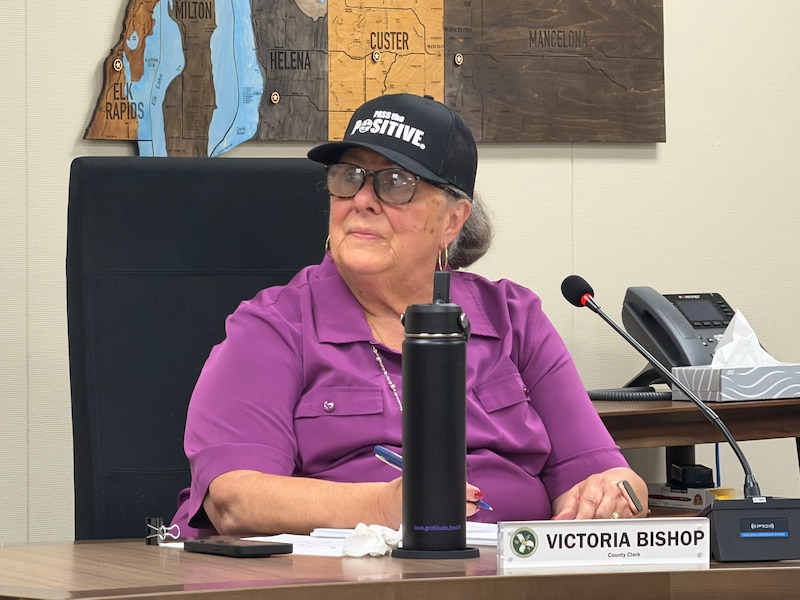
In an April press release, she said her attempts to clean the voter roll were “not an exercise in administrative overreach, but a necessary application of her supervisory jurisdiction” justified by federal laws requiring accurate voter lists. She also took out an ad in the local newspaper making many of the same arguments — arguments that don’t directly rebut the state’s claims but rather argue that state and federal law are in fact on her side.
It was the redundancy in Michigan’s election structure that led to Bishop’s undoing. The system is one of the most decentralized in the country — on purpose. While state officials can see the actions clerks take in the Qualified Voter File, they don’t have time to monitor Michigan’s 83 county clerks full-time. But the existence of municipal clerks ensures someone is always watching.
The goal is to make elections more difficult to corrupt, and it works. That decentralization allows the Barb Mullalys of the world to bring their postcards to a village council meeting — “my big mouth kind of started this shit,” she acknowledged — and alert the township clerks, who look into it after their group dinners and flag it to the state.
It is a whole series of witnesses that creates both a chain of accountability and a separation of powers. No one person controls any one stage of voting. In Michigan, having local clerks with the power to speak up means they notice when something is wrong faster than the state might — very helpful in a state with more than 7 million active voters.
That’s just Michigan. But there are also federal laws that control when people can be removed from voter rolls. And other states have a number of laws to keep their clerks in line too.
In Oregon, the law explicitly grants the secretary of state the ability to go to court to bring county clerks in line if they have “failed to comply with any election law.” In Kansas’ most populous counties, the secretary of state appoints election commissioners — and can explicitly remove them “for official misconduct.” Colorado allows the secretary of state to “issue appropriate orders” to ensure “proper” election administration.
In recent years, these laws have proven effective at cutting unruly election officials out of the process. In 2022, Colorado Secretary of State Jena Griswold took legal action against former Elbert County Clerk Dallas Schroeder, who had allegedly given unauthorized copies of election system hard drives to a number of lawyers. She eventually appointed a separate official to supervise elections in his county.
And of course, there was Peters, whose case has gained national notoriety as Trump has rallied by her side. The former Mesa County clerk was found guilty in 2024 of crimes related to breaching the county’s election system in an effort to prove voter fraud. Griswold decertified Mesa County’s voting equipment after the breach and worked with county commissioners to remove Peters’ election oversight privileges. Peters has since been released from prison years early, after Colorado Gov. Jared Polis commuted her sentence under pressure from the president.
Where does Antrim County go from here?
Months later, Victoria Bishop still does not have access to the voter roll. The state has not yet received answers to its questions, and as of September, Bishop had completed only two of her four trainings.
Bishop may not be Antrim County clerk for much longer. Her actions have inspired a campaign to recall her from office. The number of signatures required to force a recall election is nearly identical to the number of people who voted against her in the 2024 primary.
Still, it’ll be a tough bar to clear. State laws give those seeking recalls six months to gather signatures, but only the most recent 60 days of signatures can be counted. It’s not an impossible deadline — Adams Township voters recalled their own clerk in 2023 after she was stripped of election duties following her refusal to turn over a tabulator she suggested could have been rigged against Trump — but organizers in Antrim will have to solicit voters heading into the frigid Northern Michigan winter, when people spend most of their time inside.

Ashley Areeda, one of the recall organizers, says they’re not discouraged. The organizers, a bipartisan group, are planning to gather signatures at farmer’s markets, rallies, and even scheduled drive-throughs, where voters will be able to sign without leaving their car.
If they succeed, Bishop will appear on the ballot once again, this time in May. Organizers will have to propose someone to run against her, and they’ve suggested that they’ll probably choose someone without a party affiliation, lest voters be turned off by a Democratic label.
Trucker Randy said on his radio show earlier this month that their former attorney advised Bishop to start raising money for her own campaign to stay in office. If she wins — if Antrim County elects to keep her in office — she can’t be subject to a recall again for the remainder of her term, which ends in 2028.
In the meantime, Antrim’s municipal clerks are eager to put the dust-up behind them and focus on running a smooth midterm election. Most admire Annette Marcus, Bishop’s deputy, who has assumed many of her election duties.

Barb Mullaly is looking forward to voting this fall.
“There will always be fraud. I don’t care whether it’s Republican or Democrat. … At least locally, we have enough backstops, enough things in place, so when something screwy does happen — something illegal, abnormal, whatever,” it is caught, she said.
She said she chooses to believe elections are fair. She’s learned a lot about how the system works, and while she knows firsthand that one person “can mess up the system,” one person can’t stop voters from making their voices heard.
“People just pick up and do the right thing for the most part,” Mullaly said.
Hayley Harding is a reporter for Votebeat based in Michigan. Contact Hayley at hharding@votebeat.org.