
Votebeat is a nonprofit news organization reporting on voting access and election administration across the U.S. Sign up for our free weekly newsletter to get the latest.
Update, Oct. 30, 5:16pm: This story has been updated to include a comment from the Connecticut Secretary of State, as well as additional information about the Justice Department letters.
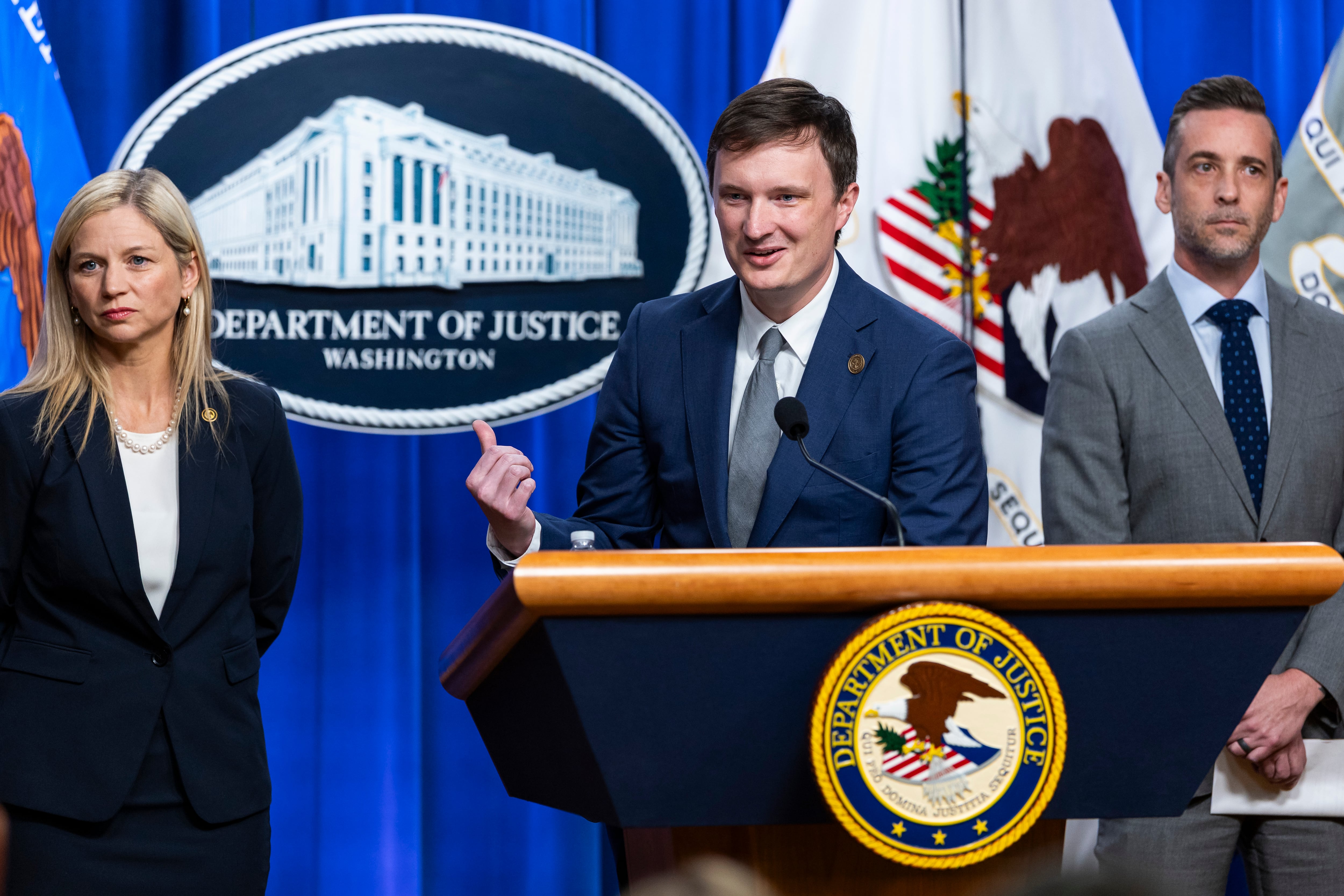
The Justice Department has sent yet another round of letters to state election officials warning them that they could face criminal prosecution for violating federal election laws, this time reminding them that they must preserve ballots, voter-registration records, and other election materials for 22 months after a federal election.
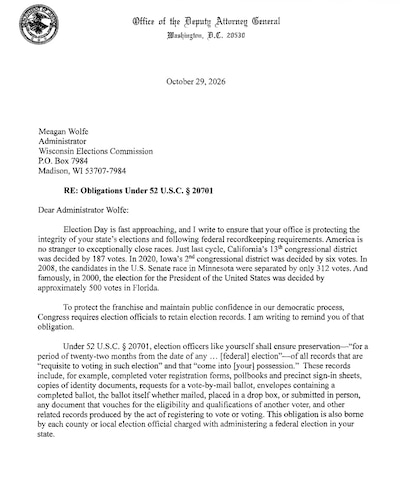
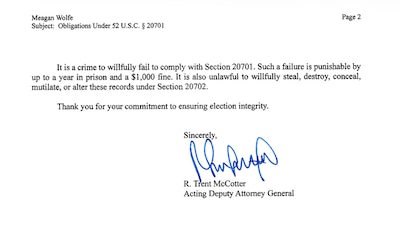
Multiple state election offices confirmed to Votebeat that they received identical letters dated Oct. 29 and signed by acting Deputy Attorney General Trent McCotter. Officials familiar with the correspondence said the letters appear to have been sent to all 50 states.
“It is a crime to willfully fail to comply with Section 20701,” the letter said, according to a copy provided to Votebeat. Votebeat also viewed letters sent to other states, which were identical. “Such a failure is punishable by up to a year in prison and a $1,000 fine.” The letter also warns that it is unlawful to willfully steal, destroy, conceal, mutilate, or alter election records.
The letters, dated Thursday, Oct. 29, came two days after a federal judge in California verbally admonished the Trump administration for threatening election officials with criminal prosecution in a separate dispute over ballots cast by suspected noncitizens.
“This court believes it would be wise that any threats to state and county elected employees cease immediately,” U.S. District Judge David O. Carter said during Tuesday’s hearing.
In a written ruling Wednesday, Carter rejected the DOJ’s attempt to force California to set aside ballots from roughly 20,000 voters and reiterated his warning: “These threats must stop.”
Justin Levitt, a former Justice Department official and White House voting rights adviser under President Joe Biden, said he was unaware of any precedent for sending such a reminder to election officials nationwide.
“Election officials know that they have an obligation to comply with this law — they know that real, real well — and this certainly looks like it’s meant to intimidate rather than to inform,” Levitt said.
Votebeat asked the Justice Department why the letters were sent just days before Election Day, why McCotter personally signed them, and whether similar reminders had been issued before previous federal elections. The department had not responded as of publication.
Another round of DOJ warnings
Several states did not immediately see the letters. As it has before, the DOJ sent some of the letters to general or incorrect inboxes. Texas’s letter, which was delivered to the correct location, was addressed to “Sec. Jane Nelson.” Nelson left office in July.
Connecticut Secretary of State, Stephanie Thomas, a Democrat, told Votebeat in a statement that her office remains focused on carrying out the Nov. 3 election.
“While I hope the decision to emphasize criminal penalties was intended simply as a reminder of the law, it could have been handled differently,” she said, adding that her office complies with the law as a matter of course, and did not need the reminder.
“This work is not something we do just because we receive a letter,” she said.
The letters are the latest in a series of warnings from the Trump administration to state election officials. A July mailing warned officials they could face prosecution for knowingly allowing noncitizens to vote, while September letters threatened civil or criminal penalties for failing to preserve records from the 2024 election.
The July letters were signed by Harmeet Dhillon, the assistant attorney general overseeing the Justice Department’s civil rights division. The September letters, signed by Eric Neff, the acting chief of the division’s voting section, directed 29 states and Washington, D.C., to preserve records in connection with ongoing litigation over access to voter-registration data. Dhillon described those notices at the time as standard litigation practice rather than threats.
The October letters, by contrast, cite an existing preservation requirement dating to 1960 without identifying a particular violation or pending investigation. They were also signed by a more senior official: McCotter, the acting deputy attorney general and the department’s second-highest-ranking official, who assumed the role in August.
McCotter has recently played a direct role in the Justice Department’s election-related litigation. Earlier this month, he signed letters to California officials, including Secretary of State Shirley Weber and Los Angeles County Registrar Dean Logan, demanding that they investigate a federal list of suspected noncitizens who had received mail ballots. He gave officials 48 hours to review the list and instructed them to set aside ballots from voters whose citizenship could not be confirmed, warning that the Justice Department would seek emergency court intervention.
The Justice Department subsequently sued California, asking a judge to bar the state from counting the ballots of voters on the list. State and county officials disputed the accuracy of the federal government’s data, saying it included U.S. citizens and people who were not registered to vote. Carter rejected the department’s request Wednesday, finding that the proposed intervention could disrupt voting and prevent eligible citizens from having their ballots counted. The Justice Department appealed, and has since issued grand jury subpoenas to California election officials.
Experts question the timing and purpose
Levitt said there was nothing inherently improper about the Justice Department reminding officials of their legal obligations, but such reminders are typically prompted by concerns about compliance or understanding of the law.
“It is not itself improper,” Levitt said. “But it’s super weird that the deputy sent this letter, and it’s super weird he sent the letter to everybody.”
Joshua Douglas, an election law professor at the University of Kentucky, also questioned the timing, particularly when election officials are occupied with preparations for Election Day.
“I have never seen the DOJ send this kind of letter across the country in the days before the election,” Douglas said.
The letters impose no new legal requirements, Douglas said, but create another issue for election officials to deal with during an already demanding period.
“At least they aren’t targeting based on politics, but it feels very unnecessary and creates confusion,” he said.
The nationwide mailing also comes as federal courts scrutinize other Justice Department demands to states. On Thursday, a federal judge in Washington ordered the department by noon today to disclose which states had received letters demanding that ballots from suspected noncitizens be set aside.
Votebeat reporters Natalia Contreras, Carter Walker, Alexander Shur, Dion Nissenbaum, Hayley Harding, and Sasha Hupka contributed.
Jessica Huseman is Votebeat’s editorial director and is based in Dallas. Contact Jessica at jhuseman@votebeat.org.