Votebeat is a nonprofit news organization reporting on voting access and election administration across the U.S. Sign up for Votebeat Michigan’s free newsletter here.
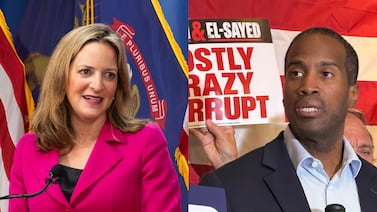
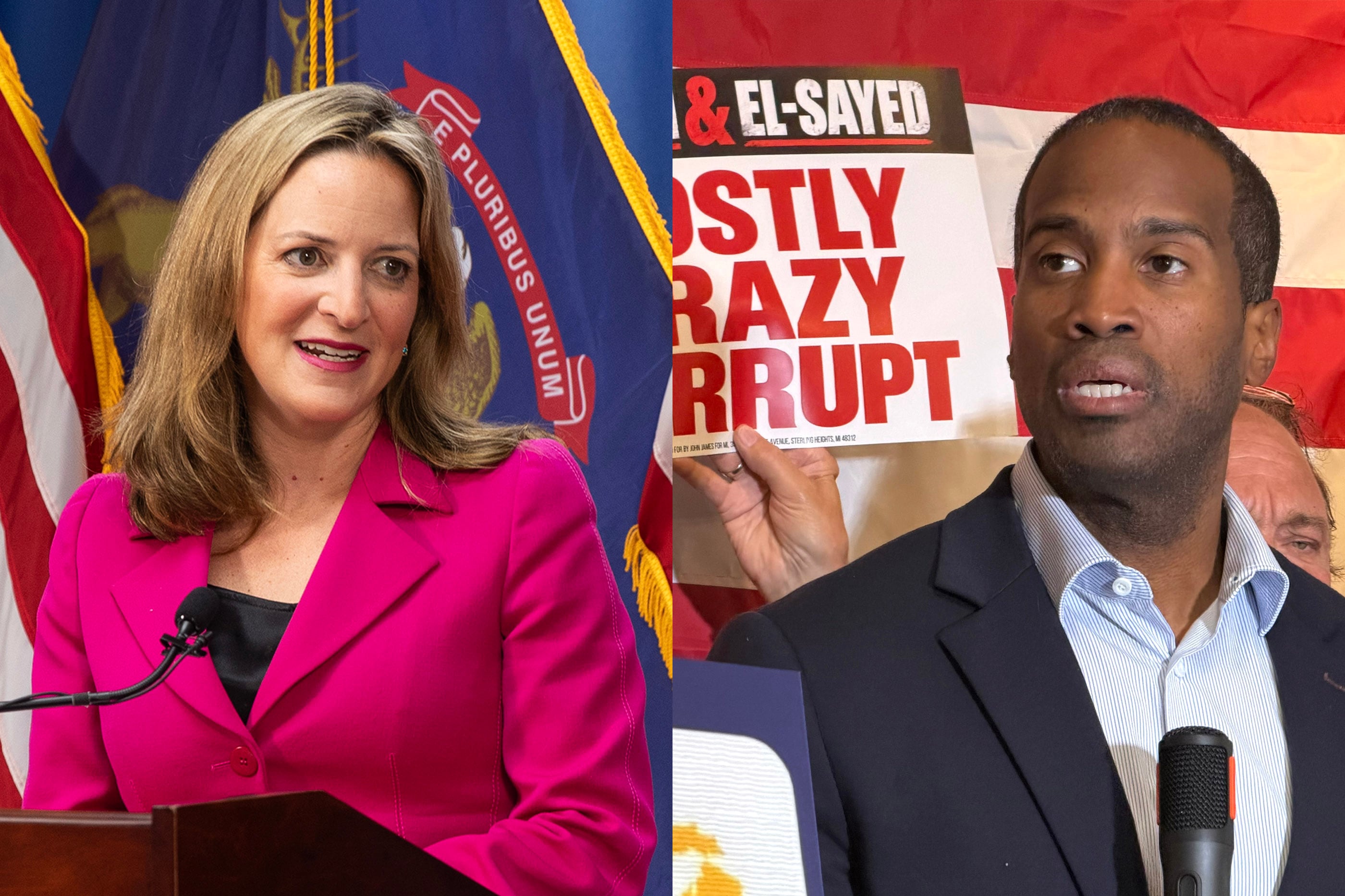
When Michigan voters weigh in on who should be their next governor, they will be choosing between a man who said the state’s 2020 election process was “rigged and manipulated” and the woman who ran that election.
It’s giving the race between U.S. Rep. John James, a Republican, and Michigan Secretary of State Jocelyn Benson, a Democrat, an interesting angle: Should a candidate’s stance on election administration dictate whether they can lead a state?
Both campaigns appear to believe the answer is yes. Benson, who’s served as the state’s top election official since 2019, has named her work in that office as one of the key reasons voters should select her, saying in her candidate questionnaire for the Detroit Free Press that, under her stewardship, Michigan’s elections ranked “consistently among the top five.” (The Massachusetts Institute of Technology ranked Michigan’s elections in the top five in 2022 and 2024, and No. 7 in 2020.) Her campaign website boasts that Benson “oversaw two of the highest turnout and most transparent elections in the state’s history.”
She’s regularly framed herself as an “election defender,” while James, she says, is an “election denier.” James said this summer that President Donald Trump won Michigan three times, even though President Joe Biden defeated him in the state in 2020. James and his campaign later said he was referring to Trump’s three wins in the state’s Republican primaries.
James, in turn, has attacked Benson’s work on elections. In a podcast interview in June, James, who ran unsuccessfully for U.S. Senate in 2020, claimed without evidence that Benson “rigged and manipulated the election process to defeat me and President Trump.”
James also signed onto a letter with other Michigan Republicans in Congress accusing Benson of allowing “an environment to persist where at least 15 non-citizens cast ballots” in the 2024 election. Michigan has charged a number of people since 2024 for voting despite not being U.S. citizens. Others are under investigation.
Other Republicans have joined in. At a September press conference, for example, James joined with Jay DeBoyer (the GOP candidate for lieutenant governor) and Anthony Forlini (who is running to replace Benson as secretary of state) to attack Benson’s record as secretary.
DeBoyer, who was the St. Clair County clerk before he became a state representative, said he used to tell his local clerks to not follow Benson’s election directives because they were in “direct violation of election law.”
Forlini, who has served as Macomb County clerk since 2021, went after Benson’s handling of a spat between their respective offices in which he said he found a number of alleged noncitizens on the voter roll and Benson’s office warned other clerks against using the methodology Forlini used. While Forlini did find at least one noncitizen who had cast a ballot, further investigation found a number of the people he flagged were in fact citizens.
If nothing else, voters are likely to walk away from the 2026 gubernatorial race more aware of what exactly a secretary of state’s role is, said Melissa R. Michelson, a professor of political science at Menlo College in California.
It could also help encourage both parties to turn out, she said. Reminding Democrats that Benson ran contentious elections could excite them, Michelson said, while standing with Trump on his claims that the 2020 election was stolen is a standard way for Republican candidates to win the president’s backing. Trump has endorsed James in the gubernatorial race.
James is “probably hoping that there’s a future for him, even if he doesn’t win this election,” Michelson said. “What better way to cement yourself as a loyal Republican who toes the party line and speaks Trump’s truth? Maybe that sets him up for something else in the future.”
A poll conducted by Michigan State University political science professor Corwin Smidt found that 77% of likely voters in Michigan said they were at least somewhat confident their county would count their votes correctly. A lower number — 68% of likely voters — said they trusted the state as well.
“The [Republican] rhetoric has not translated into a full erosion of trust down to 2020 levels,” Smidt said. After the 2020 election, he found that only 20% of Republicans said they were at least somewhat confident in statewide elections, per data he shared with Votebeat. That’s compared to more than 47% of Republicans in this latest survey ahead of the midterm.
A few weeks before the election, he said the nearly 1,400 Michiganders surveyed were largely not concerned about election integrity, instead focusing on the cost of living and the economy at large. To Smidt, Republican claims about election fraud seem like more of a move to “solidify the base” rather than persuading voters concerned about the issue.
But even if James loses, Michelson said his claims about Benson’s role in running the state’s elections could potentially set up future distrust. For one, it could affect voters’ views of this election, even though Benson has recused herself from the bulk of elections-related work. And beyond that, it could also color perceptions of future elections in the state more broadly.
It’s a new playbook politicians have been using, Michelson said — elections are only fair if you’re the winner.
“Every time a politician does this, it reduces public trust in elections,” she said. “It increases the difficulty of election officials doing their job. It increases the number of threats made. It makes it harder for election offices to get people to work at polling places because they don’t want to be confronted or intimidated or attacked.”
Hayley Harding is a reporter for Votebeat based in Michigan. Contact Hayley at hharding@votebeat.org.