
Votebeat is a nonprofit news organization reporting on voting access and election administration across the U.S. Sign up for our free weekly newsletter to get the latest.
New Jersey stepped to the forefront of the national debate over noncitizen voting this week when the governor announced that a software glitch had allowed nearly 400 noncitizens to vote in elections since 2023 — a revelation that emerged just as President Donald Trump put a target on the state’s back over the issue.
Now, New Jersey is scrambling to explain what happened, how officials addressed it, and why it took so long to tell the public.
The federal government has sued a majority of states, including New Jersey, for access to unredacted versions of their voter rolls containing voters’ personal information, though so far, federal judges have ruled against the government in more than half of those cases. A top U.S. Department of Justice official — who recently threatened to criminally prosecute election officials who knowingly allowed noncitizens to remain on voter rolls — has also demanded that the state turn over information on the noncitizens involved and said the government intends to prosecute them.
Trump and his allies have long asserted that noncitizens are registering and voting in significant numbers, but available evidence shows noncitizen voting is actually rare. As in New Jersey, some cases in which noncitizens were improperly added to the voter rolls in other states stemmed from government or technology errors, including at motor vehicle agencies.
“When things like this happen, man, you want to crawl under a rock,” said Jennifer Morrell, a former Colorado elections official who now serves as chief executive officer of The Elections Group, a consulting firm that advises elections leaders around the country. “We know that these systems, all systems in our lives, are always going to be prone to human and technological errors and it’s important to be transparent about what happened.”
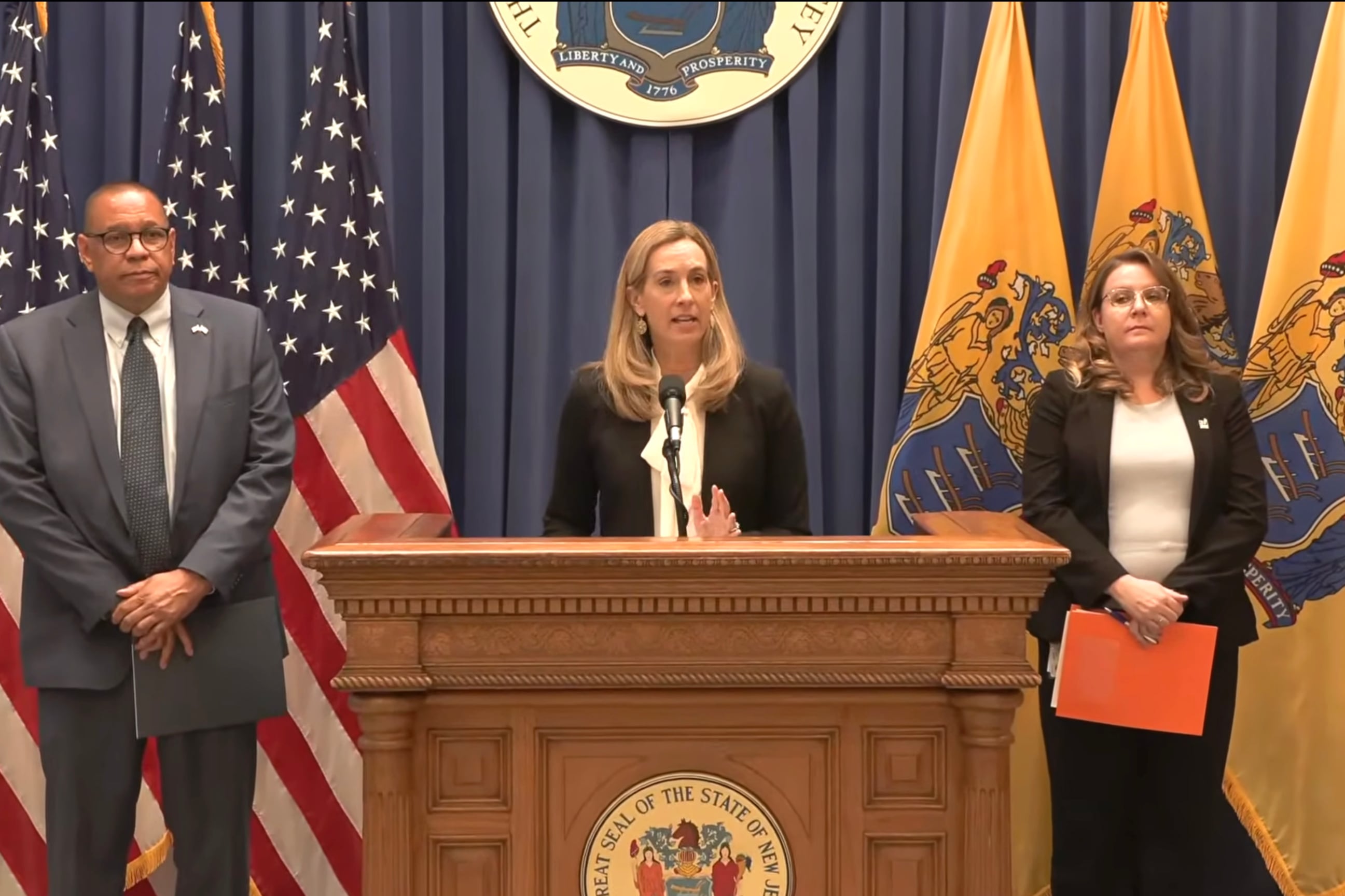
New Jersey Gov. Mikie Sherrill, a Democrat who took office in January, held a press conference Tuesday to disclose that a software problem at New Jersey’s motor vehicles department improperly registered 6,600 people to vote between June 2023 and June 2024, even though they had said that they were not U.S. citizens.
Fewer than 400 of those people cast ballots in elections between 2023 and 2026, Sherrill said. New Jersey has more than 6.6 million registered voters.
Sherrill said her predecessor’s administration discovered and fixed the software problem in June 2024. But state officials did not alert the public, or the 6,600 people who had improperly been registered, until this week, she said.
She stressed that the state is still investigating but said, based on what officials know so far, those votes did not change the outcome of any races.
New Jersey Lt. Gov. Dale Caldwell, who is also the secretary of state, and Rosalie Johnson, the official who oversees the motor vehicle agency, joined Sherrill at the press conference. Their offices did not respond to additional questions about the incident.
Sherrill said she has ordered an independent investigation to determine exactly what happened, and promised to publicly release the results.
She also harshly criticized her predecessor, Gov. Phil Murphy, also a Democrat, for failing to address and disclose the problem and said she was moving quickly to remove improperly registered voters from the rolls. A representative for Murphy did not respond to a request for comment.
“I see no reason why our state cannot run an election system well and have a computer program that can operate well,” Sherrill said. “Should any problem occur it should be caught quickly. This is just to me not a problem with some of our laws; it’s a problem with accountability.”
Sherrill said the software issue involved the state’s outside vendor, IDEMIA, a French multinational technology company New Jersey has worked with for decades. The state is replacing IDEMIA with another vendor in the coming months, state officials said.
In a statement, IDEMIA did not acknowledge any mistakes and did not respond to requests for more information.
“IDEMIA’s role is to transmit information through the motor vehicle system,” the company said. “Information submitted by IDEMIA must still be validated and adjudicated by the Division of Elections.”
New Jersey glitch echoes earlier ones in other states
New Jersey is the latest state to run into technological problems that have affected election systems and risked undermining public confidence in the nation’s voting processes.
In 2024, Oregon temporarily paused its automatic voter registration system after discovering that a data-processing error at the state Department of Motor Vehicles led to more than 1,700 people being improperly registered to vote, likely due to human error over which documents constituted proof of citizenship. That same year, shortly before the presidential election, Arizona discovered that a long-running error at its motor vehicles department improperly classified 218,000 people as having provided the proof of citizenship required by the state when they had not.
In 2017, elections officials in Pennsylvania revealed that a programming error had long allowed noncitizens to register to vote through the state’s motor vehicle agency, though it’s not clear precisely how many did. The state eventually sent letters to verify the eligibility of more than 11,000 voters, many of whom were later confirmed to be eligible.
Seth Bluestein, a Philadelphia city commissioner and the Republican member of the city’s three-person Board of Elections who helped identify the problems in Pennsylvania, said there is “a broader issue to be addressed when it comes to infrastructure related to elections.”
“Every state should check their DMV processes to make sure that their DMV is not mistakenly registering non-citizens,” Bluestein said. “To me this is about better government management.”
Keith Ingram, a former elections director in the Texas secretary of state’s office, echoed Bluestein’s assessment.
“If you’ve got a coding error, that’s something that needs to be fixed,” he said. “It doesn’t mean that you don’t get good data. It just means that you made a mistake.”
Ingram said he believes noncitizen voting “is a very small problem, if it’s a problem at all, and this doesn’t change that opinion at all.”
But New Jersey’s technological challenges can’t be divorced from the broader national debate over the country’s voting systems.
Last week, the Trump administration accused New Jersey and three other states of improperly registering 250,000 noncitizens as voters. The White House and Republican officials pointed to Sherrill’s announcement as they pushed for passage of the stalled SAVE America Act, which would require proof of citizenship to register to vote, among other provisions. They said the disclosure validated their concerns, though experts say the legislation wouldn’t necessarily prevent such errors. The problem in New Jersey wasn’t a lack of checks, they said, it was that the software wasn’t properly documenting the information being entered.
“The thing the media says never happens just keeps happening,” a social media post by the Department of Homeland Security read, accompanied by screenshots of a headline about the New Jersey issue next to a 2017 headline about the problem in Pennsylvania.
“Democrats and their media allies have repeatedly said it is impossible for noncitizens to register to vote, let alone cast a ballot,” White House spokesperson Abigail Jackson said. “Time and again, they have been proven wrong.”
The U.S. Justice Department has given New Jersey until next week to provide complete information on the 6,600 people who may have been improperly registered to vote and suggested that it may prosecute some of them for their actions.
In an interview Wednesday on Fox Business, Assistant U.S. Attorney General Harmeet Dhillon pointed to the timing of New Jersey’s disclosure, which came days after the president’s prime-time speech on elections. “I don’t think it’s a coincidence it just came up suddenly a few days after the president gave a speech,” she said.
Dhillon also said that Sherrill “appears to be saying that the prior governor may have known about this for some time.” The federal government’s demand for the identities of the people who were improperly registered and voted while ineligible is “the beginning of our investigation,” she said.
In a separate interview Wednesday with the online program “The Benny Show,” Dhillon said, “they are subject to both prosecution as well as removal from the United States.”
New Jersey Republicans are questioning the governor’s explanations and calling for a legislative investigation into what happened.
Sherrill said the people involved should not be prosecuted for a mistake made by the state government.
“We are not in the practice of releasing personally identifying information to the federal government right now given that the Trump administration continues to weaponize it against people,” she said.
She also castigated Trump for pushing false election conspiracy theories.
“Donald Trump has done more to undermine free elections in this country than certainly anyone in my lifetime, including Vladimir Putin,” she said.
Dion Nissenbaum is Votebeat’s senior national reporter and is based in Houston. Contact Dion at dnissenbaum@votebeat.org.