
Votebeat is a nonprofit news organization reporting on voting access and election administration across the U.S. Sign up for our free weekly newsletter to get the latest.
The Trump administration and some conservative election activists argue that foreign-made components in voting machines present a national security risk, and believe the federal government should take steps to mitigate it for the midterm elections. They worry another county could try to hack voting equipment to meddle in the election and some Trump allies want the president to ban voting machines altogether.
But voting equipment manufacturers say it’s impossible to build the equipment without Chinese-made parts — and they already take precautions to protect against sabotage and foreign interference.
Recent intelligence assessments suggest that America’s adversaries could run disinformation campaigns to try and sway the outcome of the elections, but that there is little evidence to suggest they will try to manipulate vote counts.
The three voting technology companies that serve around 85% of registered voters all confirmed they use some Chinese parts. The same Chinese-manufactured computer parts are used in critical infrastructure from ports and the electrical grid to telecommunications and water systems, said Pamela Smith, president and CEO of Verified Voting, a nonpartisan, nonprofit organization that advocates for secure, reliable and verifiable elections.
“We cannot domestically source all of these parts,” said Sara Cutter, executive director of the American Council for Election Technology, a trade association representing many U.S. voting equipment manufacturers and election technology companies. “The Chinese have such a deep bench of supplies in all levels of electronic supplies for any number of critical infrastructure organizations, and it’s a reality of modern American life.”
The association understands the concerns about foreign parts and has a policy of not using components from America’s top adversaries – North Korea, Russia or Iran, Cutter said, but extending that policy to China would be impossible.
Cutter said manufacturers use a variety of safeguards to protect against sabotage, including physically inspecting parts, tracking serial numbers, testing components, and using certified shipping partners.
Elections a ‘critical’ subsector
The outgoing Obama administration in 2017 designated election infrastructure as a critical infrastructure subsector, joining others including manufacturing, financial services, dams, and emergency services. The designation is meant to make federal resources available to support those sectors and ward off threats, including foreign intervention.
At the time, then-Homeland Security Secretary Jeh Johnson acknowledged bipartisan concerns from election officials around the country about any increased federal role in elections, which are run by states and localities.
“It is important to stress what this designation does and does not mean,” Johnson said in a statement. “This designation does not mean a federal takeover, regulation, oversight or intrusion concerning elections in this country. This designation does nothing to change the role state and local governments have in administering and running elections.”
But the Trump administration has nonetheless sought to increase its oversight of elections, though federal courts have blocked key prongs of its effort. And current Homeland Security Secretary Markwayne Mullin has asserted that foreign adversaries could hack voting machines.
“Foreign adversaries have parts that are vital pieces in our voting machines,” Mullin said in a July press conference. “We know that they can access what they consider the key to the back of these machines. We know that they can change voter registration and your vote. We know it’s possible. There’s not a question. It’s not even for debate.”
Mullin also raised the issue in an August letter in which he acknowledged the voting-system industry “is impacted by the fact that some necessary components cannot be sourced from domestic manufacturers, so vendors are dependent on foreign suppliers.”
Still, “voting machines with components manufactured by foreign adversaries introduce significant security risks,” he wrote. “These vulnerabilities mean that malicious actors could potentially compromise election infrastructure at any stage of the supply chain, even before the machines are assembled or deployed.”
Mullin threatened to withhold 20% of Homeland Security counterterrorism grants if states didn’t embrace Trump administration election security measures, including manual audits of paper ballots and citizenship checks of voter rolls. But a federal judge struck down the conditions in September, ruling that the agency had exceeded its authority.
Manufacturers and experts say voting equipment is protected by a series of layered precautions to keep anyone from obtaining improper physical access. Also, it isn’t connected to the internet.
Jeb Cameron, the senior vice president of customer and government relations at Election Systems & Software, said the company operates “under a healthy sort of paranoia” with its supply chain.
“We treat all components of our voting systems with high scrutiny, regardless of their country of origin,” Cameron said. “All our vendors are subject to the same supply chain securities, regardless of where they are located.”
Cameron also said it’s important to reality check the concerns.
“Just because a vulnerability may exist that doesn’t mean it can or has been exploited when you put it within the context of elections and elections administration,” he said.
Another major question is whether countries such as China, Russia or Iran are willing to take the risks of trying to overtly meddle in the administration of a U.S. election, or the results.
A declassified 2024 National Intelligence Council assessment concluded that the three countries had the “technical capability to access some U.S. election-related networks and systems,” but that they would “probably refrain from disruptive attacks that seek to alter vote counts because they almost certainly would not be able to tangibly impact the outcome of the federal election without detection.”
The assessment also noted that “there is no indication they attempted such attacks during the past two election cycles.”
Rather than working to directly change results, the assessment concluded that the countries were more likely to carry out disinformation campaigns to try and cast doubt on the results.
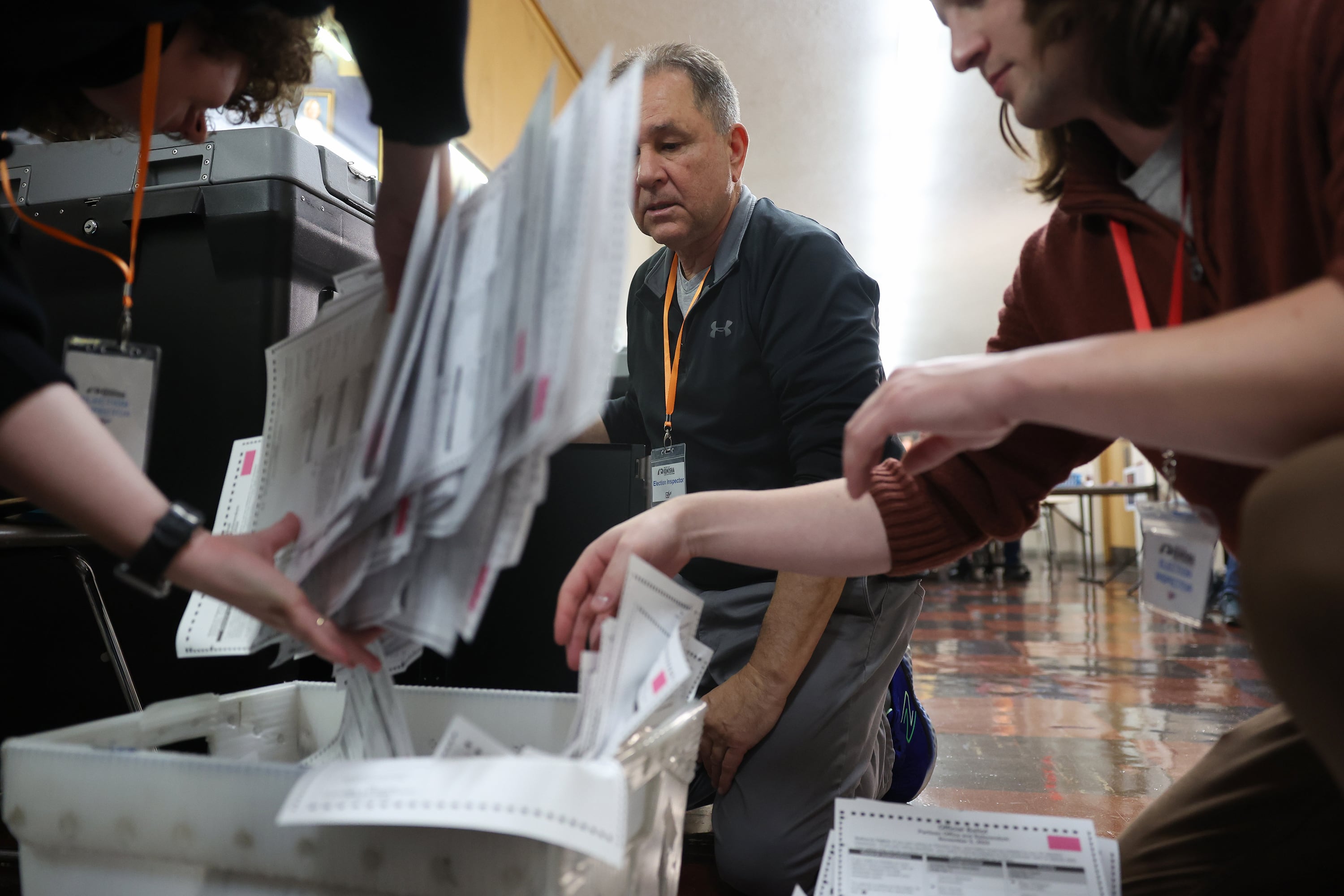
Perhaps more importantly, nearly all voting equipment across the country now has paper trails to ensure that results compiled by computer can be checked against paper copies. (Louisiana is the only state that still uses paperless voting systems statewide.) Every state now requires some form of post-election audit in which election officials check samples of paper ballots to verify that computerized vote counts are accurate, though the percentage of ballots or precincts audited varies from state to state.
Smith, from Verified Voting, said companies and election officials work to develop what she called “defensive depth,” a system of safeguards to protect against any attempts to manipulate results.
“You may have a risk inherent in your supply chain, but that does not mean you won’t end up with a legitimate, correct, accurate, fully verified result at the end of the day,” Smith said.
Smith cited a quote from Verified Voting founder Dave Dill: “If we do it right, the devil himself could build the voting machines, and we could hold an honest election.”
Dion Nissenbaum is Votebeat’s senior national reporter and is based in Houston. Contact Dion at dnissenbaum@votebeat.org.