

Votebeat is a nonprofit news organization reporting on voting access and election administration across the U.S. Sign up for our free weekly newsletter to get the latest.
More Americans are heading to the polls and relying less on mail ballots this election as voter preferences shift, according to a Votebeat analysis.
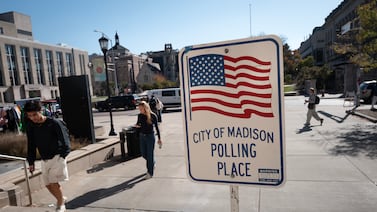
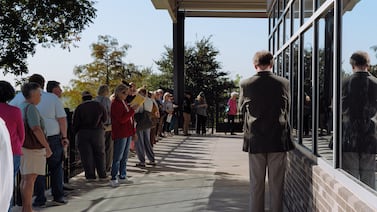
Voter turnout for the ongoing election is about 42 million as of Thursday, slightly ahead of turnout for the 2022 midterm election at the same point. But there has been a notable shift in how people are casting ballots in the lead-up to Election Day: a growing number of voters are turning away from voting by mail and are instead heading to early voting polling sites.
Clear examples of the shift are North Carolina, Georgia, and Wisconsin, where, on average, early in-person voting is up 35% compared with 2022 and voting by mail and drop box is down about 35%.
The catalysts for the shift aren’t entirely clear. But election experts, polling and voters themselves suggest that a combination of factors — including President Donald Trump’s persistent attacks on voting by mail and an end to COVID-19 pandemic concerns — are driving the changes.
Paul Gronke, a political science professor and director of the Elections & Voting Information Center at Reed College in Oregon, said both COVID and Trump have played a role in transforming how Americans vote.
“Any kind of messaging from such an influential voice in our political system, and whose attacks are taken up by, and amplified by, others with very large megaphones have moved many Republicans away from voting by mail / absentee voting,” Gronke said in an email.
But voting patterns are also adjusting to life after COVID-19.
In 2020, at the height of the pandemic, around 43% of voters cast ballots by mail, according to the Election Assistance Commission. That figure fell to 30% in 2024.
“Because Republicans and Democrats reacted differently to COVID, they also reacted differently to COVID and voting,” Gronke said. “Many more Democrats opted for the vote-by-mail option in 2020, then habituated and continue to vote that way. Many more Republicans rejected that advice, and/or listened to Trump, so voted early then habituated.”
Democratic trust in mail voting ebbs
The shift in voting trends comes amid Trump’s critiques of voting by mail and his unsuccessful attempts to restrict the widespread practice for this election through executive orders. The most recent, blocked by the Supreme Court in September, would have given the U.S. Postal Service more power to regulate voting by mail. Trump has repeatedly attacked voting by mail as riddled by fraud, even though he himself has cast ballots that way.
“There’s a lot of cheating in vote by mail,” Trump said earlier this month.
It was unclear until the Supreme Court ruling in mid-September whether voters looking to vote by mail would face new restrictions in the ongoing midterm election.
While Trump’s ballot restriction effort was derailed by the high court, his attacks on mail voting appear to have had an impact. A recent Pew Research poll found a drop in voters planning to vote by mail, driven mostly by a decline in Democrats.
“When you put [your ballot] in the mail, you don’t know if it’s going to count — if it’s going to come or not,” Greenfield, Wisconsin, resident Nereida Loma told Votebeat this month, adding that she plans to vote in person from now on.
American confidence in the Postal Service is also waning. Budget cuts have led to a spike in mail ballots being rejected because they are caught by slow-moving delivery delays.
This year, 15% of Democratic voters told Pew they planned to vote by mail, down 6% from 2024. That comes in parallel with a distinct drop in Democratic confidence in voting by mail, which fell from 85% in 2024 to 64% in the latest poll. Overall, the poll found broad bipartisan confidence that election officials would handle the election well.
Marc Meredith, a political science professor at the University of Pennsylvania who recently examined mail-in and early voting data, said Trump’s comments appear to be driving part of the shift.
“I don’t doubt that some of what you’re seeing is a reflection” of that, Meredith said.
Take the key battleground state of North Carolina, where Democrats are optimistic about winning an open U.S. Senate seat currently held by retiring Republican Thom Tillis.
Total early voting in North Carolina is up 35% from 2022, according to the latest figures, driven largely by more early voting at polling places. Early in-person voting has long been popular in the state, but it is up by 41% so far, while voting by mail is down 33%, according to state data.
North Carolina voter requests for mail ballots have also fallen, dropping from around 207,000 in 2022 to about 140,000 this year —- a 32% decline. The biggest decline came among Democrats. As of mid-October, Democratic requests for mail ballots had fallen by 41% from the same period in 2022.
That trend is playing out in other key battleground states, including Georgia, where the number of people going to early voting polling places is up 10% from 2022 and those voting by mail is down 47%, according to state data.
Wisconsin has seen in-person voting rise 53% from 2022 and a 22% drop in people sending their mail ballots back, according to the most recent state figures.
The shifts are not uniform across the country. In Pennsylvania as of Oct. 28, Democratic mail ballot requests are down slightly less that 14% compared to the same point in 2022, while independent and Republican requests are on par or even slightly up.
While ballot requests from Pennsylvania Democrats are down from last midterm, they are down less than independents and Republicans compared to the 2024 election. Democratic voters are requesting just 36% fewer ballots, while independents and Republicans are both down more than 50%. And Democrats have also returned the greatest portion of their ballots among all three, indicating they may not be as skeptical of the Postal Service as some fear.
Neil Makhija, a Democratic county commissioner in Montgomery County, outside of Philadelphia, said there’s been large increases in the number of voters in his county using drop boxes to return ballots rather than the Postal Service.
There’s a good reason for that: The county changed its messaging. Makhija himself has been vocal on social media that the most secure way to return a ballot is via a drop box, and this year, the county included a list of all its drop box locations along with the ballots sent to voters.
“We wrote frankly at the top, ‘To avoid issues with USPS, use a drop box,’” he said. “Given all the questions and uncertainty we were hearing from voters, we wanted them to know there was a secure way to return their ballot.”
Meredith said he and his co-author, fellow University of Pennsylvania law professor Michael Morse, noticed surveys showing hesitation among voters, particularly Democrats, about using mail ballots this time around and wanted to see if that was translating into their behavior. That study found a decrease, and he said his findings, as well as subsequent data he has seen, support the idea that some voters are turning away from mail voting due to concerns over the Postal Service and the Trump administration.
He said that’s likely the top reason for the decline, but there are other factors that may be at play.
“One of the most robust findings, not just in the United States but globally, is this winner-loser effect in election confidence,” he said. Voters whose party lost the most recent election, which in this case would be Democrats, tend to have decreased trust in elections.
Dion Nissenbaum is Votebeat’s senior national reporter and is based in Houston. Contact Dion at dnissenbaum@votebeat.org.
Carter Walker is a reporter for Votebeat in partnership with Spotlight PA. Contact Carter at cwalker@votebeat.org.