Votebeat is a nonprofit news organization reporting on voting access and election administration across the U.S. Sign up for Votebeat Wisconsin’s free newsletter here.
Over the past several years, gridlock between the Republican Legislature and Democratic governor’s office means election legislation in Wisconsin has hardly seen the light of day.
Though Republican lawmakers have pushed for stricter voting rules, Gov. Tony Evers has blocked those efforts at several turns during his eight years in office, leaving election policy changes in a stalemate of bills and vetoes. Instead, courts have increasingly become the primary venue for election rules to be challenged and changed.
That dynamic could change after November’s elections. Democrats hope to retain the governor’s office and win control of both legislative chambers. Republicans are vying to hold the Legislature and flip the governor’s office. Either outcome would give one party unified control of state government — a so-called trifecta — and a much clearer path to enacting its election priorities.
The results could shape election rules over the next several years, including how voters cast ballots and have them counted in the 2028 presidential election.
Still, unified control would not necessarily produce dramatic changes to Wisconsin election policy. Some major election policies are now written into the state Constitution, and Republicans have already achieved many of their goals.
“I don’t see big changes coming in state law, almost regardless of what partisan configuration the state ends up with after the election,” said UW-Madison political science professor Barry Burden, who runs the school’s Elections Research Center. Republicans, he said, took advantage of a political trifecta from 2011 to 2018 to implement their biggest priorities.
Democrats would have difficulty undoing some of those policies, like voter ID and a ban on private funding for election administration, which are now enshrined in the state Constitution, making them harder to roll back.
Democrats would have limited room to change policy
If Democrats were to win a trifecta, Burden said, Republicans’ past success in putting major election policies into the state Constitution wouldn’t leave them much room to maneuver.
They could try to make the state’s voter ID law more accommodating, but eliminating it altogether would be difficult, he said. Democrats could turn toward other priorities, like enacting automatic voter registration and potentially allowing people with felonies to vote if they’re on parole.
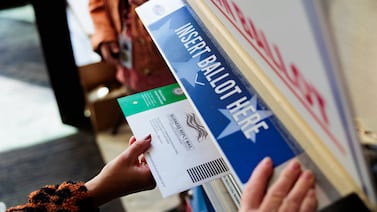
Sen. Mark Spreitzer, a Democrat from Beloit, said that if Democrats win a trifecta they would immediately try to pass legislation allowing election officials to process ballots on the Monday before an election. That measure would give officials an extra day to process ballots, likely speeding up unofficial results at the end of the night.
Other priorities, he said, include codifying the legality of absentee ballot drop boxes, expanding absentee ballot tracking for voters, allowing voters to spoil an absentee ballot, creating standards for fixing mistakes on absentee ballots, and removing a requirement for officials to put numbers on certain absentee ballots that can risk the voters’ anonymity.
“These are very low hanging fruit that either Republicans were interested in but didn’t have unanimity on, or, in a couple of these cases like drop boxes and curing, we have a different perspective than they do,” Spreitzer said.
Democratic gubernatorial nominee David Crowley, the Milwaukee County executive, told Votebeat he would prioritize the Monday processing proposal.
“This common-sense change would help election workers process ballots more efficiently and reduce delays in reporting results, while maintaining the security and integrity of the election process in Wisconsin,” he said.
Crowley also said he would support better funding for local election officials, which has long been a concern for municipal and county clerks in Wisconsin. Spreitzer agreed.
Democrats could also revive some of the bills that have stalled under GOP leadership, including shortening the state’s residency requirement, banning firearms near polling places and establishing automatic voter registration.
Crowley himself was the lead author on an automatic voter registration bill during his brief tenure in the Legislature. Like most Democratic election bills under the GOP Legislature, his bill didn’t receive a public hearing or floor vote.
Republicans could prioritize noncitizen voting legislation
Republicans would also have limited room for broad policies if they won a trifecta, Burden said, largely because they enacted most of their policy priorities during their previous period of unified control. That includes one of the nation’s strictest voter ID laws and a requirement to reject absentee ballots missing a witness address.
One area where they could go further is citizenship verification. Republicans could pursue requirements that voters provide documentary proof of citizenship, Burden said, or revive efforts to audit the state’s voter rolls for potential noncitizens.
“That has just been a drumbeat coming out of the Trump administration: executive orders, lawsuits, DOJ actions, requests for data from the state, and other things,” he said. “So Republicans in the state will feel pressure, if nothing else, from the Trump administration to do something more about citizenship in such a key battleground state.”
Republican lawmakers have already pursued such measures. Earlier this year, Evers vetoed a bill that would have required a noncitizen voter audit. During legislative testimony in January, Rep. Dave Maxey, the GOP chair of the Assembly Elections Committee, said that he would prefer IDs used for voting to also clarify a person’s citizenship status. Maxey didn’t respond to Votebeat’s request for comment.
Republicans could also revive other election bills Evers vetoed, including legislation that would have banned those with felonies from voting until they paid certain court fees, and a proposal to eliminate the voter ID exemption for people who are indefinitely confined because of age or a disability.
Republican gubernatorial nominee Tom Tiffany, a U.S. representative from northern Wisconsin, has also supported several election policies that could become relevant under unified GOP control. In Congress, he voted for the federal SAVE Act, which would have required people registering to vote in federal elections to provide documentary proof of citizenship. In his time in the state Legislature, Tiffany co-authored the bill that led to the state’s voter ID requirement.
Tiffany told Votebeat that he would approve legislation to identify ineligible voters by comparing Department of Transportation records with the statewide registration database, along with other “election integrity reforms that Governor Evers vetoed that I believe deserve another look.”
Tiffany tried to overturn the 2020 presidential election, which President Donald Trump lost. He told Wisconsin Watch recently that he thinks President Joe Biden won the race but welcomes investigations into the election.
He acknowledged the Monday ballot processing bill at a press conference in August, but didn’t signal whether he supported it. This specific policy priority may have more of a chance, Burden said, because it has broad support across the spectrum despite some GOP dissension.
Stalemate likely to continue under divided government
The stalemate that has been the status quo since 2018 would likely continue under any form of divided government, Burden said. Even if Republicans win a trifecta, Democrats have a backstop in the Wisconsin Supreme Court, which has a 5-2 liberal majority, Burden said. Republicans, meanwhile, could challenge Democratic priorities in federal court, where they may have the upper hand.
“With Evers and Republicans in power the last eight years, it’s been mostly stalemate: lots of vetoes, and very little actual lawmaking around elections,” Burden said. “If things were to flip with Tiffany in office and Democrats were to win both chambers — I think that’s unlikely — I would expect more stalemate.”
Spreitzer, the Democratic senator, said some proposals, like the Monday processing bill and deleting poll list numbers from the back of absentee ballots may still be viable under split control.
“Those are things we could very easily get done and demand in a split-government situation,” he said.
Alexander Shur is a reporter for Votebeat based in Wisconsin. Contact Alexander at ashur@votebeat.org.