Votebeat is a nonprofit news organization reporting on voting access and election administration across the U.S. Sign up for Votebeat Michigan’s free newsletter here.
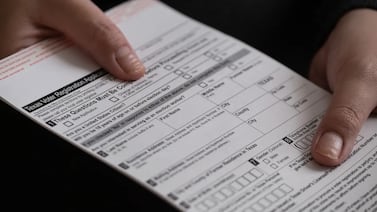
A proposed constitutional amendment to require Michigan voters to prove their citizenship is dead for 2026 after the state’s Supreme Court declined to put it on the November ballot.
The Michigan Supreme Court late Thursday denied Americans for Citizen Voting’s request to order a state board to certify its effort for the ballot. A last-ditch appeal to the U.S. Supreme Court was also rejected earlier in the day.
It’s an abrupt demise for an effort that began with a lot of optimism early last year, when Republicans took control of the Michigan House of Representatives. But supporters expect it’s far from the end of the larger movement to require newly registering voters to prove their American citizenship in Michigan and across the U.S.
“For these voters, this was never an abstract legal argument,” Paul Jacob, chairman of ACV, said of the more than 700,000 people who signed the group’s petition. Jacob is also president of the Liberty Initiative Fund, the libertarian group behind ACV.
Organizers submitted signatures earlier this year to get the proof-of-citizenship proposal on the November ballot. In order to make the ballot, the measure required 446,198 signatures from registered Michigan voters, as verified by the state’s Bureau of Elections.
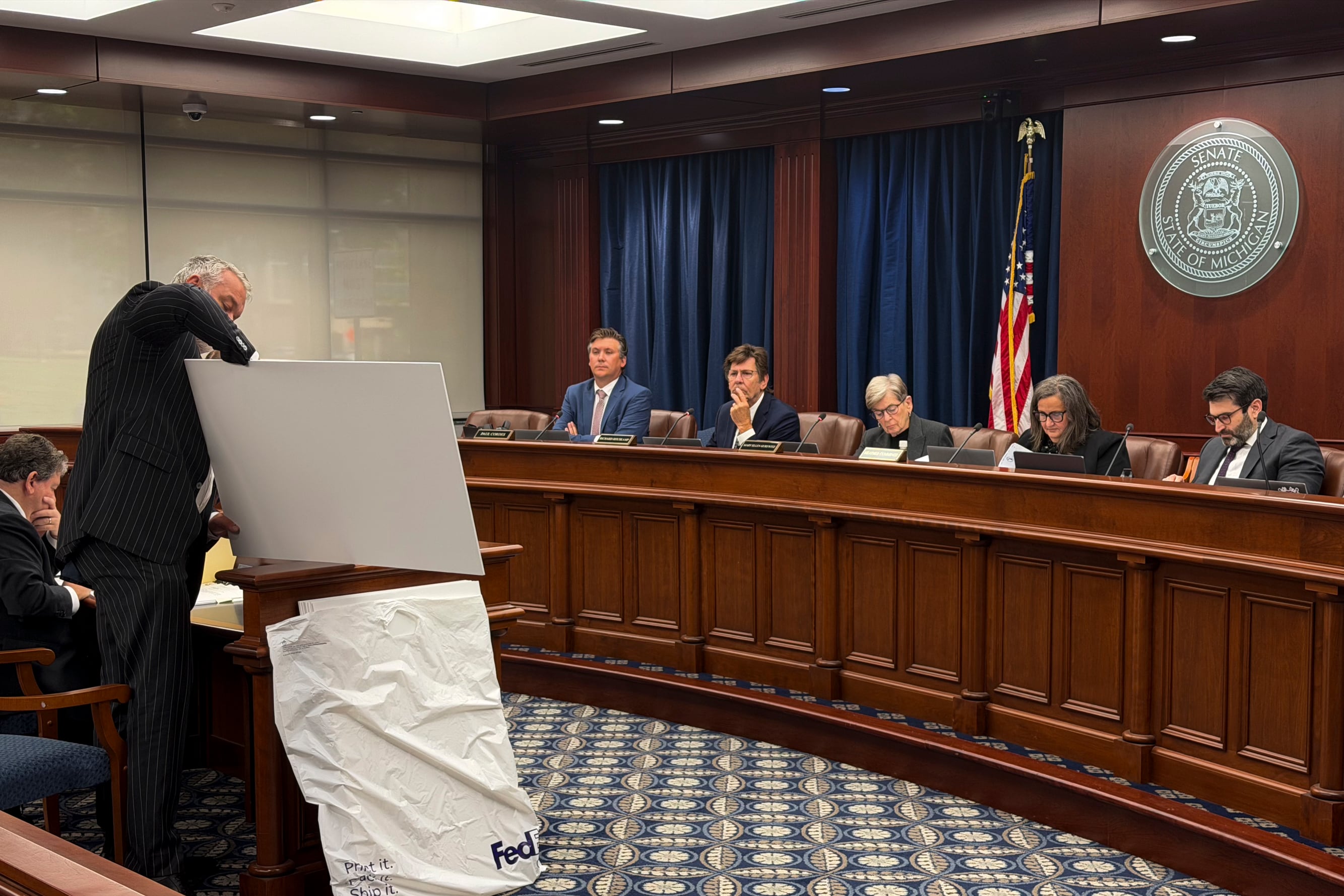
In a lengthy meeting last week, though, the Board of State Canvassers — the entity that certifies statewide ballot issues and constitutional amendments — did not agree that ACV had enough valid signatures. The two Republicans on the bipartisan board voted to put the amendment on the ballot, while the two Democratic members voted against. The tie meant no action was taken, so the proposed amendment was not put on the ballot.
In its 16-page ruling, the Michigan Supreme Court determined that decision was within the canvassers’ discretion. There is no strict ministerial duty to certify the effort for the ballot, the court determined, so it could not force the canvassers to certify.
Instead, justices suggested that the state Legislature pass new laws clarifying the signature verification process to prevent such concerns from popping up again — for instance, setting new deadlines that make judicial review more practical.
Michigan voters could get the chance to weigh in on a proof-of-citizenship amendment in a future election. ACV leaders said in statements Thursday that they intend to try again in 2028.
For the 2026 election, though, the decision means Michigan will have only two proposals on the ballot. The first is a constitutional convention, which automatically appears on the ballot every 16 years. The second, known as Michiganders for Money Out of Politics, seeks to limit the donations that utilities and state contractors can make to politicians.
Noncitizen voting is a major concern for Michigan Republicans
Being a citizen is already a legal requirement to vote in Michigan, as well as to vote in federal elections anywhere in the country. But fears that significant numbers of noncitizens are voting anyway have gained purchase in recent years, particularly as President Donald Trump has spread false and unsupported claims about rigged elections.
Investigations and audits have found noncitizen voting is extremely rare. Of the more than 5.7 million Michigan voters in the 2024 election, officials have publicly charged six — 0.0001% of the electorate — with voting despite a lack of citizenship.
But proponents of proof-of-citizenship requirements argue that even a single noncitizen vote serves to disenfranchise those who are rightfully voting. Opponents, meanwhile, argue that the hoops people would have to jump through to verify their citizenship could themselves disenfranchise large numbers of rightful voters.
The push for a proof-of-citizenship requirement in Michigan specifically began in earnest during the 2024 presidential election, when a University of Michigan student was allegedly able to register and vote despite not being a U.S. citizen.
Republican leaders, including now-Michigan House Speaker Matt Hall, highlighted that incident to advocate for the SAVE Act — a federal proof-of-citizenship bill that has languished in the U.S. Senate. State Rep. Bryan Posthumus went a step further, introducing a proposal shortly after Republicans regained the state House to amend the Michigan constitution to require verification of citizenship.
The effort in the House failed along party lines last spring. Around the same time, though, Americans for Citizen Voting began its push to qualify a similar amendment for the ballot by collecting signatures from voters. The effort raised millions, according to state campaign finance records, and spent more than $3 million for “petition management,” a category that includes paid signature gathering.
ACV organizers collected signatures through the fall and winter before ultimately filing what the group estimated to be more than 750,000 signatures in March. Supporters said at the time that the huge number was a sign that Michigan voters supported a proof-of-citizenship requirement.
“This level of support shows that Michigan voters are paying attention and expect accountability,” state Sen. Ruth Johnson, a Republican who previously served as Michigan’s secretary of state, said in March.
A random sample of signatures analyzed by the Bureau of Elections and then challenged by an outside group ultimately found that not enough of the signatures came from registered voters or otherwise had problems with how they were submitted. A few signatures from ACV were added back in after additional information was provided, but not enough for the overall total to hit the threshold needed.
Voting rights groups and election administrators, though, were concerned about the amendment, which would have required both newly registering voters to prove their citizenship and existing voters to prove their citizenship if the state couldn’t independently verify it. The result would have been two separate voter rolls — one for those whose citizenship had been verified, allowing them to vote in all elections, and one for those whose citizenship was still up in the air, allowing for much more limited ballot access.
Michael Siegrist, the clerk of Canton Township and president of the Michigan Association of Municipal Clerks, said Friday that clerks across the state are dedicated to making sure that voters are rightfully registered, but that many had concerns about how ACV’s proposed changes could have affected the work they do.
“We were really concerned about the impact to the overall election administration system,” he said. “If something like that were to pass, there’s a substantial amount of unintended consequences regarding the bifurcated election system, where you would have double the ballot styles, [have] two separate lists of registered voters.”
He hopes that election officials are more involved in future conversations about shaping what a proof-of-citizenship requirement could look like in the state.
“If they want to create a situation where we ensure there are only citizens voting, do it in a way that doesn’t ... [drop] a bomb in the system,” he said.
Hayley Harding is a reporter for Votebeat based in Michigan. Contact Hayley at hharding@votebeat.org.