Votebeat is a nonprofit news organization reporting on voting access and election administration across the U.S. Sign up for our free weekly newsletter to get the latest.
What happened?
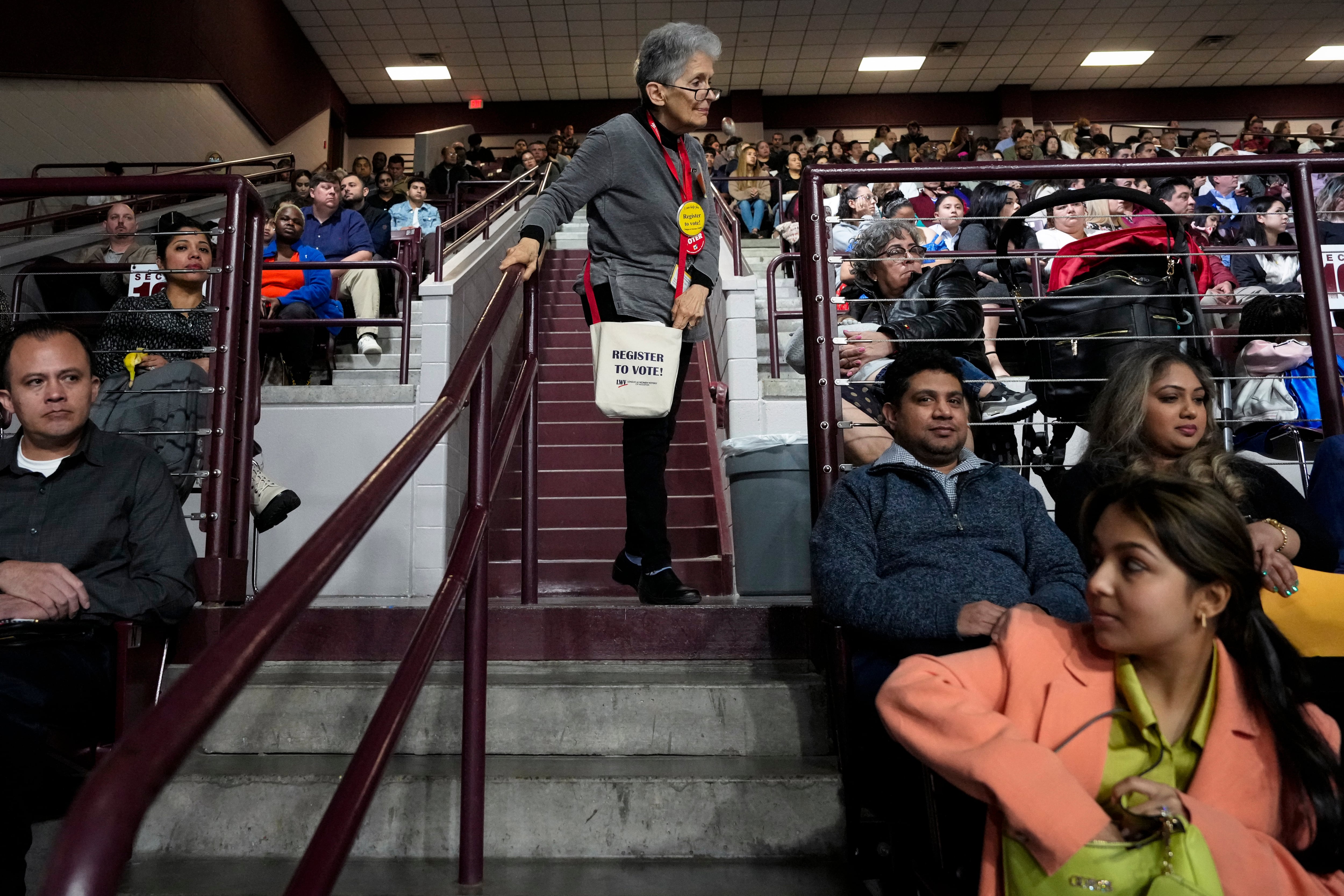
A federal judge on Monday temporarily blocked a U.S. Citizenship and Immigration Services rule that had prohibited the League of Women Voters and other groups from registering voters at naturalization ceremonies held at the agency’s offices.
In his ruling, U.S. District Court Judge Adam Abelson said the government’s ban was a potential free speech violation under the First Amendment and that it likely had a discriminatory intent that breaches Fifth Amendment protections.
In a statement, League of Women Voters CEO Celina Stewart celebrated the decision and emphasized the organization’s history of supporting new citizens as they prepared to vote.
“Today’s ruling protects that fundamental democratic principle, and we will continue fighting to ensure every eligible voter can participate freely and fully in our democracy,” she said.
What’s the dispute?
USCIS announced in August 2025 that only state and local election officials can register new citizens to vote at ceremonies held at the agency’s facilities. In issuing the ban, the agency cited the “administrative burden” it faced in making sure that nongovernmental organizations providing those services were truly nonpartisan.
The League of Women Voters and several of its local chapters, along with the Greater New Orleans chapter of the National Council of Jewish Women, filed a lawsuit in November 2025, alleging that the federal rule violated their constitutional rights and a federal law related to agency rulemaking.
The USCIS rule doesn’t apply to naturalization ceremonies held at federal courthouses, so much of the LWV’s work has continued. But the ban on registering people at USCIS facilities caused the voting rights group to cancel 166 planned events where members and volunteers “planned to register roughly 10,000 new voters,” according to the November complaint.
The LWV said in court filings that it has registered more people at naturalization ceremonies than any other organization.
In the complaint, the LWV points out that many state and local election officials — who would still be allowed to register voters at USCIS facilities under the ban — are elected in partisan races, and that the government hasn’t shown any evidence of the group being partisan.
But the group’s core argument is that the ban violates its First Amendment rights to free speech and freedom of assembly in public places. It also claims that the USCIS violated a federal law by creating the rule without an opportunity for public comment, and that the rule itself is “arbitrary and capricious.”
The League “made a very strong showing” that it’ll prevail on the merits of its argument that the ban unconstitutionally restricts its free speech rights, Abelson wrote in the ruling.
Separately, the National Council of Jewish Women argued that the ban was a Fifth Amendment violation because it was put in place with discriminatory intent.
Highlighting federal officials’ recent critical statements about immigration and the USCIS decision to replace the term “naturalization candidate” with “alien” in its materials, Abelson said that a discriminatory intent was likely a motivating factor for the ban.
What happens now?
The court case is likely to continue. The Monday ruling was preliminary, and the federal government could appeal. A USCIS spokesperson didn’t immediately respond to a request for comment.
Read more Votebeat coverage about the ban on voter registration at some naturalization ceremonies here:
Clarification, Aug. 5: This article has been updated to specify that USCIS announced its ban on nonprofit groups at naturalization ceremonies held at the agency’s facilities last August.
Alexander Shur is a reporter for Votebeat based in Wisconsin. Contact Alexander at ashur@votebeat.org.