
Votebeat is a nonprofit news organization reporting on voting access and election administration across the U.S. Sign up for our free weekly newsletter to get the latest.
A panel of federal judges on Sunday appeared skeptical of the Trump administration’s position in its extraordinary effort to compel California to set aside as many as 20,000 ballots in the ongoing election and investigate the voters’ citizenship.
In a 105-minute hearing, two of the three 9th Circuit Court of Appeals judges hearing the case voiced clear concerns about the Justice Department’s request that the court immediately force California to segregate ballots cast by voters on a list of suspected noncitizens the Trump administration produced earlier this month.
Judge Mark Bennett, who was appointed to the court by President Donald Trump in 2018, grilled Justice Department attorney Matthew Donnelly about the federal government’s request, citing language in the U.S. Constitution referred to as the Elections Clause, which gives states authority to set the rules for congressional elections, subject to congressional oversight.
“It seems to me that under the Elections Clause, [the state legislature has] the right to determine the manner of the elections, including sorting out non-citizens,” Bennett said to Donnelly. “And Congress has not directly changed what the legislature has adopted, which they had the right to do, and it seems to me you want us to issue an injunction that is entirely inconsistent with the law the California legislature has adopted pursuant to the Elections Clause. How can we do that? Why doesn’t the Elections Clause foreclose the relief you are requesting here?”
The lawsuit, along with a separate Justice Department action unfolding in Alaska, represents extraordinary efforts by the Trump administration to intervene in the conduct of the ongoing midterm elections.
Even as voting is underway, the Trump administration is demanding that state officials change the way they are handling and counting ballots from registered voters, in California’s case, and has filed a separate lawsuit preemptively trying to block certification of election results in some potential circumstances in Alaska’s U.S. Senate race.
The results of elections in California, which has 52 House seats, could play a key role in deciding which party will control the U.S. House of Representatives. Meanwhile, the U.S. Senate race in Alaska will be crucial to Democratic efforts to gain control of the upper house.
On Sunday, the judges pressed Donnelly to explain why the Justice Department asked the appeals court to act when the lower court has yet to even hold a hearing on the federal government’s appeal.
“The District Court has said it’s going to rule expeditiously. It gave you the timing you wanted” for a hearing, Bennett said. “I don’t see how we have jurisdiction.”
The judges also asked a series of questions about the analysis the federal government relied on to produce its list of potential noncitizens, which state officials have said isn’t reliable.
Judge Patrick Bumatay, another Trump appointee, appeared more sympathetic to the Justice Department’s argument and asked California’s attorneys’ pointed questions.
California officials say list of potential noncitizens on the voter rolls is flawed
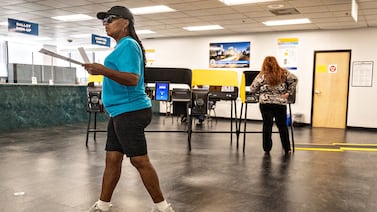
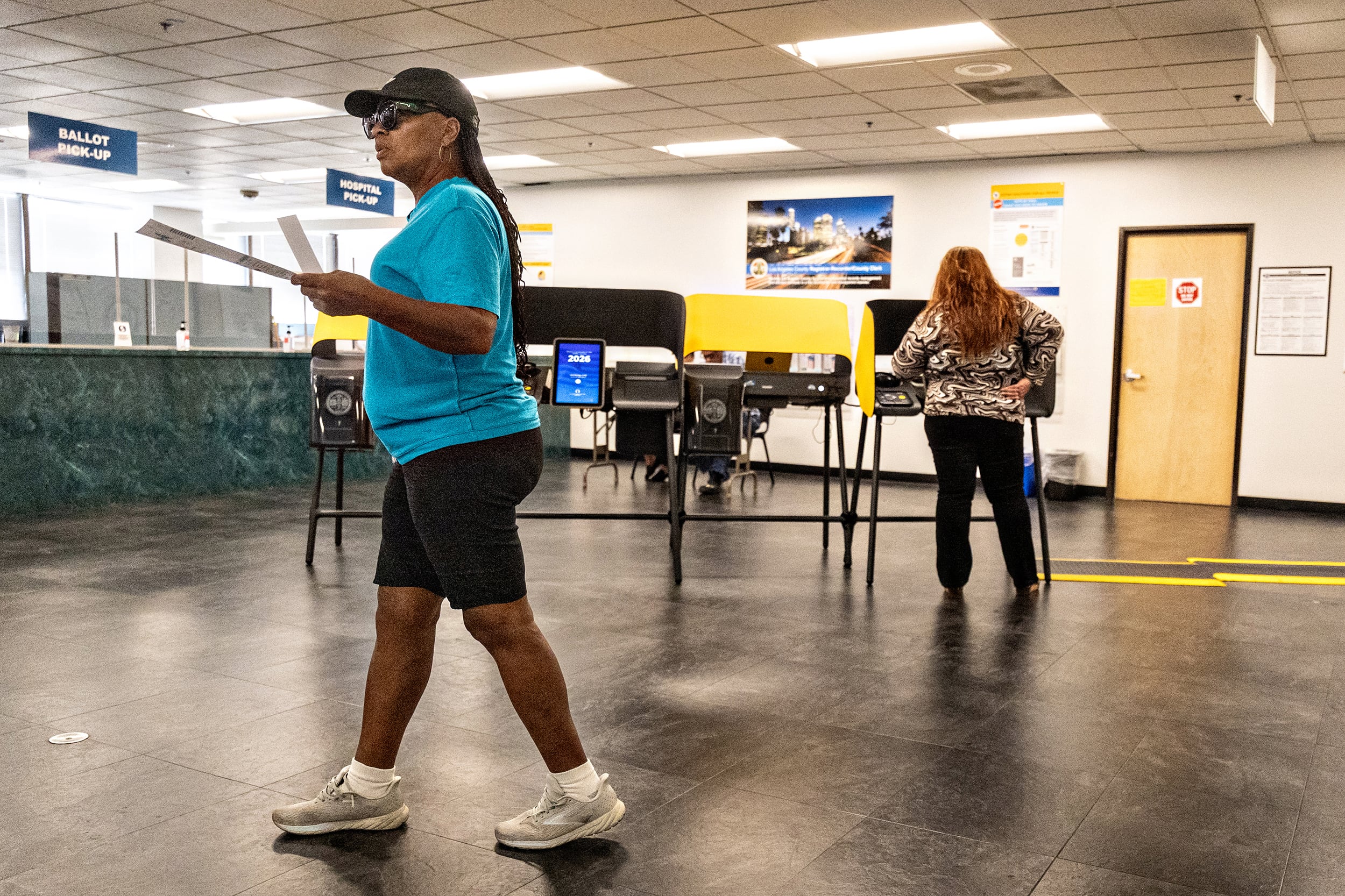
The legal showdown started on Oct. 13 when the Justice Department sent Los Angeles County election officials a thumb drive it said contained the names of 20,000 potential noncitizens on state voter rolls. It gave California 48 hours to check the names and commit to segregating ballots from any of the people on that list until it investigated and confirmed whether they were eligible voters. California officials questioned the timing of the action and noted that they had already started sending out mail ballots and opened early voting centers on Oct. 5.
California officials also said the federal government’s list was “deeply flawed.” In its court filings and public statements, Los Angeles county officials said 7,035 of those names had Los Angeles County addresses. It compared a sample of 200 of those voters with county voter records, and found fewer than half were active voters, more than 70% had never voted, and a quarter said they were born in the U.S., a strong indicator of citizenship.
The Justice Department filed a lawsuit against California on Oct. 15, demanding that it segregate ballots returned by any voter on its list until their eligibility was confirmed. Before the District Court even ruled, the Department of Justice asked the 9th Circuit Court of Appeals to take swift action, setting up Sunday’s emergency court hearing in San Francisco.
With early voting underway in California, the Trump administration argued that urgent action was needed to compel the state to segregate the ballots.
“Every minute of processing that occurs without segregating the ballots of suspected ineligible voters causes untraceable disenfranchisement and dilution of the votes of United States citizens,” the Justice Department told the court in its motion to the Court of Appeals. “Once illegally cast ballots are counted and commingled with lawful votes, the resulting harm is impossible to remedy.”
In court filings, Los Angeles’ registrar-recorder, Dean Logan, pointed out that the federal government had the voter data underlying its list earlier this year, but waited until the election was already well underway and ballots had been mailed out to send the list to California officials, and the list could contain outdated and incorrect information. He also said the difficulty of complying with the federal government’s demands “cannot be overstated.”
“This is an incredibly complex system involving thousands of workers and changes of this magnitude simply cannot be effectively completed overnight without jeopardizing the effectiveness of the system as a whole,” his lawyers wrote in a court filing.
California officials asked the appeals court to block the Trump administration request and warned that the lawsuit could set the stage for further intervention by the federal government.
“This litigation is a precursor to further interference here in California. The Court must not be drawn into this chilling degradation of democratic values and constitutional principles,” the state said in a court filing.
The Justice Department is aggressively suing California and Alaska as voting is underway
Sunday’s hearing comes amid a flurry of actions by the Trump administration to inject itself into states’ administration of the midterm election. On Friday, the Justice Department sent letters to local election officials across California warning them that they would “risk significant federal scrutiny” if they did not set aside ballots cast by potential noncitizens.
In a statement Saturday, San Benito County Clerk-Recorder Francisco Diaz said two federal agents hand-delivered an official demand letter Friday, with a list of 33 suspected noncitizens.
Diaz’s statement said that “not all listed individuals” were currently registered with the county and that the federal government’s letter demanded Social Security numbers, driver’s license numbers, and other nonpublic information. The county is reviewing the letter with legal counsel, Diaz said in the statement, and, “we will not be intimidated by agents with guns for simply doing our jobs.”
California Attorney General Rob Bonta on Saturday also accused the Trump administration of “waging a campaign of intimidation against elections officials, voters, and our democracy” and expressed confidence the state would prevail in court.
The legal fight in California comes in tandem with a White House attempt to prevent certification of the U.S. Senate race in Alaska if it results in a narrow loss for the incumbent, Republican U.S. Sen Dan Sullivan.
The Trump administration is arguing that the presence on the ballot of a second Dan Sullivan — a retired teacher who is one of four candidates in the U.S. Senate race — could confuse voters who intended to vote for the incumbent. Trump said he personally directed the Justice Department to file the lawsuit and accused Democrats of covertly backing the retired teacher in a deliberate attempt to divert the Republican vote.
Polls show Sen. Sullivan in a tight race with Democratic challenger Mary Peltola.
The expansion of Trump administration’s legal attacks on the ongoing election process has raised concerns that the White House could be laying the groundwork to challenge election results the president does not like, as polls suggest that Republicans are likely to lose control of the House of Representatives and that they could also lose their Senate majority. Many legal experts have questioned the Justice Department’s authority to bring the California and Alaska cases. The outcome of Alaska’s race is seen as central to determining control of the Senate.
On Sunday, Attorney General Todd Blanche defended the Alaska lawsuit and dismissed any concerns that Trump would try to overturn the results of a legal election.
“President Trump is not trying to take over a state election in any way, shape or form,” Blanche said on CNN. “What we are trying to do is make it clear that, if it is obvious after the election that confusion led to an improper and illegal result, that the Alaskan system should be able to address that.”
Justin Levitt, an election law professor at Loyola Law School in Los Angeles who worked as a senior voting rights adviser in the Biden White House, said the Trump administration lawsuits were unlikely to pave the way for any credible challenges to the results.
“I don’t think the cases in either Alaska or California meaningfully further the likelihood that a post-election challenge succeeds, because neither of the cases in Alaska or California are reality-based,” he said. “There’s no law there. And just waving your hands in a document filed with a court doesn’t do anything other than just waving your hands in a press conference.”
Dion Nissenbaum is Votebeat’s senior national reporter and is based in Houston. Contact Dion at dnissenbaum@votebeat.org.