
This coverage is made possible through a partnership between Flatwater Free Press, Nebraska’s first independent nonprofit newsroom focused on investigative and feature reporting, and Votebeat, a nonprofit news organization covering voting access and election administration across the U.S. Sign up for Votebeat’s free newsletters here.
For most of the 21st century, some of Nebraska’s smallest counties have conducted elections entirely by mail following bipartisan action to expand voting access. The effort has saved taxpayer money and made it easier for residents in the state’s most isolated rural areas to vote.
But now, as President Donald Trump pushes to restrict mail voting nationwide, Nebraska’s Republican nominee for secretary of state is proposing changes to a system that has become essential to election administration in some of the state’s most Republican counties.
Scott Petersen, who defeated incumbent Secretary of State Bob Evnen in the Republican primary in May, has called for establishing in-person voting in those counties rather than automatically mailing ballots to all registered voters. He argues that extended mail voting encourages outside groups to collect ballots and influence elections. Petersen has argued that technology could make polling places accessible to rural voters without requiring counties to conduct elections only by mail.
Morrill County in the Nebraska Panhandle is one those counties, along with 10 others that have opted to conduct their elections entirely by mail. The county’s election commissioner, Candace Panas, said all-mail voting saves the county the costs of setting up polling places and hiring poll workers.
“I don’t have the money in my budget to turn around and get all my polls in order and all the equipment and things I would have to get to do that,” she said. “There’s just no way my budget would allow me to do that.”
Since 2005, Nebraska has allowed counties with fewer than 10,000 residents to hold elections entirely by mail. Eleven counties now do so: Boone, Cedar, Cherry, Clay, Dawes, Dixon, Garden, Knox, Merrick, Morrill and Stanton. All 11 supported Trump by wide margins in the 2024 election, ranging from 71% voting for Trump in Dawes County to 90% in Cherry County.
Those 11 counties also have consistently recorded higher voter turnout than Nebraska as a whole. In the 2022 midterm election, turnout in those counties averaged about 69%, compared with 55% statewide.
The difference is not simply a reflection of rural voting habits. A 2024 Flatwater Free Press analysis found that the number of ballots cast in the 11 counties increased by an average of 16% between the 2016 and 2020 presidential elections, as most transitioned to all-mail voting. Participation also increased in lower-turnout elections, including the 2022 midterms, even as statewide turnout declined.
The findings suggest that automatically sending ballots to registered voters may have helped boost participation in counties where residents often live far from polling places.
Panas said the move to all-mail voting has been positive, noting that many Morrill County voters are elderly or live far away from the county seat, making in-person voting hard. The county also had rural roads washed out by recent flooding and some still are not passable from massive wildfires last year, she said.
How Nebraska Republicans helped expand mail voting
Mail-in voting has been around as long as Nebraska has been a state, but for most of its history, the state required those voting in absentia to provide a reason they couldn’t get to the polls on Election Day. Absentee ballots were available mainly to deployed military members, the disabled, and the elderly. But in 1999, the Nebraska Legislature opened mail-in voting to all voters, becoming a no-excuse state that allows any registered voter to request an early-voting ballot without having to provide a reason.
In Nebraska, the effort was solidly bipartisan, introduced by a Democratic state lawmaker, publicly supported by the Republican Nebraska secretary of state and advanced unanimously from committee. It was signed soon after passing in the Legislature by then-Gov. Mike Johanns, a Republican.
At a 1999 legislative hearing, Republican Secretary of State Scott Moore said some voters were reluctant to request absentee ballots because they couldn’t honestly claim they would be unable to vote in person on Election Day.
“And I respect them for that, but if they don’t vote because of it, I want to take care of the problem,” Moore told lawmakers.
The intent was to get more voter participation in elections, and it clearly worked, said Dave Shively, who headed elections in Lancaster County from 1999 to 2023, when he retired as county election commissioner. Shively conducted one of the first elections in the state in mid-1999 that allowed no-excuse absentee voting.
In 2005, Republican state Sen. Deb Fischer sponsored legislation allowing Nebraska’s smallest counties to conduct elections by mail, in part to avoid the expense of equipping far-flung polling places with accessible voting machines required under federal law. Fischer, now a U.S. senator, later explained that maintaining the equipment across sparsely populated counties was prohibitively expensive.
The transition was gradual. Some counties first experimented with mailing ballots to voters in a handful of precincts before expanding the practice countywide. In Stanton County, inaccessible polling locations and a tornado that destroyed much of the town of Pilger helped accelerate the shift. In Knox County, officials expanded mail voting after seeing turnout rise in precincts that tried it in 2018.
“We probably have a larger number today of people that are what we call 100% voters — people that never miss an election — because, you know, they get that ballot in the mail and always send it in,” Shively said. “If they didn’t get that ballot, they might not vote in every election.”
A longtime voting practice faces new opposition
Voting by mail has been besieged by critics in recent years who cast it as a threat to election integrity. It became a national partisan flashpoint in 2020, following President Trump’s claim — without evidence — that voter fraud cost him re-election. Trump has since cast doubt on mail ballot security, although he has repeatedly cast his own votes by mail and has encouraged Republican voters to utilize mail ballots.
In March, Trump issued an executive order designed to restrict mail voting by requiring the U.S. Postal Service to deliver ballots only to those voters who appear on lists built from federal data that has been called into question as unreliable. Courts have blocked that effort for this year’s midterms.
Some Nebraska Republicans also have sought to restrict mail voting, despite officials’ assurance of vote-by-mail security. Since 2024, Republican lawmakers have introduced measures to limit early and mail voting, including those to again require voters to provide an acceptable reason to vote by mail and cut the time voters now have to vote by mail or early in person from 35 days to 22 days.
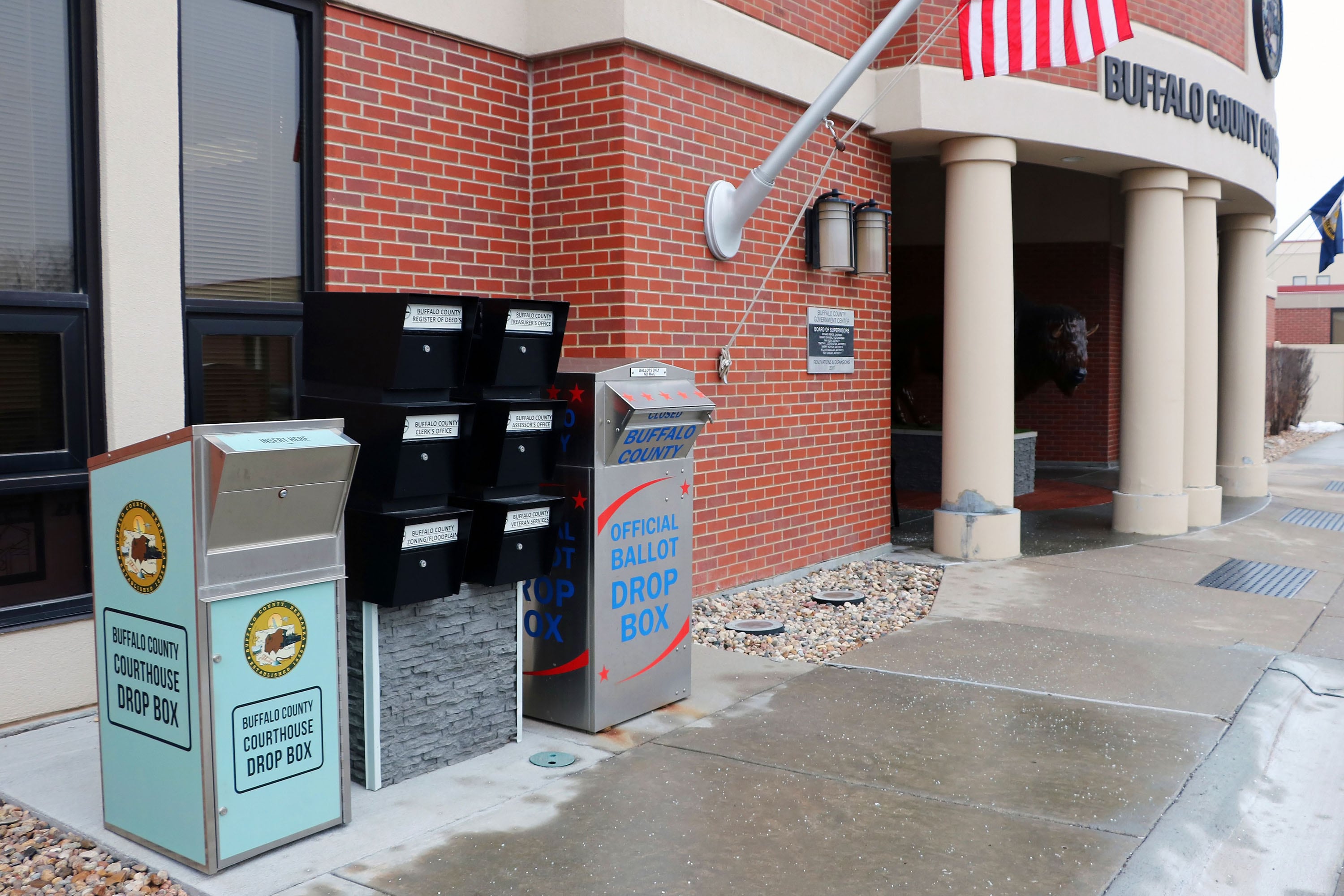
Those proposals failed to advance, but Nebraska has adopted other changes. After voters approved a photo ID requirement in 2022, lawmakers passed a law requiring people voting by mail to provide identification information when requesting or returning their ballots. The state has also imposed security requirements on ballot drop boxes and tightened rules governing their use.
Nebraska election officials say voting by mail is reliable and accurate thanks to its extensive security measures: a photo ID requirement to receive a mailed ballot, a signature requirement on the outside envelope of a returned ballot that is matched to the signature on voter registration records, and barcodes on the envelope that are scanned.
The barcode both allows voters to check that their ballot was accepted and ensures against anyone trying to return duplicate ballots. If the election office were to receive a duplicate ballot tied to a registered voter, it would accept only the first received and reject any others. Voters who find that their mailed ballot was not received may contact their county election office. But election officials in Nebraska are not required to inform a voter if their ballot is rejected.
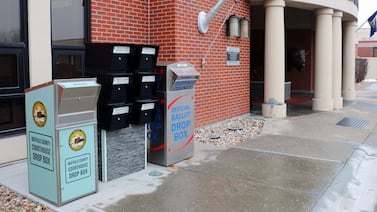
Outside of counties that conduct all-mail elections, Nebraska does not automatically provide mailed ballots to all registered voters. All eligible residents must request a mail ballot be sent to them. Mailed ballots also may be returned in person to the voter’s county election office or to ballot drop boxes managed by election officials.
Evnen, who has served as Nebraska’s top election official since first being elected in 2018 before losing his primary to Petersen in May, defends the state’s mail voting system, even as he has said he would comply with Trump’s executive orders on voting.
“In the 2024 general election, 300,000 Nebraska registered voters chose to vote by mail,” Evnen said in a recent social media post. “We work hard in Nebraska to assure that our mail-in voting is honest.”
Petersen, meanwhile, has argued that rural voters could be accommodated without mailing ballots to everyone, though he has offered few specific details.
“It’s prohibitive to vote if you live too far from a polling place,” Petersen told Nebraska Public Media. “There’s an easy way with technology to address that without making the whole county mail in, right?”
Margery Beck is a reporter for Flatwater Free Press in partnership with Votebeat. Contact Margery at mbeck@flatwaterfreepress.org.