Votebeat is a nonprofit news organization reporting on voting access and election administration across the U.S. Sign up for Votebeat Pennsylvania’s free newsletter here.
Update, Sept. 16, 7 p.m.: This story has been updated to include comments from the Pennsylvania Department of State.
New records provide the most detail so far about the previously opaque process by which the federal government concluded that thousands of potential noncitizens are registered to vote in Pennsylvania.
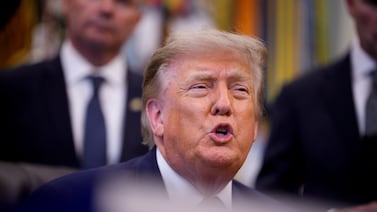
On July 16, the day President Donald Trump delivered a high-profile speech on election security, the Department of Homeland Security said it had found more than 250,000 potential noncitizens registered to vote in California, Nevada, New Jersey, and Pennsylvania. The states, though, called into question the accuracy of that number and asked for more information on how it was calculated.
DHS answered Pennsylvania’s query on Sept. 9, according to an email to Secretary of the Commonwealth Al Schmidt obtained by Votebeat and Spotlight PA. The department said the U.S. Citizenship and Immigration Services’ Fraud Detection and National Security Directorate identified the potential noncitizens by comparing the state’s publicly available voter roll to internal DHS databases.
The email broke nearly two months of silence from the Trump administration over exactly how it arrived at the numbers Trump referenced in his July speech.
When DHS first informed Pennsylvania about the potential noncitizen registered voters in July, it told the Pennsylvania Department of State that Social Security numbers had been used in some of the matches. However, this led to confusion given that Pennsylvania has not provided the Trump administration with a list of registered voters that includes Social Security numbers.
But the Sept. 9 email, signed only by the DHS Office of Intergovernmental Affairs, said that DHS had not used “federal enumerators” like Social Security numbers to perform the matching. Instead, it said it used fields such as first name, last name, date of birth, phone number, and address.
DHS did not immediately respond to a request for comment on the conflicting information.
The email also said that some of the 14,576 registered voters it flagged in Pennsylvania were firmer matches than others. “The more attributes from the individual registered voter that match an individual in DHS immigration records, the higher the confidence level of the match,” the email said.
“The highest confidence level of matching indicators, for example, first name, last name, middle name, date of birth, address, and phone number would be a 6-attribute match. If an individual did not have the same phone number or the same address, this would be a lower confidence match but likely still the same individual.”
The email went on to say that if matches were not made on all six main criteria, other indicators may have been used, such as previous addresses or spousal information.
In the email, DHS said it would send Pennsylvania officials a list of the potential noncitizens it identified. “Each one of the 14,576 individuals identified should be carefully reviewed by your state to determine eligibility for voting in a federal election,” it wrote.
The email offered Pennsylvania the choice of sending the registered voters’ federal enumerators to DHS to confirm or deny their citizenship, or conducting its own analysis.
It’s unclear whether the department has sent Pennsylvania the list of alleged noncitizens registered to vote since sending the email last week. A spokesperson for the Pennsylvania Department of State did not respond to a question on whether the list had been provided yet.
Pennsylvania, as well as Nevada, recently called into question DHS’ confidence in its own numbers.
In Nevada, staff in the secretary of state’s office recorded an August call in which DHS officials said the original figure of potential noncitizens it had identified represented “the ceiling” of how many noncitizens were actually on the rolls.
In a letter recapping an August call with DHS representatives, Schmidt said that “DHS representatives explained that they did not have high confidence” in the figures they were presenting.
In its Sept. 9 email, the department disputed Schmidt’s framing, calling it a “blatant mischaracterization.”
A spokesperson for the Department of State said its characterization of the call was accurate, and that the state would only use “credible” information to maintain its voter rolls.
“Voters can be confident that eligible Pennsylvania citizens will not be disenfranchised by faulty methodology or unreliable data,” Matt Heckel said in an email.
Carter Walker is a reporter for Votebeat in partnership with Spotlight PA. Contact Carter at cwalker@votebeat.org.