Votebeat is a nonprofit news organization reporting on voting access and election administration across the U.S. Sign up for our free weekly newsletter to get the latest.
When President Donald Trump pressured state and local officials to intervene in his behalf in the 2020 election, it wasn’t a matter of abstract constitutional theory for the people running elections. It was armed protests outside offices, threats against their families, subpoenas for voter data, and months of uncertainty about whether doing their jobs would land them in legal jeopardy.
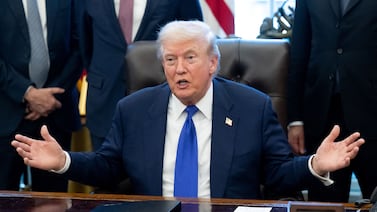
Now, Trump says he wants Republicans to “nationalize the voting” and “take over the voting in at least 15 places,” language that evokes the pressure campaigns he and allies mounted during that contentious 2020 period.
Trump’s 2020 effort ultimately stalled when even some Republicans refused to take steps they believed were unlawful. And his call to nationalize voting this week prompted pushback from some GOP members of Congress and other Republican figures.
Senate Majority Leader John Thune said Trump’s proposal raised constitutional concerns, and he warned that nationalizing elections could make them more susceptible to cybersecurity attacks. Rep. Don Bacon of Nebraska was more blunt, saying he has long opposed federal control of elections. “I’ll oppose this now as well,” he wrote on X.
On Tuesday, White House press secretary Karoline Leavitt said Trump’s comments referred to his support for federal legislation commonly called the SAVE Act.
Election officials say the lesson of 2020 was not that the system is invulnerable, but that it can be strained in ways that cause lasting damage long before courts step in. While it’s unclear whether Trump’s latest demands — and possible future actions— would lead to the same level of disruption, legal experts say some of the backstops that ultimately stopped him last time are now weaker, leaving election officials to absorb even more pressure.
Memories of 2020 shape the response
Kathy Bernier, a Republican former Wisconsin lawmaker and Chippewa County clerk, was the chair of the state Senate’s election committee following the 2020 election and repeatedly pushed back on Trump’s claims of widespread fraud. As Republicans launched a prolonged review of the results, Bernier criticized the effort publicly, saying Wisconsin’s elections were secure and that “no one should falsely accuse election officials of cheating.”
She faced extensive backlash, including calls for her resignation, and Bernier said the dispute escalated to the point that she carried a gun for protection. She ultimately left the legislature, a decision that she said wasn’t politically motivated.
A key takeaway from the 2020 election for election officials, Bernier told Votebeat, was the importance of radical transparency — not just following the rules, but showing people, in real time, that the rules are being followed “to a T.”
“When there’s a paper jam,” she said, “announce it.”
Still, she said, officials also learned the limits of that approach. After she tried to boost election confidence across Wisconsin, she came to a blunt conclusion: “There’s nothing you can do with ‘I don’t believe you.’”
In the years that followed, Bernier said, a bigger danger than Trump himself were the “charlatans” who took his words and turned them into a business model, spreading conspiracy theories for profit. The misinformation and disinformation those people spread, Bernier said, continue to resonate among the conspiratorial segments of the GOP.
The impact of their campaigns has been felt acutely by election officials. Many received death threats, and some had to relocate and enhance their security protections. Large cities redesigned their election offices to better protect their workers, and election official turnover increased dramatically, reshaping the profession long after the votes were counted.
Stephen Richer, a Republican who became recorder in Maricopa County, Arizona, shortly after the 2020 election, had similar advice: Follow the law, tell the truth, and consult attorneys, national associations, and state associations before making key decisions, because “the likelihood that they are dealing with your jurisdiction alone is limited.”
Georgia Secretary of State Brad Raffensperger is among the Republicans who prominently resisted Trump’s calls to overturn the 2020 election. He and his wife received death threats, and were assigned a protective team by the state. He declined an interview with Votebeat, but in a statement this week, he urged lawmakers to improve state election administration “rather than rehashing the same outdated claims or worse — moving to federalize a core function of state government.”
Pennsylvania Secretary of State Al Schmidt, another Republican who pushed back on Trump’s baseless allegations of widespread fraud following the 2020 election and faced similar retaliation, told Votebeat that the state’s elections are freer and fairer than ever before, and that the Constitution stops Trump from unilaterally nationalizing elections.
The Michigan Department of State, similarly, said this was a settled constitutional matter.
On the other hand, Michigan Republicans have asked the U.S. Justice Department for increased federal involvement in elections in the state, calling for monitors — not atypical in American elections — as well as “oversight,” although GOP leaders didn’t elaborate on what that would mean.
Richer, who lost his reelection bid for recorder in 2024 to another Republican, said Trump’s comments, combined with similar calls for federal involvement, suggest the Republican Party is drifting from its traditional commitment to federalism and local control. He also pointed to increased legislation at the federal level seeking to standardize elections, which has received little pushback from the Republican Party. That’s despite Republicans criticizing an earlier Democratic legislative effort as federal overreach.
“Clearly the federal government is going to do things that it’s never done before,” he said. “The FBI going in and taking materials from an election that happened over five years ago is unprecedented, so maybe we’re destined for additional unprecedented actions."
Election officials and courts the most significant ‘line of defense’
One of the key reasons that Trump failed in his efforts to delay and then overturn the 2020 election was the “men and women of principle” in his administration, said David Becker, an election lawyer who leads the nonprofit Center for Election Innovation & Research. Becker, a former Justice Department official, said the experience offered an uncomfortable lesson: Those internal guardrails existed because individuals chose to enforce them — and there is less reason to assume they would be there again.
After the 2020 election, Bill Barr, the attorney general at the time, disputed Trump’s claim that there was widespread fraud; the Cybersecurity and Infrastructure Security Agency similarly disputed the president’s claim that swings in unofficial results during election night meant that there was election fraud; and national security officials reportedly warned Trump that he couldn’t seize voting machines.
“That line of defense is largely gone,” Becker said, because “the primary and perhaps only qualification for being hired by this administration — particularly in those key roles in the Justice Department and Department of Homeland Security — is loyalty to this man.”
With fewer internal checks, Becker said, the second and most important line of defense this election cycle is courts and state and local election officials. Courts have already stymied many of the election policies Trump has tried to carry out via executive order, and “election officials are holding firm.” But he cautioned that court challenges take time — time in which “untold damage” can be done to erode public trust and to the officials caught in the middle.
That gap between what Trump can say and what he can actually do is where the risk now lies, said Justin Levitt, an election law professor at Loyola Marymount University who advised President Joe Biden’s administration on democracy and voting rights. Levitt said Trump does not have the legal or operational authority to unilaterally nationalize elections, even if he were inclined to cross legal boundaries.
He contrasted the president’s ability to control elections with ICE’s use of force in Democratic-run cities. In immigration enforcement, Levitt said, Congress has given the executive branch authority that can be exercised aggressively or improperly, even when courts later find those actions unlawful. In those cases, Levitt said, the president has “his finger on a switch” — the practical ability to act first and answer questions later. “No such switch exists” in elections, said Levitt.
But with fewer administration officials pushing back on Trump’s claims compared with his first term, Levitt said election officials can expect Trump’s messaging to get “much, much, much worse this year,” and for those claims to be given more oxygen by the rest of the federal government.
“It’s up to us to choose to believe him or not,” he added. Obedience in advance isn’t required, and treating Trump’s claims as commands would grant him authority he does not have, Levitt said, adding, “We have agency in this.”
Alexander Shur is a reporter for Votebeat based in Wisconsin. Contact Alexander at ashur@votebeat.org.