Votebeat is a nonprofit news organization reporting on voting access and election administration across the U.S. Sign up for our free weekly newsletter to get the latest.
Welcome to a new occasional feature at Votebeat: a chat with Votebeat staffers and outside experts on hot topics in elections. Today, we’re chatting about redistricting with Harvard Law School professor Nicholas Stephanopoulos, co-founder of the redistricting website PlanScore, and Loyola Law School professor Justin Levitt, who runs the website All About Redistricting. The transcript below has been edited for clarity and brevity.
Nathaniel Rakich (managing editor, Votebeat): Redistricting usually happens in years ending in -1 and -2, as congressional districts are resized to account for the most recent population data from the U.S. Census (which happens at the start of every decade). But over the past year, several states have broken with precedent and decided to redraw their congressional districts in the middle of the decade.
Facing pressure from President Donald Trump to shore up Republicans’ chances in the 2026 midterms, Republicans in Texas, Missouri, and North Carolina redrew their congressional maps to add more safe Republican seats. In response, Democrats successfully got a ballot measure passed to override California’s independent redistricting commission to add more safe Democratic seats, and they are currently attempting to pass new maps out of Virginia and Maryland as well. Two other states, Utah and Ohio, have also redrawn their congressional maps this cycle, but because they were legally obligated to.
First, let’s establish how weird this is. How unprecedented is it for this many states to draw new congressional districts mid-decade?
Nicholas Stephanopoulos (professor, Harvard Law School): It’s totally unprecedented in the modern era. You have to go back to the Gilded Age to see this much discretionary redrawing of maps.
Justin Levitt (professor, Loyola Law School): Agreed. Individual states have done this before, but not in the context of a national partisan war.
Carrie Levine (editor-in-chief, Votebeat): Is it possible to gauge whether this is an unusual blip, or whether it’s going to be the new normal?
Justin Levitt: I think it’s the new normal unless an adult in the room steps in.
Congress could fix this ... tomorrow.
The Supreme Court could fix this.
If they don’t, the war continues.
Nicholas Stephanopoulos: I agree. Now that this genie is out of the bottle, there’s no incentive for legislators to forgo this redistricting technique.
Witness Democrats’ glee at the prospect of squeezing 10 blue seats out of Virginia’s 11 districts.
Justin Levitt: I’ll add that the gerrymandering we’ve seen so far is relatively restrained, crazy as that sounds. California could have gone much bigger.
There’s no federal law saying that districts have to be connected to each other. If California Democrats had wanted to put Riverside in the same district as San Francisco, or Humboldt County in with West Hollywood, they could have.
Nicholas Stephanopoulos: Exactly. Why not draw a district in Illinois made up of two noncontiguous bubbles — one in Chicago, the other hundreds of miles downstate.
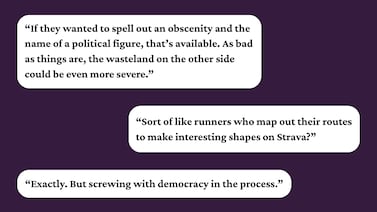
Justin Levitt: If they wanted to spell out an obscenity and the name of a political figure, that’s available. As bad as things are, the wasteland on the other side could be even more severe.
Carrie Levine: Sort of like runners who map out their routes to make interesting shapes on Strava?
Justin Levitt: Exactly. But screwing with democracy in the process.
Nicholas Stephanopoulos: There’s also not much evidence that map-drawers are using statistical algorithms to maximize their partisan advantage. But that could be harnessed to win more seats in some places.
Nathaniel Rakich: Wowzer. I mean, I think most people would agree something like non-contiguous districts are beyond the pale. Do you think that kind of thing could actually impel Congress or the Supreme Court to step in?
So far, they’ve shown little interest in doing so.
Nicholas Stephanopoulos: I don’t think anything could change the mind of the current Supreme Court, which seems to see partisan gerrymandering as normal and good. (Most recently, they declined to block California’s new map in an order earlier this month.)
Justin Levitt: Yep. It’s hard to root for states to violate the Constitution. But if California was going to wade into this fight, I wanted them to go all out ... in part to inspire Congress to set reasonable rules.
Nicholas Stephanopoulos: I also think aggressive gerrymanders by Democrats are helping Republicans realize that both sides can play this game — Republicans aren’t guaranteed to have the advantage in a gerrymandering war, as they did in the 2010s when they controlled more state governments.
There was a time when ending partisan gerrymandering wasn’t a partisan issue. Former President Ronald Reagan deplored it. In the 1986 case Davis v. Bandemer, the Republican National Committee sided with Indiana Democrats in asking the Supreme Court to strike down a new map as a partisan gerrymander, while the Democratic National Committee told the court to stay out of this area.
And the justices in Bandemer crossed ideological lines in their positions. It’s only from the 2000s onward that the reform position came to be associated with Democrats.
But successful gerrymanders by Democrats could make Republicans more willing to consider federal action. For instance, Republican Rep. Kevin Kiley of California — who is very likely going to lose his seat because of the new map — has now proposed legislation to ban mid-decade redistricting. Democratic Rep. Marc Veasey of Texas has proposed a bill to do the same thing.
Carrie Levine: Going back to the Supreme Court for a minute … When the court ruled in 2019 (in the case Rucho v. Common Cause) that federal courts aren’t the right place for partisan gerrymandering claims, do you think the court meant for there to be no limit to partisan gerrymandering whatsoever?
Nicholas Stephanopoulos: If the court isn’t bothered by a 48D-4R map in California, or a 10D-1R map in Virginia, I think nothing will offend it.
Except maybe a large Democratic advantage in the aggregate, like in the ’70s and ’80s!
Justin Levitt: Agreed. Rucho was the perfect opportunity for the court to rein in partisan gerrymandering in an even-handed way (or to not get involved and just let lower courts do their thing). There was an obvious Republican gerrymander and an obvious Democratic gerrymander before the court at the same time. And the court chose cowardice.
It’s no more interested in wading in today than it was seven years ago.
Carrie Levine: What does all this mean for the push to create more independent redistricting commissions?
Nicholas Stephanopoulos: That’s a great option for state legislative and local redistricting.
Justin Levitt: Agreed. I think that’s on pause for congressional redistricting for now.
Nicholas Stephanopoulos: Redistricting commissions for congressional districts are concerning if done piecemeal due to the possibility of partisan asymmetry — for example, if all the blue states adopt fair maps via commissions while red states gerrymander.
Back in 2022, I wrote a column worrying about redistricting commissions in blue states, so I’ve been beating this drum for a while.
Justin Levitt: On the other hand, commissions aren’t totally dead, even for congressional districts — because they really do draw fair maps, which voters appreciate.
The California ballot measure that passed last year was carefully worded. It didn’t repeal California’s commission; it just paused it until after the 2030 census.
Nathaniel Rakich: Yeah, but are they really going to go back to using the commission? As you guys noted, the genie is out of the bottle. Are Democrats in California and Virginia really going to voluntarily sacrifice several Democratic-held House seats in the 2032 election?
Justin Levitt: Not without Congress putting rules in place to govern congressional redistricting across the country. But that could happen.
Nicholas Stephanopoulos: Yeah, congressional action seems really far away right now — but all it would take is a Democratic trifecta with a little wiggle room in 2029.
University of California Los Angeles law professor Joseph Fishkin has proposed pairing redistricting reform with expanding the House, which I think is a great combination. Then there’s no need to sacrifice California or Virginia Democrats!
Carrie Levine: Do you think a Democratic trifecta is likely to make that sort of change a priority?
Justin Levitt: Democracy reform will absolutely be a priority. Court reform could be well up there on the menu too.
Democracy reform was also a priority for Democrats in 2022, but their legislation to outlaw partisan gerrymandering and shore up voting rights couldn’t make it past a Republican filibuster in the Senate. (They were also two votes shy of advancing the package by changing filibuster rules, but lacked the support of former Democratic Sens. Joe Manchin and Kyrsten Sinema — who aren’t around anymore.)
Nicholas Stephanopoulos: Yeah, I think this is like item 1 or item 2 on the Democratic agenda (the other biggie being guaranteeing access to abortion nationwide).
I don’t know exactly what shape electoral reform would take in this scenario, but I’m reasonably confident that Democrats would do something. They’re very, very aware of this issue, and I think the intra-party debate has largely been won by the reformers.
Nathaniel Rakich: Let’s talk about the elephant in the room. The Supreme Court is currently considering Louisiana v. Callais, a case over Louisiana’s congressional map that could overturn Section 2 of the Voting Rights Act, the landmark 1965 law that bans racial discrimination in voting. (I should note that both Justin and Nicholas submitted amicus curiae briefs in the case.)
In the redistricting context, Section 2 of the VRA requires states to draw districts that give minority voters the opportunity to elect their preferred candidate whenever practicable. But if the Supreme Court strikes it down, dozens of predominantly Black and Latino districts across the country could be eliminated.
What’s your guys’ read on that case? What are the range of possible outcomes here?
Justin Levitt: It’s a HUGE range. From nothingburger to effectively declaring a portion of the Constitution unconstitutional.
I like to remind folks that, in 2023, we were awaiting similar potentially giant news in Allen v. Milligan (another case that threatened the VRA) and Moore v. Harper (a case that could have ended state judicial review of congressional redistricting) — and the court backed away from the cliff’s edge in both cases.
Nicholas Stephanopoulos: I still find it so, so objectionable that this is the potential vehicle for hobbling the VRA.
Justin Levitt: Yeah, Nick, Callais should have been the easiest case ever. I still think it’s the easiest case ever. Justice Clarence Thomas thinks so too, but in exactly the opposite direction, and that’s made it weird.
Nicholas Stephanopoulos: Callais is a constitutional racial gerrymandering case! It’s not a VRA case! The VRA is only relevant as a potential justification for the district in Louisiana that’s being challenged. (The 6th District, which was redrawn in 2024 to be predominantly Black after the Supreme Court maintained the status quo for VRA claims in Allen v. Milligan.)
But Louisiana is no longer offering that justification. It will just take the court so many contortions to reach the issue of the VRA’s constitutionality here.
And there are several actual VRA cases floating around. So I really don’t know why this is the big one.
Carrie Levine: So where does that leave us on this unusually complicated case? Are there any tea leaves to read?
Justin Levitt: There are nine people who know what the court will do in Callais. And I’m not one of them.
As Nick says, the question should have been whether Louisiana drew its lines predominantly based on race or predominantly based on politics. And literally all of the evidence says that it drew its lines predominantly based on politics.
Nicholas Stephanopoulos: The fact that the case was reargued — i.e., it was originally part of the court’s 2024-2025 term, but the court wanted to hear it again — is the biggest tea leaf. The court didn’t need to do that to decide the racial gerrymandering issue, and the court’s (read: Justice Brett Kavanaugh’s) focus at the reargument was on the “temporal” critique of Section 2 of the VRA — the idea that it’s somehow outdated or obsolete.
Oral argument was also a bit of a mess, but Kavanaugh, Justice Amy Coney Barrett, and Chief Justice John Roberts all said things that suggested skepticism of the current interpretation of the VRA.
I also want to flag the U.S. solicitor general’s devious proposal in Callais.
The solicitor general says, “Hey, no need to strike down Section 2 — just add one teensie new requirement for plaintiffs: that their sample maps achieve states’ political objectives.” Like advantaging a certain party.
That one little tweak would effectively doom just about every Section 2 case. Because the new predominantly nonwhite district required by a successful Section 2 case would essentially always change the political composition of the map. So if the state just says it wants to maintain that political composition, the plaintiff would lose.
Justin Levitt: The court could take a few different statutory interpretation paths that look small but practically would be really really big. That’s one of them. And, as Nick said above, absolutely none of them are necessary to decide this case.
Nicholas Stephanopoulos: I can see the court’s conservatives being drawn to the solicitor general’s proposal because its impact would be so huge — but it would seem much more modest than a sweeping ruling declaring the VRA unconstitutional.
Justin Levitt: The only mild blessing in a statutory interpretation decision is that Congress could adjust the statute in response.
Nicholas Stephanopoulos: More provisions for the 2029 omnibus election reform bill!
Justin Levitt: Yep. And that would also unquestionably be on the menu for a democracy-friendly Congress.
Carrie Levine: So we’re back to a huge range of options in terms of how the justices could rule, and the potential effects.
Justin Levitt: Correct.
And as with redistricting commissions, it’s really important not to focus only on Congress when discussing Callais. The biggest impact of an adverse VRA decision would be on local government.
Nicholas Stephanopoulos: At least last year (before reargument), my guess was that the court would just strike down the challenged Louisiana district as a racial gerrymander, in which case Louisiana would have to draw a different, less funny-looking Black-opportunity district, and the case wouldn’t affect any other states.
Nathaniel Rakich: Same.
Justin Levitt: And that would have been one of the other easy outcomes!
The district Louisiana drew after the Supreme Court upheld the VRA in Milligan wasn’t even close to the district plaintiffs were asking for.
Nathaniel Rakich: Basically the exact same district got struck down in the ’90s for being a racial gerrymander.
Justin Levitt: And/but the reason this time was different.
The reason this time was to preserve a bunch of Republican-held seats, including Speaker Mike Johnson’s.
Nathaniel Rakich: It would have been very easy to draw a more compact second Black-opportunity district. It’s just that doing so would’ve endangered Republican Rep. Julia Letlow, which Republicans didn’t want to do.
Justin Levitt: Right. WHICH IS WHY IT WAS PREDOMINANTLY POLITICS.
Nicholas Stephanopoulos: Well, if she wins a Senate seat they can do that!
Justin Levitt: Sorry — this case makes me shout.
Nicholas Stephanopoulos: And very little makes Justin mad. 😉
Carrie Levine: Well, given the reargument, everyone has had a lot of time to get worked up about it.
Nicholas Stephanopoulos: I want to flag the historical context here, too. A maximal Callais decision — one in which the Supreme Court strikes down Section 2 — could lead to the biggest drop in minority representation in Congress since the end of Reconstruction. So the stakes are pretty high.
Justin Levitt: A maximal Callais decision would also declare the 15th Amendment unconstitutional.
Which is a pretty nifty trick. And would be really hard to write.
(That’s in part why I’m guessing the majority of the court won’t go there. Leaving Thomas once again to write for himself.)
Nicholas Stephanopoulos: The court’s conservatives seem to believe this narrative that Section 2 of the VRA is this all-powerful sword that plaintiffs are using left and right to draw new maps. One of the goals of my amicus brief was to show how wrong this narrative is.
Justin Levitt: Yeah, Thomas in particular has this stereotyped view that it’s easy to win Section 2 cases. That couldn’t be farther from the truth.
Nicholas Stephanopoulos: Most Section 2 cases lose, and the vast, vast majority of district maps are never challenged (let alone struck down) on this basis. The court’s conservatives are over-indexing based on a tiny number of cases in the Deep South.
Nathaniel Rakich: You guys mentioned that there are other VRA cases still floating out there — including a few on whether private citizens have the right to sue over the VRA, as well as VRA-based challenges to the congressional maps in Alabama, Georgia, North Carolina, and Texas. What happens to those cases after Callais?
Justin Levitt: Some of them might continue on, some of them might change course, some of them might stop dead. Depends entirely on what the court decides, and how it decides, in Callais.
Nicholas Stephanopoulos: At least some of those cases — like the ones in North Carolina and Texas — also didn’t look likely to win anyway, I think.
Justin Levitt: Oh, we might agree to disagree on Texas.
North Carolina was a much harder case. Texas had an awful lot of evidence stacked up. (At least in some parts of the state.)
Carrie Levine: Does the fact that those cases are in limbo tell us anything important?
Justin Levitt: I’m not sure how much to make of that fact, Carrie. The Supreme Court often holds cases that seem related to something they’re considering even when the result isn’t all that significant.
There were a bunch of cases held for Allen v. Milligan two years ago, and that decision didn’t change the law at all.
And people forget Milligan also upheld the constitutionality of the VRA! (Again, this case makes me shout.)
Nicholas Stephanopoulos: Yeah, an additional crazy thing is that the court just addressed the operation of the VRA two years ago, in Milligan. Nothing has changed since then! Not even the court’s composition.
Justin Levitt: RIGHT.
Nicholas Stephanopoulos: It really supports the most cynical views of the court — i.e., that it upheld the status quo in Milligan because the court wanted to avoid another big race-related blockbuster that term (the other being the case that struck down race-based affirmative action at most colleges).
Nathaniel Rakich: When are you guys expecting a decision in Callais? And what’s the latest that we could get a ruling and still have it affect the 2026 elections?
Justin Levitt: If the court is planning to make significant changes to the VRA, my money’s on a decision in late June. It’s going to be hard to write, and there will be some vigorous responses.
If it essentially just says “stick with current law,” could be any day now.
Nicholas Stephanopoulos: One slightly humorous question is whether a dissenter can unilaterally delay the decision so it’s less likely to affect this election. I think the answer is yes.
I can imagine Justice Elena Kagan coming up with all kinds of excuses for why she’s not done with her opinion yet. “Sorry, guys, my computer crashed.” “I had to travel for a while.” “You almost convinced me, but then I went back to dissenting.”
Justin Levitt: And all of that means that if the decision is a big deal — and it might not be! — the court is likely to rule too late to affect any districts in 2026.
Nathaniel Rakich: Right, because candidate filing deadlines will have already passed by late June — and many states will even have held their primaries by then.
Carrie Levine: So does that mean that the longer this takes, the more likely it’s a big deal? Or not necessarily?
Justin Levitt: Not necessarily. The reverse is true — it only comes quickly if it’s not a big deal. But a late opinion could be big potatoes or small potatoes.
Nicholas Stephanopoulos: I agree. Because reaffirming the status quo is also very controversial in this area. Milligan took forever but just reaffirmed the status quo.
Nathaniel Rakich: Right, the same point about a dilatory dissenter holds if liberals are in the majority. It could be Thomas or Alito who drags his feet.
Carrie Levine: And sometimes, the justices’ thinking evolves through the process of writing rulings, right? (And dissents and concurrences.)
Justin Levitt: 100%.
Nicholas Stephanopoulos: Although I tend to think that happens more in less familiar, less ideologically charged cases.
Nathaniel Rakich: OK, this has been a great discussion! We’ve already covered a lot of ground, but do you guys have any closing thoughts before we wrap — either on Callais or redistricting at large?
Justin Levitt: I’d just make the point that a party can’t fully insulate itself from electoral backlash through redistricting.
Redistricting is a seawall. It stops modest tides. An electoral tsunami comes in right over top of that seawall.
Nicholas Stephanopoulos: I like to mention (1) state voting rights acts and (2) multi-member districts with proportional representation.
Justin Levitt: Both super important.
And both available to the states (at least for the state legislature) without any congressional action.
Nicholas Stephanopoulos: State VRAs are a big new trend (in blue states at least), and they go well beyond the federal VRA. They might be the wave of the future after Callais, or they might be imperiled by Callais.
And as my colleague Guy Charles stresses, proportional representation may be the only route forward for proponents of minority voting rights if Callais neuters the VRA.
Compared to race-conscious districting, proportional representation has the big advantage that it achieves even greater minority representation without any race-based lines at all.
Carrie Levine: That’s so interesting! We may need to have a whole second separate chat on it.
Nathaniel Rakich: Haha, we’ll have to have you guys back. Thanks so much for joining us!
Nathaniel Rakich is Votebeat’s managing editor and is based in Washington, D.C. Contact Nathaniel at nrakich@votebeat.org.
Nicholas Stephanopoulos is the Kirkland & Ellis professor of law at Harvard Law School and the co-founder of the redistricting website PlanScore. Contact Nicholas at nstephanopoulos@law.harvard.edu.
Justin Levitt is a professor of law and the Gerald T. McLaughlin Fellow at Loyola Law School. He runs the website All About Redistricting. Contact Justin at justin.levitt@lls.edu.
Carrie Levine is Votebeat’s editor-in-chief and is based in Washington, D.C. Contact Carrie at clevine@votebeat.org.