
This coverage is made possible through a partnership between Flatwater Free Press, Nebraska’s first independent nonprofit newsroom focused on investigative and feature reporting, and Votebeat, a nonprofit news organization covering voting access and election administration across the U.S. Sign up for Votebeat’s free newsletters here.
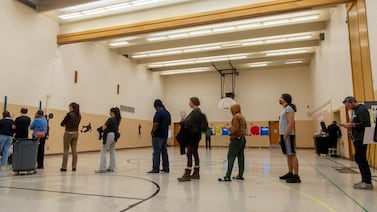
Voters lined up early on Nov. 3 at a northern precinct in Omaha’s Elkhorn area, where Darbi Eschmann stood by ready to help, looking every bit the seasoned poll worker.
But it was her first time working the polls, and she hadn’t volunteered for the role. Eschmann was drafted under a Nebraska law that requires compulsory service on Election Day, much like jury duty.
“I learned about it when I received a summons in the mail,” Eschmann said.
Nebraska is the only state in the country that treats election work as a civic obligation. While other states beg for volunteers through churches, civic organizations, and even businesses, every registered voter in Nebraska who is at least 18 years old is eligible to be selected to serve as an election worker. Anyone who ignores a summons to work an election can be charged with a criminal misdemeanor and fined up to $100.
As election officials nationwide struggle to recruit enough poll workers, Nebraska’s century-old system offers a possible solution: a reliable pool of workers who don’t have to volunteer. New research suggests the experience may also increase trust in elections. California lawmakers took notice, passing a bill this year to establish a similar draft before Gov. Gavin Newsom vetoed it.
Nebraska’s election worker draft dates back to 1914, when lawmakers established the system to address corruption in Omaha, according to a 1996 Federal Election Commission report. At the time, powerful politicians controlled the county election office and its poll workers, and they faced repeated accusations of manufacturing ballots to manipulate outcomes.
Election officials say the Nebraska draft covers not only the need for poll workers but helps with equitable representation of the two major political parties at the polls. State law requires that the main poll workers at every polling place include a Democrat and a Republican. Other workers should also include other recognized parties and nonpartisan voters.
“Sometimes, that’s hard to come by, so we can use the draft to help with that,” said Sarpy County Election Commissioner David Jones.
Those drafted into service generally don’t lose the pay from their normal jobs. Counties pay minimum wage, currently $15 an hour under state law, and sometimes as much as $20 an hour for more tech-heavy roles. Employers are expected to make up the difference.
A solution to poll worker shortages
While the draft is available statewide under the law, until recently it was employed only by Douglas and Sarpy counties.
Douglas County drew more than half its election workforce from the draft this year, according to Douglas County Election Commissioner Danielle Jensen. While 989 workers volunteered, 1,063 were drafted, Jensen said.
“The good thing about the draft is it does lower our average age of workers,” Jensen said. “The national average is, I believe, between 60 and 65. Ours is actually 55.”
This year, central Nebraska’s Hall County — which includes the 54,000-resident city of Grand Island — also drafted election workers, enlisting 29 for November’s general election.
Hall County’s decision came after it struggled to find enough workers for the 2024 presidential election. In a survey submitted to the U.S. Election Assistance Commission, the county reported that it had wanted 24 additional workers but couldn’t recruit them. The county cited long hours, people working multiple jobs, and concerns about political polarization.
“I expect to need to implement drafting workers by the next presidential” election, the county wrote in its response.
Hall County Election Commissioner Tracy Overstreet said the struggle continued into this year, when the county was forced to dip into its standby workforce for the May primary, leaving polling sites vulnerable to staff shortages had even one person not shown up to work the polls.
“I think we will do this again in 2028,” Overstreet said. “And I’ll plan to draft for the primary and the general.”
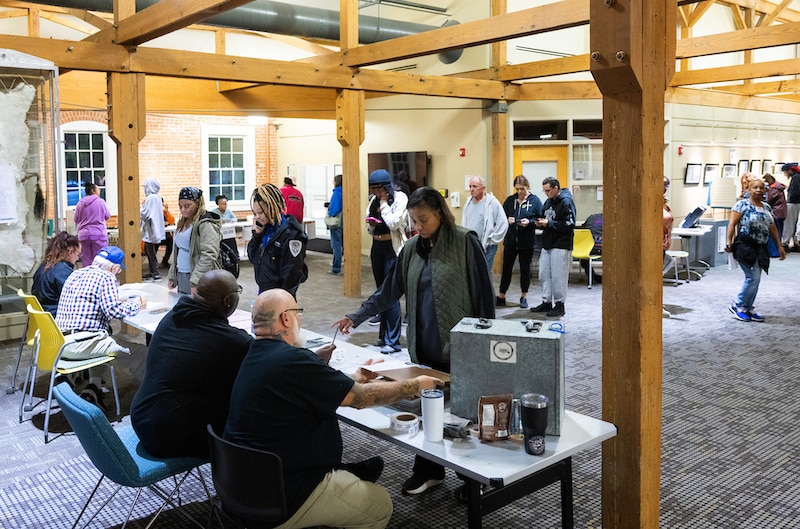
The draft works almost exactly the way jury duty does: The county election commission sends out summonses to a small percentage of randomly selected registered voters telling them to report for election duty. As many who receive a call to jury duty often ask: Can they get out of it?
Just like with jury duty: It depends. State law allows exemptions for anyone 70 or older and those with documented health issues. It also generally releases people who are traveling or who have pressing work obligations, though draftees must provide documentation of those issues. State law also allows those with young children to defer service until the children are older.
But once summoned, a person is on the hook. They must serve for four elections over an indefinite period of time. Once they have completed their fourth election, they can no longer be required to serve as a poll worker.
Aside from the exemptions, the only way to get out of the service is to permanently give up one’s voter registration — a move most aren’t willing to make, election officials said.
From drafted workers to volunteers
The draft may be helping the two Nebraska counties that have long used the draft to avoid the poll worker recruitment difficulties common elsewhere in the country.
Nationwide, nearly half of election jurisdictions reported difficulty finding enough poll workers in a 2024 federal survey. But Douglas County reported that recruiting enough workers was somewhat easy, while Sarpy County said it was neither difficult nor easy.
Overstreet said implementing the draft this year in Hall County made the job of recruiting poll workers much easier for the general election.
“This election was definitely less stressful,” Overstreet said. “I think Nebraska is really one of the most progressive states when it comes to election law.”
Barry Burden, director of the Elections Research Center at the University of Wisconsin–Madison, says many communities do have difficulty recruiting enough poll workers whose diversity mirrors the voters in those communities.
Burden helps conduct the National Election Worker Survey, which surveys temporary poll workers about recruitment and training.
“Drafting poll workers somewhat randomly from the population is a promising solution to address both of these common challenges,” Burden said, although he does see both pros and cons.
A potential upside of drafting: Americans with little prior knowledge of elections, when forced to be involved, could develop a better understanding of the election process. That can breed trust in elections, he said.
That upside has largely played out for the Nebraska counties that use a draft, some election commissioners said.
Jones, appointed Sarpy County election commissioner last year by Gov. Jim Pillen, learned of the draft as he was getting up to speed on how Sarpy County elections had been run before his appointment. Initially, he was not a fan.
“My first reaction was, ‘Are you kidding me? The last thing I want is a poll worker who doesn’t want to be there,’” he recalled.
Then he learned that many of those drafted into service went on to become volunteers after their compulsory obligation ended. He’s now a convert.
Lauren Prather, associate professor of political science with the University of California San Diego, helped lead the survey of Nebraska election workers around the May primary. The university is conducting a similar one about the November election. It’s also doing a statewide survey of Nebraskans to understand the public support for the draft, she said.
Prather found that inexperienced drafted workers initially knew less about elections and had less trust in the process than experienced workers and volunteers. But both their knowledge and trust increased after working one election. And among drafted workers completing their four-election obligation, one in four said they would return as volunteers.
Jones has been “amazed at how many people stayed on to volunteer,” he said. “I credit a lot of that to the training our staff provides, but also, I think people just realize that they appreciate providing that civic duty and being part of the election process in their community.”
California considers a draft
At least one other state with dense population areas that have struggled to recruit election workers has taken notice of Nebraska’s unique poll worker draft. In California, state Assemblymember Corey Jackson introduced a bill to start an election worker draft.
“Their preliminary research shows that not only does this system address staffing shortages, but it also produces a more demographically representative workforce in elections while building election knowledge and confidence for all worker types,” Jackson’s spokesman, Daniel Peeden, said in an email.
The bill had bipartisan support and was passed by the California Legislature. The proposal would have allowed counties to establish their own drafts, requiring election officials to select and notify workers, evaluate requests for exemptions, and train those chosen to serve. Newsom didn’t agree and vetoed it.
“Given the unprecedented attacks on our election systems, I am concerned that while well-intentioned, this bill could inadvertently redirect resources away from local election officials administering free and fair elections,” the governor said in a statement.
Newsom’s opposition means Jackson does not plan to resurrect the bill later this year when the California Legislature reconvenes, Peeden said.
Even in Nebraska, the system comes with trade-offs for the people required to serve.
A potential downside: Nebraskans drafted into the system might be less inclined to fully engage, unlike volunteers, who are typically experienced and highly motivated, Burden said.
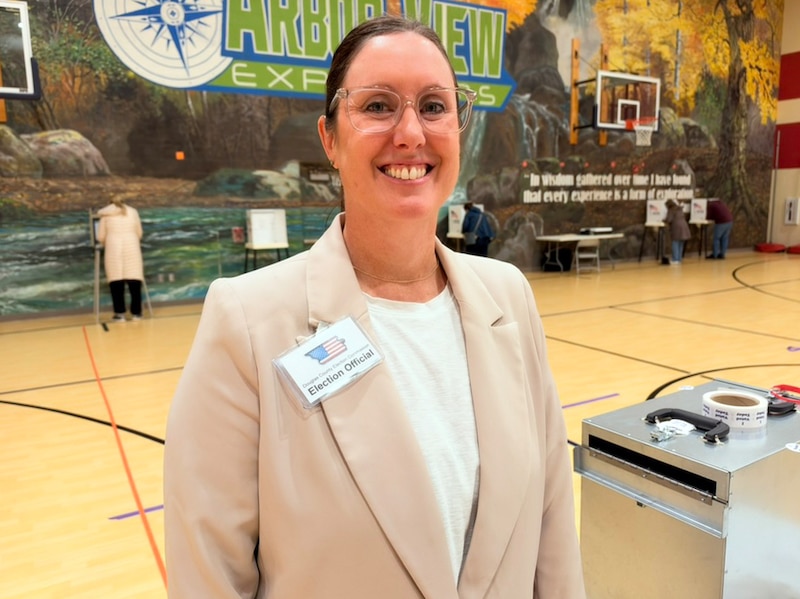
Eschmann, who worked her first election earlier this month after being drafted, said she did not see a lack of engagement from those in her freshman draftee class, but she agrees with the sentiment that being drafted doesn’t always instill a desire to volunteer.
But she personally walked away with a sense of pride for civic duty and a better understanding of how the election process works — including a newfound understanding of how secure that system is.
After her mandatory stint is up, she’s not sure she’ll volunteer. A clinical nurse, she worked about 14 hours on Election Day, then had to show up for a 12-hour nursing shift the next day.
“I’m tired,” she said. “It was a long, long day. If they shortened it to six hours or so, I’d be more willing to consider volunteering.”
Margery Beck is a reporter for Flatwater Free Press in partnership with Votebeat. Contact Margery at mbeck@flatwaterfreepress.org.