Votebeat is a nonprofit news organization reporting on voting access and election administration across the U.S. Sign up for Votebeat Wisconsin’s free newsletter here.
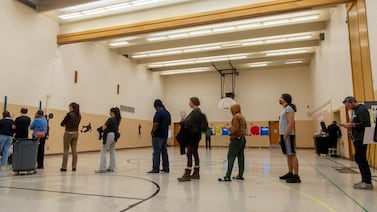
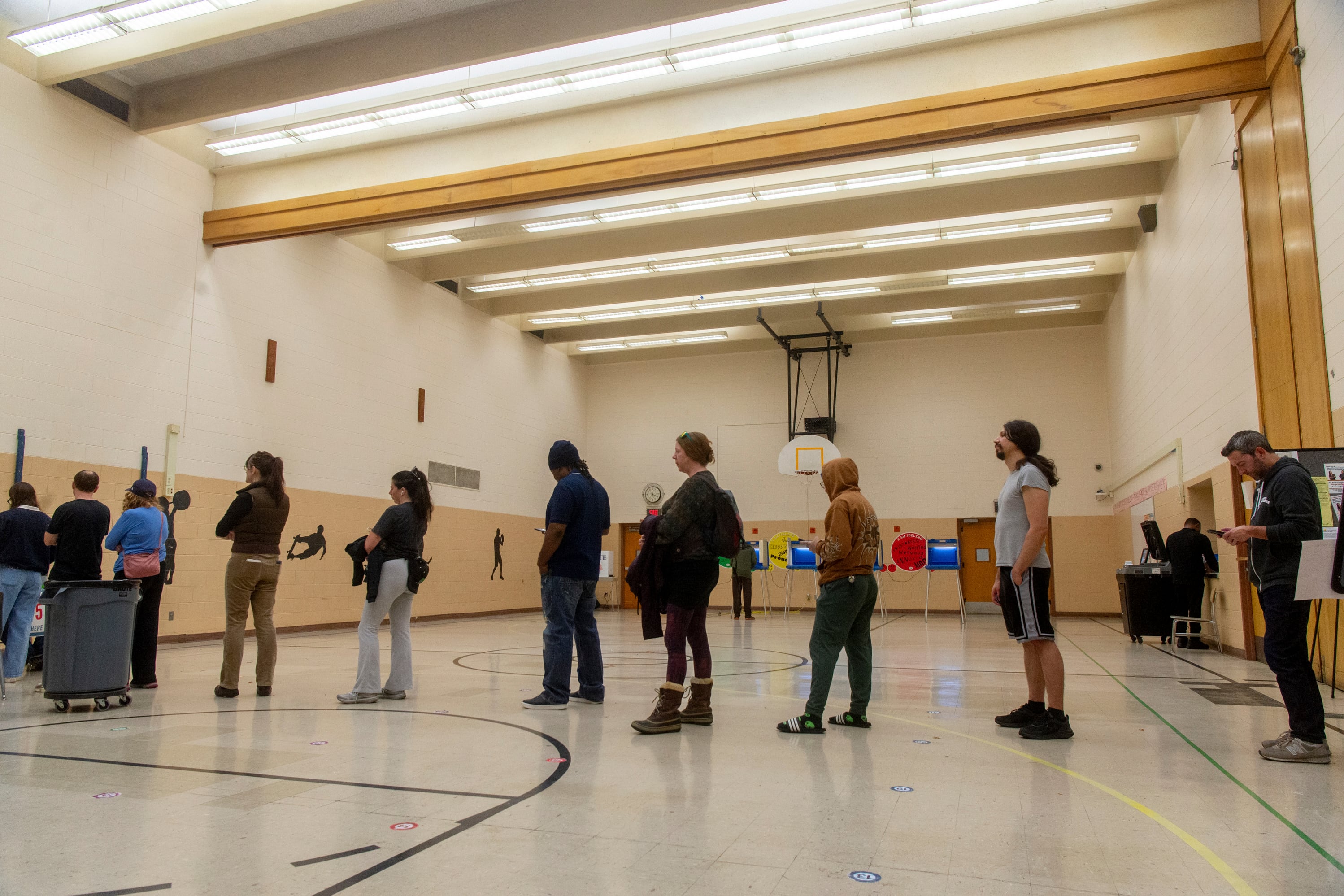
Polling places serving some Wisconsin universities had hourslong lines in the November election, as officials continue to grapple with ways to reduce the waiting time for students who may be voting in Wisconsin for the first time.
The lines in November were particularly long at polling places near the University of Wisconsin campuses in Stevens Point and Whitewater, but in past elections there have been long lines at university polling places across the state, from Madison and Milwaukee to Eau Claire.
College voters present a unique challenge for Wisconsin officials. Many don’t register ahead of Election Day, and same-day registration takes time. That can lead to long waits, which can be further exacerbated by understaffing and some factors outside of election officials’ immediate control, like students not knowing whether they’re registered or bringing insufficient documentation.
At a Stevens Point city council meeting on Nov. 16, representatives of voting groups grilled the city about long campus lines that they said disenfranchised some students.
The election operation there “was a failure, but most importantly was avoidable,” said Ella Jordahl, voter access director at the student-focused voter group The Wisco Project.
Four other speakers showed up to the meeting, painting a picture of frustration and chaos among those who waited in line — one said some of the people in line left and did not come back.
Faced with the potential for lines that can take hours to get through, election officials have begun treating polling station lines more and more like a science. That has led to some stark improvements across the nation — from Madison to Orange County, California — but those innovations can be costly and hard to duplicate in smaller Wisconsin university towns.
All the challenges inherent to college polling sites are solvable, The Elections Group CEO Jennifer Morrell said.
“The hard part is, there’s no single solution,” she added. “It needs to be very much a holistic thing based on communication, adequate resourcing and technology that works well for everybody.”
Lack of funding, preparedness exacerbate Wisconsin lines
The long polling place lines in Stevens Point and Whitewater appear to have resulted, at least in part, from limited resources in both municipalities.
The line at the polling place serving University of Wisconsin-Stevens Point students was especially long because so many of them were registering on Election Day, City Clerk Susan Pagel said. But she added that a lack of city resources made the problem worse.
The city decided to consolidate polling locations for this election — from 11 to six — as it faces budget constraints, Pagel said.
After the election, Pagel and Mayor Mike Wiza proposed spending $35,000 on additional electronic pollbooks used to check in voters quicker. The city finance committee approved that measure on Nov. 9.
That investment is “an important and necessary step, but not the whole solution,” said Brittany Vulich, All Voting Is Local Action’s Wisconsin senior campaign manager. The city should also consider additional locations for students to vote early in-person, she added at the Nov. 16 Stevens Point city council meeting.
In Whitewater, waits became especially long after a polling location serving university students on the University of Wisconsin-Whitewater campus ran low on ballots. City Clerk Heather Boehm didn’t respond to multiple requests for comment.
In a post-election memo, Boehm said the ballot quantities ordered at the city’s polling places were based on the turnout at the same polling places in 2022. During that election, Boehm said, Ward 13 saw 180 voters, and she therefore ordered 200 ballots. But that contradicts data submitted to the Wisconsin Elections Commission, which shows 355 voters from that ward.
Ultimately, 421 voters showed up in the college campus building serving Ward 13 in November.
The ballot shortage led officials to direct voters to an ExpressVote machine, which prints voters’ choices on a paper ballot and encodes them in machine-readable barcodes, but extensive lines formed there, according to the city memo.
The city also had issues two years ago, when inadequate staffing led to hourslong waits and, eventually, a court-granted extension to keep the polls open late.
Solutions have reduced lines across the country
This isn’t a new problem across the state: Madison struggled with lines at its university polling and early voting locations in the past, and has spent 10 years trying to fix it. The city appears to have succeeded.
Madison first established early voting sites at the University of Wisconsin-Madison in 2016, Deputy Clerk Kaitlyn Bernarde told Votebeat, while simultaneously developing a relationship with the university to encourage students to register ahead of Election Day.
“Even if we have a couple outreach events that maybe get like 50 voter registrations, that just takes off the demand on Election Day,” Benarde said. “You can’t get voters in and out within a couple minutes when they are also having to register.”
Even with those events, the number of Election Day registrations is still high, she said. For that reason, the city often doubles staffing at college campus polling sites — 18 workers or more — compared with other locations that are assigned just eight, Bernarde said.
The city plans its staffing levels using a tool developed by MIT and Caltech to calculate wait times based on the number of voting stations, check-in stations and expected voters, Bernarde said.
Some of the extra poll workers go through the lines to direct people to where they need to be depending on whether they’ve already registered, she said. The city also made a point of focusing its poll worker training on processing Election Day registrations.
The results aren’t perfect. There were long lines at early voting locations in the 2024 election, Bernarde said, but as a result the city added another weekend of early voting at a campus location.
“We’ve really made a conscious effort to try to improve this process and be aware of our office’s capabilities,” Bernarde said.
One polling place on campus in this election had 13 election workers and three check-in stations to keep wait times under 15 minutes, Bernarde said. The longest wait times all day were 12 minutes for people registering and four minutes for those already registered, she said.
In California, another state that allows same-day registration, Orange County Registrar of Voters Bob Page has also focused on reducing lines at polling sites that serve college students.
Beginning in 2025, poll workers at a University of California-Irvine voting location now confirm whether students are registered at the polling site entrance. Registered voters go straight to a line to vote, and unregistered voters get routed to a registration tent.
That added step, Page said, reduced the waits for students already registered to vote. It also reduced confusion, he said, “because it was clearer to election workers and the voters where they were in the process.”
It’s essential to keep students informed on deadlines and the required documentation to vote, Morrell said. Encouraging early voting is key, too, she added, because when students show up to vote it’s often in a big group, and registering all those people takes a lot of time.
“Anything that you can do to take some of those folks out of line on Election Day, that’s part of the solution,” she said.
Having more check-in stations for student polling places and more officials trained on same-day registrations and familiar with methods for reducing long lines is also helpful, she said.
Morrell said that, given the complicated nature of polling place lines, looking to duplicate what works in other jurisdictions “is exactly the right approach.”
Successes can be challenging to duplicate in cash-strapped cities
But in Stevens Point — and smaller, more poorly resourced offices across the country — officials can’t easily duplicate the successes seen in Orange County and Madison.
When Stevens Point operated 11 polling locations, its limited staff and budget meant the city often had to rely on employees from the county clerk’s office to troubleshoot problems, Pagel said. Reducing the number of polling locations to six means fewer sites for voters, but also allows the city to concentrate its staff and resources at those locations and handle more problems without relying on additional assistance from the county.
Given her lack of resources, Pagel said she plans to address the long lines by offering better training to poll workers on voter registration, and working with the university to encourage students to register early.
‘What we need to do is have better line control,” she said. “Make sure the students have the required documents ready.”
Another potential solution — adding more poll workers to help voters move through the lines — is currently prohibited by city ordinance.
Stevens Point’s municipal code sets five election officials as the default at each polling place and gives the clerk discretion to increase that number to 11, but no higher. The ordinance allows one additional worker to serve as a greeter.
Pagel said she wasn’t sure why the restriction was in place, and that it will prevent her from taking the kind of steps Madison and Orange County have taken.
“I’ll be looking for an ordinance change to allow me to have more than 11,” she said.
Alexander Shur is a reporter for Votebeat based in Wisconsin. Contact Alexander at ashur@votebeat.org.