
Votebeat is a nonprofit news organization reporting on voting access and election administration across the U.S.
This news analysis was originally distributed in Votebeat’s free weekly newsletter. Sign up to get future editions, including the latest reporting from Votebeat bureaus and curated news from other publications, delivered to your inbox every Saturday.
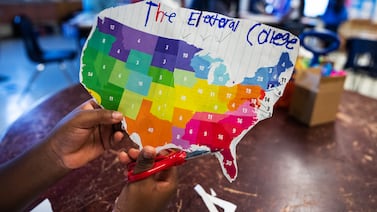
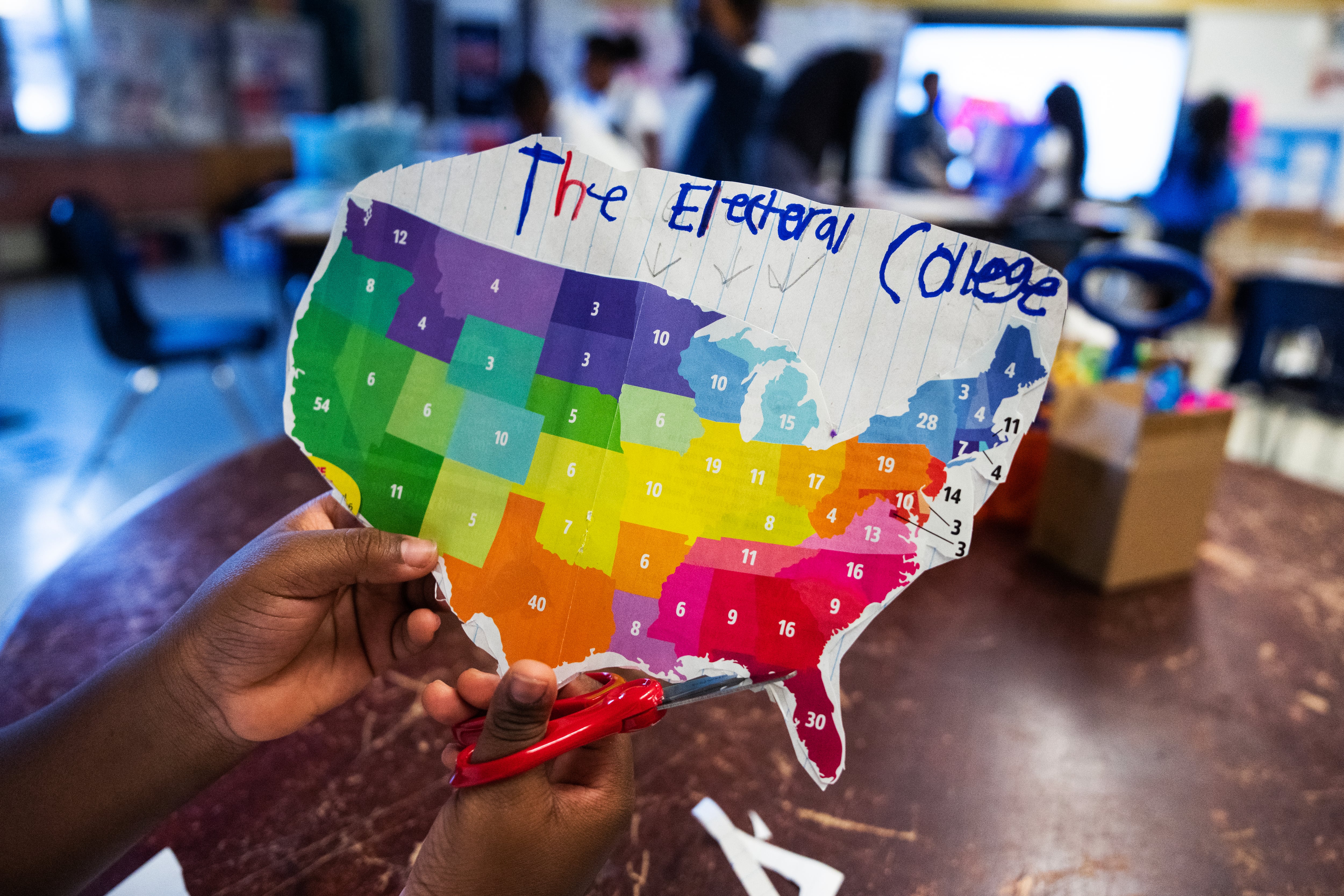
It’s one of the first things you learn if you take high school civics: The national popular vote doesn’t pick the president. The Electoral College does.
But there’s a movement afoot to rewrite those lesson plans. And after this month’s elections, its goal — to effectively eliminate the Electoral College — may actually be within reach.
The National Popular Vote Interstate Compact seeks to solve a simple problem: Sometimes, the winner of the presidential election isn’t the candidate who got the most votes. There have been four times in U.S. history (1876, 1888, 2000, and 2016) when one candidate won the national popular vote but another candidate won the Electoral College — and thus became president.
Those elections were followed by calls to abolish the Electoral College — usually from Democrats, who coincidentally were on the losing end of all four. But the Electoral College is written into the Constitution, so ending it would be a very heavy lift. It would require either a constitutional amendment … or a more creative solution like the NPVIC.
The proposal is essentially an end run around the Electoral College. States that ratify the compact agree to award their electoral votes not to the winner of that state, but to the winner of the national popular vote. The compact would not take effect until states worth 270 electoral votes (a majority) sign on — but if that happens, their collective action would be enough to guarantee that the national popular vote winner also wins the Electoral College.
The compact seemed like a long shot when the organization National Popular Vote first introduced it in 2006. But over the years, more and more states — namely, those controlled by Democrats — have joined. Today, the agreement has 19 signatories worth 222 electoral votes, putting it just 48 shy of taking effect.
Those last few votes, though, were always going to be an uphill battle. In order to hit the magic number of 270, the NPVIC needs to pass in several purple states whose leaders have historically been more sympathetic to the Electoral College. But after Democrats’ overwhelming gains in the 2026 election, they will soon hold the reins of power in five such states, worth 61 electoral votes.
It’s far from guaranteed that those states will embrace the compact and willingly surrender their outsized influence in presidential elections. (A previous Democratic governor in Nevada vetoed the compact for that very reason.) Moving ahead could very well put a state in the position of awarding its electoral votes to a candidate who failed to win the support of its own voters.
But the governor of Pennsylvania and the incoming Senate majority leaders in Arizona and Michigan have expressed openness to joining the compact. If it passes in those three states plus either Wisconsin or Nevada before July 20, 2028, it would be activated in time for that year’s presidential election.
Electing the president by popular vote could drastically change the way presidential elections are run. Instead of focusing on just a handful of swing states, campaigns might fan out across the country, giving as much attention to voters in New York and Wyoming as Nevada and Georgia. It might also have major implications for election administration — a close presidential election in one state would no longer require a recount, but a close race nationally could trigger an unprecedented nationwide one.
But even if the NPVIC gets to 270 electoral votes, that doesn’t necessarily mean we’ll find out what it’s like to live in a post-Electoral College world. Because that’s when the lawsuits would start flying.
“If this does get enough states to put it into force, I think everyone agrees that it will end up in litigation,” said Josh Douglas, an election law professor at the University of Kentucky. “And likely this is a good candidate to go up to the Supreme Court.”
There are several arguments to be made that the NPVIC is unconstitutional. The most obvious is that it’s too cute by half — that it violates the framers’ intent when they created the Electoral College. While the Constitution gives state legislatures the power to appoint electors however they see fit, some legal scholars argue that historical precedent precludes electors from casting their votes based on election results from outside their states’ borders.
Another argument is that the NPVIC violates the compact clause, which says, “No State shall, without the Consent of Congress … enter into any Agreement or Compact with another State.” That’s perhaps not as fatal as it sounds; the Supreme Court in 1893 ruled that congressional signoff is required only for compacts that undermine the supremacy of the federal government. But it’s anyone’s guess whether today’s court would view the NPVIC as doing so. (The NPVIC’s website also says it is “working to obtain support in Congress for the Compact.”)
The NPVIC could also violate the 14th Amendment’s equal protection clause because it envisions a nationwide election that is conducted under 51 different sets of election laws. Depending on where a voter lives, they may or may not be able to cast a ballot by mail, register to vote at the last minute, or — if they are a convicted felon — even vote at all. But popular vote supporters argue that the amendment simply prohibits states from discriminating against “any person within its jurisdiction.”
“I really think this is a close call,” Douglas said about the various cases against the NPVIC. “I think there are good arguments on both sides. I think it’s really hard to predict what the [Supreme] Court will say.”
Starting early next year, all eyes will be on Arizona, Michigan, Nevada, Pennsylvania, and Wisconsin to see whether they actually put the compact over the top. If they do, it could set up one of the most closely watched election law cases in history just months before a high-stakes presidential election. Just when it seemed like 2028 couldn’t get more interesting, the NPVIC has gotten our attention.
Nathaniel Rakich is Votebeat’s managing editor and is based in Washington, D.C. Contact Nathaniel at nrakich@votebeat.org.