Votebeat is a nonprofit news organization reporting on voting access and election administration across the U.S. Sign up for Votebeat Pennsylvania’s free newsletter here.
The Pennsylvania Department of State is launching a pilot program to try out the use of internet-connected electronic pollbooks, and the devices would be deployed as early as the May primary election.
More than half of Pennsylvania counties are already using or have tested out electronic pollbooks, or e-pollbooks. But the state doesn’t currently allow those systems to be connected to the internet, limiting their utility, proponents say, and some county election officials have been petitioning the state to change that.
Proponents point out that internet-connected pollbooks could reduce administrative burdens and allow counties to check results more quickly. But some county officials are concerned that connecting them to the internet could compromise election security.
Amy Gulli, a spokesperson for the Department of State, said that on Jan. 28, the department informed e-pollbook vendors about how to to apply to participate in the pilot program, which is still in the early stages, and “will assess whether internet-connected EPBs allow county election officials to respond to polling place issues faster and more efficiently.”
Gulli emphasized that voting machines and ballot tabulators will still not be connected to the internet. The e-pollbooks would be disconnected from the internet before they are used to transfer data on who voted into the state’s voter management system.
Some states, such as Arizona and New Mexico, allow e-pollbooks to be connected to the internet.
Devices could ease election administration
Thad Hall, Mercer County’s election director, previously oversaw elections in Arizona, and said he has been pushing Pennsylvania since 2021 to update its guidance. Mercer County uses the KNOWiNK Poll Pad, the most widely used e-pollbook in the state. While he said other factors will prevent him from participating in the pilot, he does hope to use connected pollbooks in the future, as he did in Arizona.
Hall said the internet connection would allow counties to more easily provide their polling place workers with updated lists of who is eligible to vote.
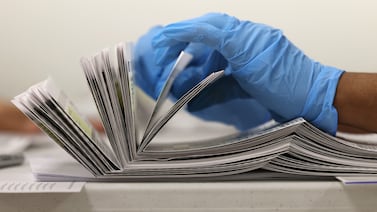
Pennsylvania’s deadlines for registering to vote and requesting a ballot leave a tight turnaround time for printing pollbooks in time for Election Day. Even when a county uses an e-pollbook, the devices can’t be updated as quickly as if they had an internet connection, so the county still needs to print paper pollbooks as a backup and sometimes force poll workers to flip between the two sources to find the voter.
Connected pollbooks also would allow election directors to easily see which precincts are opening on time in the morning and monitor turnout throughout the day, allowing counties to see in real-time whether they need to deploy more resources to overburdened precincts.
After the polls close, the devices could also help election officials more quickly check the accuracy of their results, Hall said. Typically, the data showing who voted on Election Day is not uploaded to the state’s voter rolls until the days after the election, but internet-connected e-pollbooks would allow that data could be uploaded nearly instantaneously, meaning administrators could verify on election night whether the number of cast ballots matches the number of voters recorded checking in for a given precinct.
Finally, he pointed out that the new devices could help mitigate problems with paper pollbooks on Election Day.
In 2025, Chester County mistakenly printed paper pollbooks that excluded independent and third-party voters, forcing thousands of them to vote provisionally until supplemental pollbooks could be printed and deployed to the polls. With internet-connected e-pollbooks, an updated file could have been pushed out far more quickly.
Some concerned about security
Not all counties are greeting the pilot program with excitement, though. Joe Kantz, a county commissioner in Snyder County and president of the County Commissioners Association of Pennsylvania, said he is concerned about security and the perceptions this will create about the state’s elections.
Unclear sections of the law have resulted in a wide array of election policies across the state, and internet-connected e-pollbooks could become another difference between counties, he said, inviting further criticism of the state for non-uniform election administration.
Beyond that, he is also concerned about the security of the devices.
If a bad-faith actor was to hack a precinct’s e-pollbook and take it offline, Kantz said, voters could be prevented from voting. “I’m not against progress, but I’m concerned about the security aspect of networking anything related to elections,” he said.
The Department of State did not specify what security measures would be in place. Hall said that in Arizona, precincts used secured WiFi hotspots.
Jerry Feaser, a former Dauphin County elections director who now works for e-pollbook vendor KNOWiNK, said the devices can’t be used to directly add voters to the state’s voter rolls, as even in states which allow same day registration at the polls using e-pollbooks, registration needs to be approved by an election official. Conversely, voters can only be added to the e-pollbooks from the voter rolls if their registration has been approved by an election official.
Hall also pointed out that even if someone were to get access to an e-pollbook and try to fraudulently add voters, counties would be able to detect that though other methods, such as by checking the numbered list of voters who come into a precinct on Election Day or through the original copy of the voter file.
One Pennsylvania county, Delaware, partnered with KNOWiNK in September to run a mock election using internet-connected e-pollbooks, which Feaser said went “swimmingly.” Other KNOWiNK counties have already expressed interest in participating in the state’s pilot program, he said.
Gulli, the Department of State spokesperson, said applications from the vendors are due Feb. 28, and it is still unclear how many counties will participate in the pilot.
Carter Walker is a reporter for Votebeat in partnership with Spotlight PA. Contact Carter at cwalker@votebeat.org.