Votebeat is a nonprofit news organization reporting on voting access and election administration across the U.S. Sign up for our free weekly newsletter to get the latest.
The FBI’s search of a Fulton County, Georgia, election office, sent shock waves through election offices nationwide that have spent years responding to lawsuits, audits, and investigations driven by President Donald Trump’s false claims about the 2020 election.
But state election officials — many of them gathered this week for a national conference — projected confidence afterward, saying their work has already withstood years of scrutiny following the 2020 election, and they have followed federal and state law.
Nevada Secretary of State Cisco Aguilar, a Democrat, said election officials are “concerned” and “upset,” and believe “a certain individual is trying to intimidate us” ahead of the 2026 and 2028 elections. At the same time, he said, officials want voters to know they are running “safe, secure, and accessible elections,” with safeguards that are continually reviewed and improved.
Utah Lt. Gov. Deidre Henderson, a Republican and the state’s chief elections officer, said the only response to heightened scrutiny is strict adherence to the law. “We’re committed to orderly and fair elections, no matter what political party the voter belongs to,” she said. “But we live in a reality where politicians politicize stuff.”
Those comments came as the National Association of Secretaries of State met this week for its annual winter conference, with the FBI’s search in Georgia hanging over the gathering. The conference schedule shifted amid the uncertainty, with NASS officials offering late confirmation that Attorney General Pam Bondi, Homeland Security Secretary Kristi Noem, and Director of National Intelligence Tulsi Gabbard would address the group on Friday.
Tensions surfaced Thursday as speakers addressed the Trump administration’s increasingly aggressive push for greater federal control over elections. Sen. Alex Padilla, a California Democrat and former secretary of state, referenced the Fulton County search and called it a “wake-up call” for election officials.
Later, West Virginia Secretary of State Kris Warner, a Republican, introduced Jared Borg, a special assistant to the president and deputy director of the White House Office of Intergovernmental Affairs, noting that Borg had been asked to speak about the administration’s future plans — including the possibility of a second executive order on elections. Borg did not address that issue during his remarks and declined to comment when asked about it afterward.
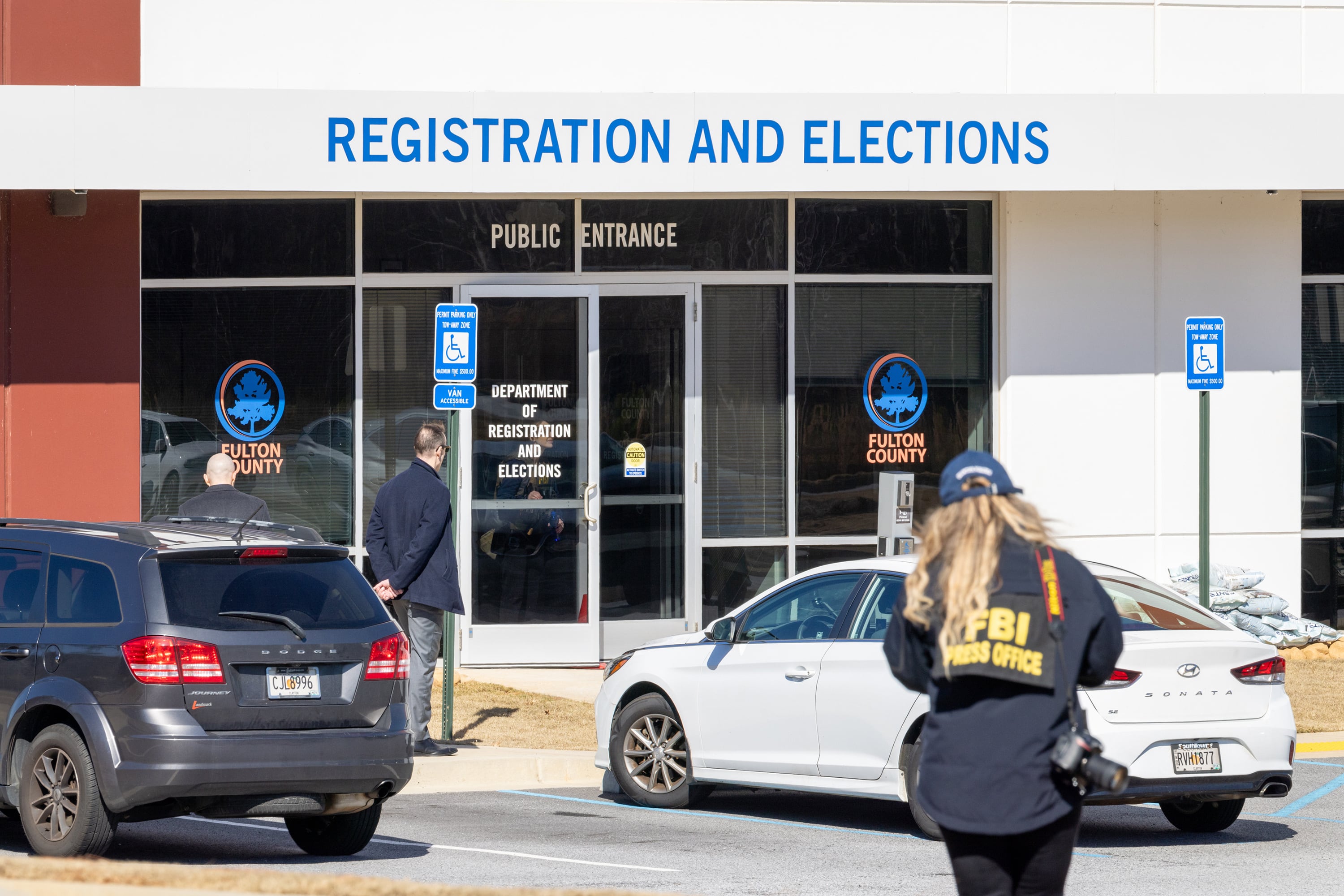
The FBI on Wednesday executed a broad search warrant at a Fulton County elections office as part of a federal investigation into the handling and preservation of 2020 election records. A federal judge authorized agents to search for ballots, tabulator records, ballot images, and voter rolls, citing potential violations of federal election law.
The search came a week after Trump repeated his claims that the 2020 presidential election was rigged and said “people will soon be prosecuted for what they did.”
Trump-appointed officials at the Justice Department and other agencies in 2020 said they had found no evidence of fraud swaying the outcome of the election, and allegations of it from Trump and his allies were rejected by courts, election officials, and experts after multiple audits and reviews found Trump lost the election to Joe Biden.
The raid in Fulton County, which Gabbard was present for, is the latest escalation of Trump’s efforts to use the federal government’s authority and resources to continue pursuing those allegations over elections. And it’s the most visible federal law enforcement step to date connected to Trump’s long-running claims of widespread election misconduct, raising concern among election administrators about continued scrutiny years after the election.
Last week, Bondi sent a letter to Minnesota Gov. Tim Walz pressing the Justice Department’s demands for voter roll data amid tense discussions over immigration enforcement efforts there, prompting Minnesota Secretary of State Steve Simon to call it “an outrageous attempt to coerce Minnesota into giving the federal government private data on millions of U.S. Citizens in violation of state and federal law.”
Election officials have openly said they are preparing for a range of scenarios including potential federal intervention in the administration of the 2026 midterm elections.
Arizona Secretary of State Adrian Fontes, a Democrat, framed the FBI action as politically motivated.
“This administration is weaponizing law enforcement across the board and in this case for the purpose of satisfying the president’s obsession with his 2020 election loss,” Fontes told Votebeat in a statement. “If Arizona is next, so be it. We’ve got nothing to hide and they’ve got nothing to prove.”
Warrant leaves key questions unanswered
The search warrant stands out for its breadth and timing: Issued more than five years after the 2020 election, it authorizes federal agents to seize nearly all of Fulton County’s election records from that contest, including ballots, tabulator tapes, ballot images, and voter rolls, rather than just materials tied to specific allegations.
The warrant cites federal records-retention and election-crime statutes, though required retention periods have long since passed, and allows government attorneys to take custody of and independently review the seized materials. Both statutes are typically subject to a five-year statute of limitations, which would have expired in 2025 for conduct related to the 2020 election.
David Becker, executive director of the Center for Election Innovation & Research, said he is not aware of any evidence that Fulton County destroyed election records before retention requirements expired and said the county appears to have preserved its ballots.
Becker said the five-year limitation has run out and leaves “no possible claim” tied to how the election was conducted.
Becker added that seizing ballots years after an election raises separate concerns, including new chain-of-custody problems that could undermine the integrity of any evidence gathered. “We have no idea what’s going to happen to those ballots once they’re seized,” he said, warning that such uncertainty could itself create evidentiary issues.
A rare federal search, in a county long targeted by Trump
Fulton County is Georgia’s most populous county, and encompasses most of Atlanta. Its unique position helps explain why federal investigators are still seeking access to physical ballots and detailed election records years after the election. The county has faced sustained litigation, audits, and public-records disputes tied to the 2020 vote, creating pressure to retain ballots and related materials long after many states stopped keeping them.
That prolonged scrutiny overlaps with Fulton County’s central role in Trump’s efforts to overturn his 2020 loss in Georgia, a Republican stronghold that flipped for Biden and also elected two Democratic senators in the same election cycle. Trump and his allies repeatedly singled out the county as evidence of a stolen election, even after recounts, audits, and court rulings upheld the results, keeping local election officials under pressure long after most jurisdictions moved on.
The FBI search followed earlier attempts by the Justice Department to obtain 2020 election records through the courts. In December, the department sued Fulton County after officials declined to turn over ballots and related materials without a court order, arguing the records were sealed. The lawsuit sought access to the same categories of records later named in the search warrant, marking a shift from civil litigation to criminal process.
Fulton County did not respond to an interview request, and the Georgia Secretary of State’s Office declined to comment.
States say their systems have already been tested
For election officials elsewhere, the Georgia search underscores just how atypical Fulton County’s situation has become. Many states say their 2020 election systems were examined exhaustively and are governed by clear legal timelines for record retention, making similar searches for 2020 records less likely.
Michigan Secretary of State Jocelyn Benson said the FBI’s search in Fulton County was rooted in “unproven conspiracy theories” about the 2020 election. While election officials welcome good-faith questions, Benson said, they reject efforts “driven by conspiracy theories” and “verifiably untrue claims” to use the federal government to intimidate election workers or interfere with elections for political purposes.
Calli Jones, a spokesperson for the Arizona Secretary of State’s Office, said the agency is notifying county election officials about the situation in Georgia but is not issuing formal guidance. She said the office is preparing in case a similar situation were to arise in Arizona and is available, along with its legal staff, to assist counties with questions about record retention.
She added that Arizona no longer has 2020 ballots, because state law requires counties to destroy ballots within 24 months of an election.
Pennsylvania election officials were “not aware of similar activity taking place in Pennsylvania,” a spokesperson for the Department of State said in a statement, emphasizing that the state’s 2020 election “was free, fair, safe, and secure,” with results upheld repeatedly by state and federal courts.
Jessica Huseman is Votebeat’s editorial director and is based in Dallas. Contact Jessica at jhuseman@votebeat.org.
Carrie Levine is Votebeat’s editor-in-chief and is based in Washington, D.C. Contact Carrie at clevine@votebeat.org.
Nathaniel Rakich is Votebeat’s managing editor and is based in Washington, D.C. Contact Nathaniel at nrakich@votebeat.org.