Votebeat is a nonprofit news organization reporting on voting access and election administration across the U.S.
This news analysis was originally distributed in Votebeat’s free weekly newsletter. Sign up to get future editions, including the latest reporting from Votebeat bureaus and curated news from other publications, delivered to your inbox every Saturday.
What a week of election news, huh?
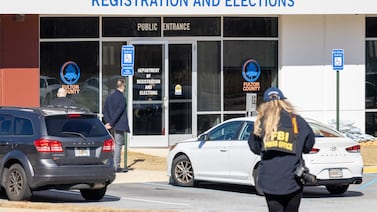
Attorney General Pam Bondi set off a furor when she appeared to link the aggressive immigration enforcement efforts in Minnesota to the state’s refusal to share its voter rolls with the Trump administration. The FBI searched a Fulton County, Georgia, election office, apparently as part of a criminal investigation into the 2020 election. Congressional Republicans dropped big new legislation to overhaul election administration.
Against that backdrop, secretaries of state from around the country gathered in a hotel ballroom in Washington, D.C., many expressing growing unease about the implications of the Trump administration’s actions and rhetoric around the 2026 elections they’re responsible for administering in November.
Multiple Trump administration officials were scheduled to address the secretaries’ conference at various points, but the plans kept shifting. Earlier this week, a spokeswoman for the National Association of Secretaries of State said Bondi — whose Justice Department has so far sued 23 states and Washington, D.C., for access to their voter rolls — and Homeland Security Secretary Kristi Noem would potentially be added to the schedule. Later, Director of National Intelligence Tulsi Gabbard was added to the list of expected officials, less than 48 hours after she appeared at the FBI search in Fulton County.
It wasn’t clear what they were planning to say, and some Democratic secretaries said they planned to skip the remarks.
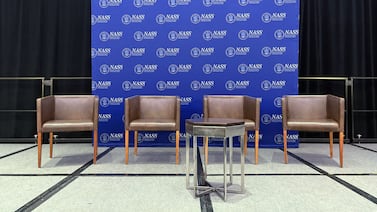
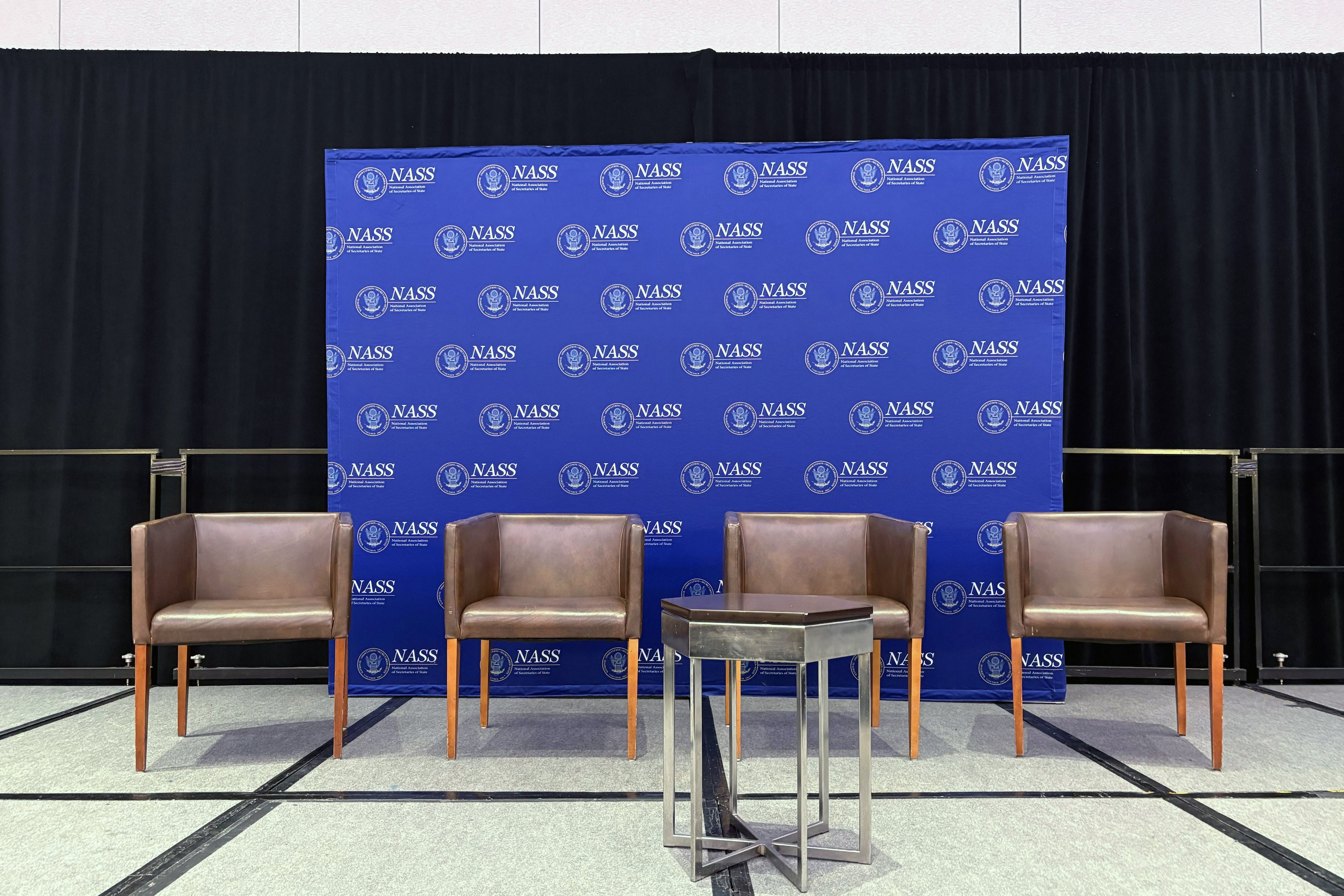
But after a crowd of secretaries of state, their staff, consultants, vendors, and media members filled the ballroom Friday afternoon, with four chairs set up on the dais, Mississippi Secretary of State Michael Watson, a Republican, announced that the chairs would stay empty.
“Unfortunately, it appears that we will no longer be having a 3 o’clock session,” Watson said, to rueful chuckles.
It wasn’t the only shift.
An early agenda had called for a Thursday panel with two White House officials, as well as Harmeet Dhillon, the Justice Department’s assistant attorney general for the Civil Rights Division, and Heather Honey, the deputy assistant secretary for election integrity for the Department of Homeland Security. Ultimately, only one official, Jared Borg of the White House Office of Intergovernmental Affairs, spoke. Borg opened by outlining the administration’s efforts to overhaul a federal database used by many states to verify voter citizenship, as well as ongoing consultations with secretaries of state on that and related initiatives.
Election officials from both political parties had pointed questions.
Referring to comments from Justice Department officials about states’ maintenance of voter rolls, Utah Lt. Gov. Deidre Henderson, a Republican and the state’s chief election officer, said it is “problematic to publicly claim that secretaries of state are not doing our jobs and that the federal government has to do it for us.” Connecticut Secretary of State Stephanie Thomas, a Democrat, asked why the administration wasn’t answering their questions about its election initiatives.
Maine Secretary of State Shenna Bellows, a Democrat, asked pointedly how the Trump administration squared his executive order on elections with the fact that the Constitution gives authority over elections to the states and Congress. Borg said the question would be better directed to Bondi or Noem the next day.
But as it turned out, Bellows didn’t get the chance, and she wasn’t happy about it. After Watson announced the session wouldn’t happen, a small group of Democratic secretaries of state spoke to the press. “Noem, Bondi, and Gabbard are cowards for not showing up today and answering the questions from election officials from across the country about this administration’s abuses of power,” Bellows said, while secretaries of state from Connecticut, Delaware, Rhode Island, and Vermont looked on.
Their frustrations with the Trump administration were clear. But the Democratic secretaries ended on a more upbeat note: emphasizing that NASS is still a bipartisan organization, and that their Republican colleagues are just as committed to administering a fair 2026 election as they are.
“Following the U.S. Constitution and the rule of law,” Thomas said, “is not a partisan issue.”
Carrie Levine is Votebeat’s editor-in-chief and is based in Washington, D.C. Contact Carrie at clevine@votebeat.org.