Votebeat is a nonprofit news organization reporting on voting access and election administration across the U.S. Sign up for our free weekly newsletter to get the latest.
Congressional Republicans on Thursday redoubled their efforts to regulate elections nationwide, introducing two new bills that draw heavily from President Donald Trump’s agenda.
U.S. Rep. Bryan Steil, the chair of the House Administration Committee, unveiled the Make Elections Great Again Act, a bill that would overhaul several aspects of how elections are run, from limiting the use of mail voting to setting a national photo ID requirement for voting.
Later in the day, Sen. Mike Lee and Rep. Chip Roy introduced the SAVE America Act, which combines a photo ID requirement for voters with the SAVE Act, a bill passed by the House last year to require Americans to prove their citizenship when registering to vote.
Both the MEGA Act and SAVE America Act face long odds of becoming law anytime soon. Although the measures could pass the Republican-controlled House, they would almost certainly fail in the Senate, where the filibuster effectively means that legislation needs 60 votes to pass. (Republicans control the Senate only 53-47.) Given that both bills go farther than the SAVE Act, which has languished in the upper chamber for almost a year, there’s little reason to expect they would have any more luck in the Senate.
Trump and his allies have for years been intent on changing the way U.S. elections are run, building on their false assertions of widespread fraud. In recent days, billionaire Elon Musk has used his social-media site X to pressure senators to pass the SAVE Act, which may explain the timing of the two new bills.
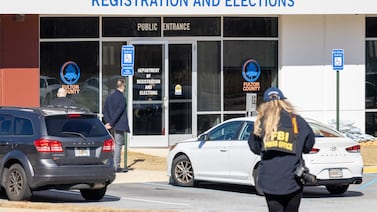
Since the start of Trump’s second term, his administration has also attempted to exercise extraordinary power over election administration, suing 23 states for not sharing comprehensive data on their registered voters and issuing a sweeping executive order on elections last year. The bills also come the same week that the FBI seized ballots from the 2020 election from an elections office in Fulton County, Georgia, in search of evidence of malfeasance.
So far, however, key provisions of Trump’s executive order have been struck down in court, and in recent months, he’s repeatedly called on Congress to pass legislation enacting his election-related priorities. The two proposals contain several policies from Trump’s 2025 executive order.
In November, the White House press secretary said the White House was working on a second executive order on elections, but one has yet to materialize.
What the Republican election bills would do
Should they ever pass, the SAVE America Act and especially the MEGA Act would represent the most transformative federal law aimed at reshaping national election administration in decades.
Both bills would:
- Require Americans to provide proof of their U.S. citizenship (such as a passport) when registering to vote. Currently, new registrants must attest that they are a U.S. citizen, but most people aren’t required to provide documentation to prove it. According to Ballotpedia, Arizona, New Hampshire, and Wyoming are the only states that currently require proof of citizenship to register to vote.
- Require voters to provide photo ID. According to the National Conference of State Legislatures, 23 states ask voters to provide photo IDs; in 13 states, non-photo IDs are acceptable, while 14 states plus Washington, D.C., don’t ask voters for ID. Notably, the ID requirement would apply not only to in-person voters, but also to mail voters, who would have to provide photocopies of their IDs (although the MEGA Act allows voters to provide unique identifying numbers, such as the last four digits of their Social Security number, instead). Currently, only Arkansas and North Carolina require mail voters to enclose copies of their IDs.
- Require states to regularly check their voter rolls for noncitizens. For example, the MEGA Act would require states to compare their voter lists against the Department of Homeland Security’s citizenship database, known as SAVE, on at least a monthly basis. The Trump administration upgraded SAVE last year to make it easier to use for large-scale searches, and the department said in November that 26 states are now using it for voter verification.
The MEGA Act also includes a host of other provisions, such as:
- Banning universal vote-by-mail. In other words, the eight states (plus Washington, D.C.) that automatically mail ballots to every voter would no longer be allowed to do so.
- Prohibiting states from accepting mail ballots that arrive after Election Day. Currently, 14 states and Washington, D.C., do this, as long as the ballots are postmarked on time. The Supreme Court is expected to rule on the legality of this practice later this year.
- Barring anyone except the voter, an immediate family member, or caregiver from possessing the voter’s ballot. Each state has different rules about who (if anyone) can return a mail voter’s ballot for them, but several have laws broad enough that allow third parties, such as campaign operatives, to do so — a practice Republicans have described as “ballot harvesting.”
- Requiring states to provide hand-marked paper ballots. According to Verified Voting, nearly 70% of registered voters already live in a jurisdiction that uses hand-marked paper ballots. Most of the remaining jurisdictions use ballot-marking devices, which would be still legal under the bill, but they would need to provide voters with the option to hand-mark their ballots as well.
- Outlawing ranked-choice voting. This would affect only two states: Alaska and Maine.
The provisions in both bills would only apply to federal elections, forcing states to choose between changing their state election laws to match and administering federal and state elections differently. Either way, the bill would likely create more work for election officials. Given how many states would have to change their voting procedures, the enactment of either of these bills would send officials scrambling to adapt to unfamiliar requirements.
And if officials fail to live up to the law, they could be held liable in new ways. The MEGA Act explicitly allows the attorney general, and even private citizens, to file civil lawsuits against election officials for noncompliance.
Connecticut Secretary of State Stephanie Thomas, a Democrat, said that this type of broad mandate from the federal government “not only potentially disenfranchises voters, but it also ignores how under-resourced elections and secretaries of state are in general.”
Nathaniel Rakich is Votebeat’s managing editor and is based in Washington, D.C. Contact Nathaniel at nrakich@votebeat.org.