
Votebeat is a nonprofit news organization reporting on voting access and election administration across the U.S. Sign up for our free weekly newsletter to get the latest.
The Trump administration is asking a federal judge to quickly lift her recent ruling against major provisions of a presidential executive order on elections, arguing in an appeal that the court’s action will effectively prevent the government from putting new voting restrictions in place before the November election.
Last week, U.S. District Judge Indira Talwani halted President Donald Trump’s efforts to create centralized lists of adult citizens and give the U.S. Postal Service unprecedented authority over who can vote by mail. Her 37-page ruling concluded that the president did not have the constitutional authority to regulate state elections, as his March executive order tried to do.
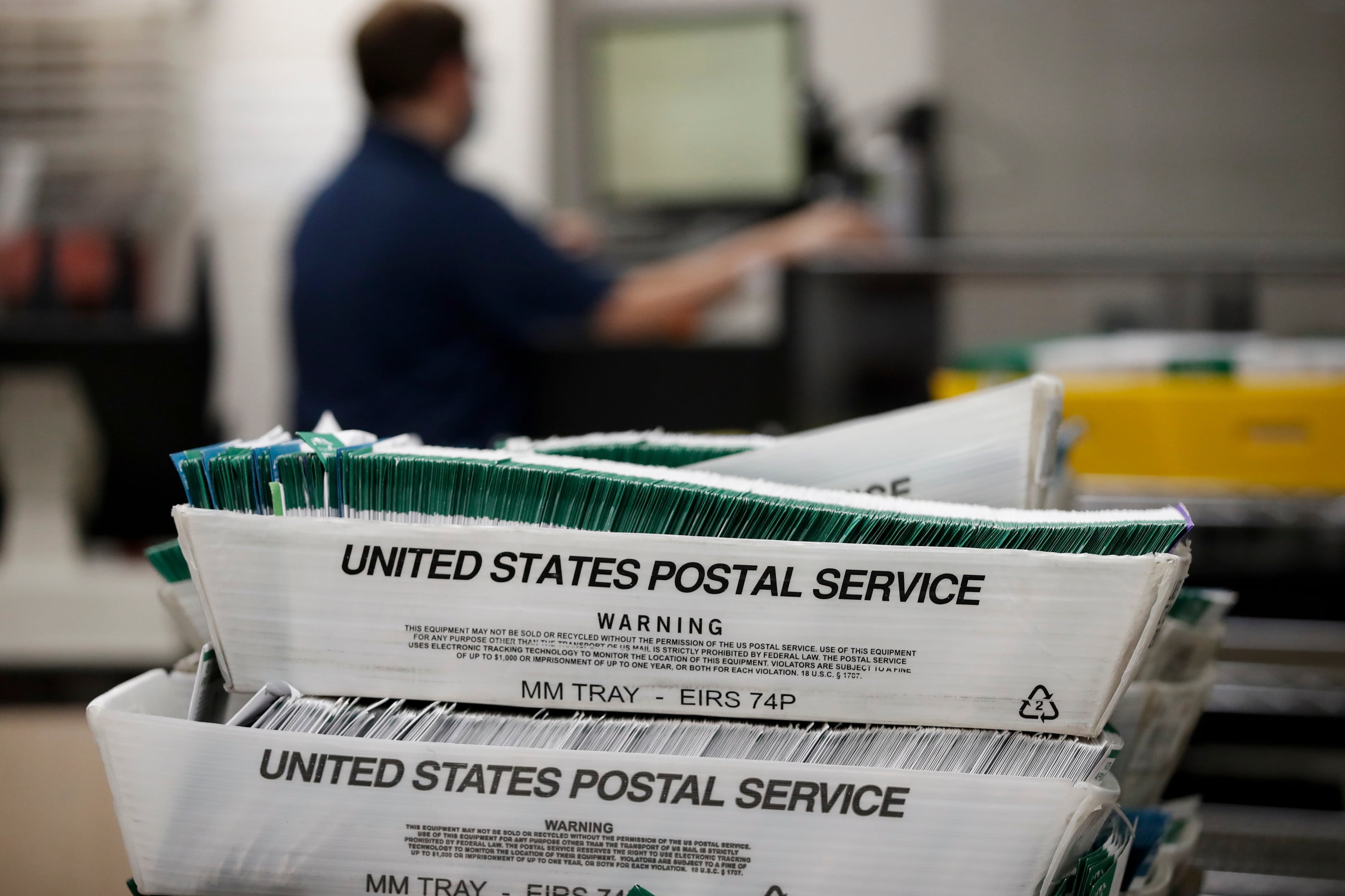
The executive order directed the U.S. Department of Homeland Security and Social Security Administration to create a nationwide list of verified U.S. citizens over 18, and thus presumably eligible to vote in federal elections. It also called on the U.S. Postal Service to create a system to handle and accept mail-in ballots only from voters on preapproved lists.
Talwani’s order prevents the federal government from enforcing those provisions of the order against the 24 jurisdictions (23 states and the District of Columbia) whose attorneys general and governors brought the lawsuit in federal court in Massachusetts. The list includes most Democratic-led and swing states, including Arizona, California, Michigan, Nevada, New York, North Carolina, Pennsylvania, and Wisconsin.
This week, the Trump administration appealed Talwani’s ruling to the First Circuit Court of Appeals and said it is still proceeding with its efforts to set up the new system for the rest of the states. But it warned that the judge’s order will make it impossible for the U.S. Postal Service to create a bifurcated system for the November election, even if the administration ultimately prevails on appeal. Government attorneys asked Talwani to lift her ban by Monday.
The request for a quick decision suggests that the Trump administration may be trying to speed things up so the case reaches the U.S. Supreme Court as soon as possible.
“Operationally, it would not be possible for us to put a two-tiered system in place where one set of rules apply to the ballot mail of the Plaintiff States, and another applies to the remaining states,” Steven Monteith, the Postal Service’s chief customer and marketing officer and executive vice president, said in a court filing. “Doing so would cause operational confusion and significantly increase the complexity and efficiency of implementing any final rule.”
But the Trump administration’s nationwide efforts to use the Postal Service to regulate who gets ballots also hit a separate legal roadblock this week when another federal judge in Washington, D.C., ruled that the executive order violates a years-old agreement requiring the federal government to ensure voters who request mail-in ballots get them in time to ensure they can be counted.
U.S. District Judge Emmet Sullivan concluded that the Trump administration’s plans to send ballots only to voters on preapproved lists breached a 2021 agreement between the Postal Service and the NAACP meant to ensure that the agency prioritized ballot delivery. In contrast to Talwani’s ruling, Sullivan’s decision applies nationwide.
“These proposed rules directly undermine commitments that the Postal Service made to ensure mail-in ballots are delivered and counted,” said Anthony Ashton, senior associate general counsel for the NAACP, in a statement.
The U.S. Postal Service and Department of Homeland Security did not respond to requests for comment.
Dion Nissenbaum is Votebeat’s senior national reporter and is based in Houston. Contact Dion at dnissenbaum@votebeat.org.