Votebeat is a nonprofit news organization reporting on voting access and election administration across the U.S.
Can Hamas members from the Gaza Strip walk in and vote in Minnesota elections?
A group of disguised conservative activists armed with hidden cameras set out to test that claim during the state’s recent primary election. The Election Day exploit put a spotlight on Minnesota’s election laws, and has now triggered investigations.
The furor centers on a Minnesota law allowing what is often referred to as “vouching.” It permits a registered voter to clear the way for up to eight other eligible voters to register and cast ballots on Election Day by signing a sworn statement affirming that those people live in their precinct.
The rarely used law has been on the books in Minnesota since 1973. It’s most typically used for residents of nursing homes who have moved out of their longtime houses but haven’t yet changed their addresses.
The activists decided to test the law at Minneapolis polling places during the August 11 primary.
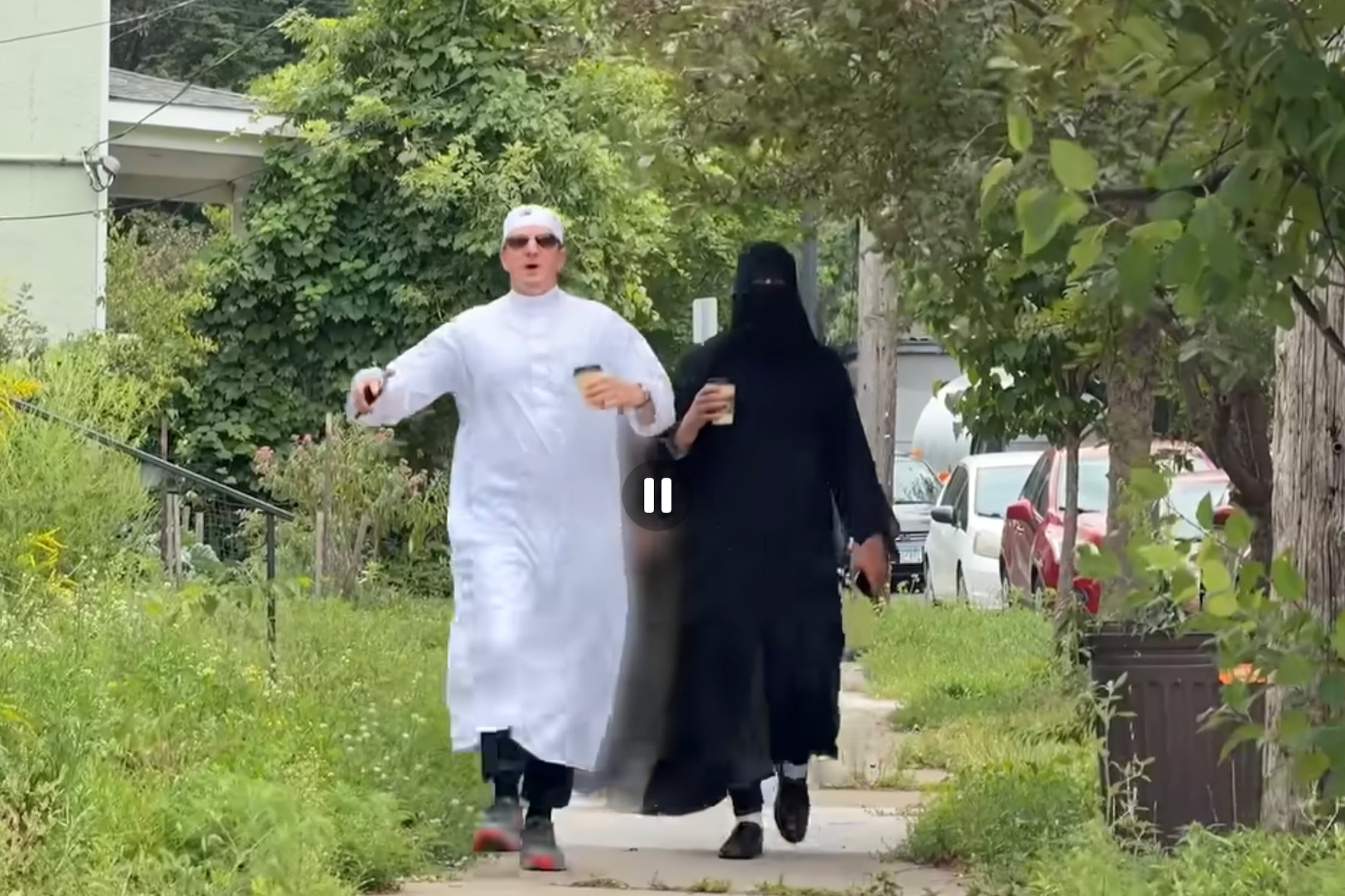
One of the men, Cam Higby, dressed as a conservative Muslim woman with his face hidden by a black veil and said he misrepresented himself as a registered voter to see if he could game the vouching system. Another, James O’Keefe, dressed in traditional Muslim clothing, appeared to impersonate at least two registered voters at different polling places, and said he wanted to vouch for prospective voters. Another activist, Anthony Rubin, walked into a polling place saying he wanted to vouch for several people he claimed were newly arrived Hamas members from the Gaza Strip.
None of the activists said they went so far as to try to cast a ballot in the election. But they did release a series of carefully edited videos suggesting that the Minnesota vouching system is so lax that it makes it possible for virtually anyone to vote in an American election, creating a furor on social media.
What is vouching and how does it work?
So, how does the Minnesota law work, and is it unusual? To use the system, the person doing the vouching has to be either a registered voter in the precinct or an employee of a residential facility — such as a nursing home — vouching for a resident of that facility. That person must sign a sworn statement saying that they know that the people they are vouching for live in the precinct. This can serve as proof of residency for eligible voters looking to register to vote on Election Day, in lieu of documentation such as a state ID or utility bill.
The person being vouched for doesn’t have to show a physical ID to verify their identity, but must still fill out the standard voter registration application, which requires them to affirm that they are a U.S. citizen and eligible to vote in Minnesota. It also asks them to provide a Minnesota driver’s license number, a state ID number, or the last four digits of their Social Security number. That information is checked later by elections officials to make sure it’s legit. Lying on a voter registration form is a felony carrying a penalty of up to five years in prison and $10,000 in fines.
In Minnesota’s 2024 general election, about 19,000 voters used the vouching system, about 0.6% of the 3.2 million people who cast ballots that year. Of that 19,000, the vast majority were already registered voters updating existing registrations on Election Day with information such as a new address. Around 5,500 people were voting for the first time.
Minnesota’s vouching law has become a prime target for conservative activists who say the process exposes the vulnerabilities of a system that doesn’t require voters to show an ID. A registered voter can vouch for up to eight people. Someone working in a nursing home can vouch for an unlimited number of residents.
“With tens of thousands of voters registering through vouching across recent cycles, without basic verification safeguards, the vouching policies and practices leave Minnesota’s elections vulnerable and risk Americans’ votes being canceled by fraudulently registered voters,” Will Scolinos, an attorney at conservative nonprofit America First Legal, said in May.
Minnesota Secretary of State Steve Simon has publicly defended the law. In a letter earlier this year to the U.S. Department of Justice, he pointed out that other states also allow some forms of vouching. For example, Alaska allows state voter identification requirements to be waived if the election official knows the identity of the voter, Iowa allows registered voters to vouch for someone from the same precinct without documentation on Election Day, and Arkansas permits staff members to vouch for residents of long-term or residential care facilities.
Simon denounced the activists’ Election Day operation as “outrageous and totally unacceptable.”
The videotaped incidents were reported by poll workers on Election Day and are under investigation by elections officials and local law enforcement, Simon said.
“The conduct was disturbing,” Simon told Votebeat. Simon said the law has long had bipartisan support in the state as a way to expand voter access, especially for elderly residents.
“This is America,” he added. “Do what you want. If you want to dress up as someone, look no further than Borat and Sacha Baron Cohen. But we have to draw the line.”
Could those people claiming to be newly arrived Hamas members from the Gaza Strip have voted?
To do so, the prospective voucher would have had to break several laws by impersonating a registered voter and signing an affidavit falsely claiming that the other people lived in the precinct. Then the fake Hamas members would have had to break the law by providing false information about their identity and their eligibility to vote in Minnesota.
It is unclear from the videos released by the activists if the poll workers detailed the other steps they would have to go through before they could vote. Anthony Rubin declined to comment or release the raw footage from the incidents. O’Keefe did not respond to a request for comment.
Higby said the group was trying to expose shortfalls in the state election system.
“The goal was never to vote, it was never to touch a ballot, it was never to obtain a ballot,” Higby told Votebeat. “It was simply to test the system and see if poll workers would be prepared to allow me to vote.”
But Simon said in his 11 years as Minnesota’s top elections official, he’d never seen a single case of someone trying to game the vouching system to illegally vote.
“Could someone scam the system?” he asked. “Anything is possible. But you have to look at what is probable.”
Simon said he’d also never before seen a case of someone impersonating a voter.
“There is no end to the creativity of people who are looking to do wrong,” he said. “You have to look at the track record and the incentive structure. There’s a high likelihood that someone is going to get caught.”
Dion Nissenbaum is Votebeat’s senior national reporter and is based in Houston. Contact Dion at dnissenbaum@votebeat.org.
This news analysis was originally distributed in Votebeat’s free weekly newsletter. Sign up to get future editions, including the latest reporting from Votebeat bureaus and curated news from other publications, delivered to your inbox every Saturday.