Votebeat is a nonprofit news organization reporting on voting access and election administration across the U.S.
This news analysis was originally distributed in Votebeat’s free weekly newsletter. Sign up to get future editions, including the latest reporting from Votebeat bureaus and curated news from other publications, delivered to your inbox every Saturday.
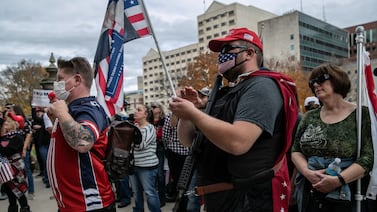
Sometimes it seems like the 2020 presidential election never ends.
Trying to prove that he actually won that race has been an animating feature of President Donald Trump’s second term, even though audits, investigations, and court cases have all found that he lost to former President Joe Biden.
Trump’s obsession has famously become a litmus test within the Republican Party. But a new analysis shared first with Votebeat suggests that, six years later, the issue may be losing some of its animating power for candidates.
States United Action, a nonpartisan nonprofit that supports state officials in protecting elections, examined the number of people running for statewide office or Congress who backed President Donald Trump’s false claim that the 2020 presidential election was stolen, refused to certify the legitimate results of that election, or attempted to overturn those results. The group categorizes those candidates as “election deniers.”
The group found that the number of such candidates fell by about 30% between 2022 and 2026, dropping from 285 to 197.
The candidates this year on the States United Action list includes contestants for governor in key swing states, attorneys general, U.S. senators, members of the House of Representatives, and, perhaps most importantly, secretaries of state. If they win, it would give them expanded control over the levers of electoral power for what is expected to be a contentious 2028 presidential election.
Right now, according to States United Action, 27 current statewide officeholders on their list have some oversight of elections. This November, 33 candidates for statewide office are on the ballot across the country.
If history is any guide, most of them are likely to lose. Since 2021, according to the group’s analysis, fewer than one in four of such candidates have won a statewide office.
“We know that election denial is a losing campaign strategy and that Americans are tired of hearing the same old lies,” said Joanna Lydgate, CEO of States United Action. But, she added, “the threat they pose to our elections and the rule of law is very real: The candidates who win in 2026 will run our elections in 2028 and serve as a check on Trump’s power in the meantime.”
Such candidates are on the ballot in almost all of the swing states expected to be pivotal to the 2028 presidential race, including Arizona, Nevada, and Wisconsin.
One of the most closely watched races is the one for Arizona secretary of state, where incumbent Democrat Adrian Fontes faces Alexander Kolodin, an attorney who helped bring unsuccessful lawsuits challenging Arizona’s 2020 election results and was later disciplined by the State Bar over election-related litigation.
Kolodin, who did not respond to a request for comment, rejects the “election denier” label. On the campaign trail, he has sought to highlight his work in the Arizona Legislature, noting that several of his election reform bills have passed with bipartisan support, though those largely came out of negotiations around must-pass pieces of legislation.
Meanwhile, Kolodin would not say at a recent debate whether Arizona’s elections were safe and secure.
The persistent attacks on America’s electoral system are starting to take a toll on voter confidence. Recent polls have shown shrinking confidence in the country’s elections. For example, a recent University of California, San Diego survey found that less than half Americans — just 49% — thought the November election would be free and fair.
Pew found less of a partisan gap than in the past, though cautioned that Democrats and Republicans have different reasons for their dwindling confidence.
Thad Kousser, a UC-San Diego political science professor, said that electing election skeptics to office doesn’t necessarily mean that they will throw a wrench into the process.
“The real question is not what people have said about past elections but whether the elections that they run are going to be rooted in reality, informed by the experts in their teams,” he said. “If people come into office and take an open and honest look, that’s going to be very different than if they came in with their mind made up, ignored the evidence and pushed for policies that are not rooted in reality.”
One recent case of that arose in South Dakota, where outgoing Secretary of State Monae Johnson entered office as a skeptic of the electoral office and is leaving as a defender of its integrity. Johnson, a Republican, is endorsing a Democrat to replace her in the fall election after feuding with her party over the issue.
Dion Nissenbaum is Votebeat’s senior national reporter and is based in Houston. Contact Dion at dnissenbaum@votebeat.org.