

Votebeat is a nonprofit news organization reporting on voting access and election administration across the U.S. Sign up for our free weekly newsletter to get the latest.
This coverage is made possible through a partnership between Flatwater Free Press, Nebraska’s first independent nonprofit newsroom focused on investigative and feature reporting, and Votebeat, a nonprofit news organization covering voting access and election administration across the U.S. Sign up for Votebeat’s free newsletters here.
A group that questioned the validity of Nebraska elections and promoted claims of voter fraud following President Donald Trump’s loss in 2020 may have helped stifle mail voting in one of the state’s most populous counties.
The Nebraska Voter Accuracy Project worked statewide, but it concentrated on Sarpy County. Volunteers from the group went door to door in the suburban Omaha county, quizzing residents about their voting histories and focusing on whether they voted by mail, which the group advocates against.
The efforts helped generate 52 complaints of voter fraud in the county. It sparked a county investigation costing about $88,000 that ultimately found no evidence of widespread fraud or criminal wrongdoing.
And that work also may have made Sarpy County residents less likely to vote by mail in the next two election cycles, voting data suggests.
For years, voters in Sarpy County had been more likely to cast their ballots by mail than voters statewide. But that pattern reversed after the 2020 election. While mail voting has remained popular across Nebraska, Sarpy County’s participation fell sharply, leaving it well below the statewide average. Early figures from this year’s midterm election, however, suggest mail voting may be making a comeback in the county.
The Nebraska Voter Accuracy Project’s leaders told the Flatwater Free Press they believe that the group’s efforts helped lead to the drop. There’s no direct evidence establishing that the group’s campaign caused Sarpy County voters to abandon mail voting.
But the timing of the decline, and the group’s concentrated efforts in the county, raise questions about whether its allegations influenced how residents chose to cast their ballots.
The executive director of Common Cause Nebraska, a transparency-in-government watchdog that advocates for voting rights, believes it’s plausible the group’s efforts could have depressed mail voting in Sarpy County.
“Nebraska elections, including vote by mail, have been shown to be safe and secure time and again,” said Common Cause’s Gavin Geis. “Anyone working to decrease the voice of Nebraska voters in any county should be ashamed of that work.”
The county’s investigation offered a glimpse of how election-fraud allegations were influencing some residents. Investigator William Black found that several complaints stemmed not from perceived wrongdoing in Sarpy County but from national television coverage and cable news commentators. More than one witness expressed the belief, “If it’s happening there, it’s happening here!”
Other factors may help explain Sarpy County’s decline in mail voting. During the pandemic in 2020, Sarpy mailed absentee-ballot applications to voters but did not continue the practice in 2022. Unlike Douglas County, Lancaster County and Hall County, Sarpy also does not maintain a continuing list of voters who receive absentee-ballot applications before each election as these other counties do.
The decline doesn’t surprise election expert Tammy Patrick, who said election officials across the country are seeing double-digit drops in requests for mail ballots this year.
“Where the noise is loud, incessant and pervasive, voters may change their voting behavior,” said Patrick, chief programs officer at the Elections Center run by the National Association of Election Officials. She said the Nebraska Voter Accuracy Project’s advocacy, rampant concerns about the U.S. Postal Service, and changing policy may all have influenced voters’ decisions. “The ongoing, unsupported narrative that voting by mail is not secure and fodder for rampant fraud has eroded some voters’ confidence.”
The shift in Sarpy County is stark.
In 2018, nearly a third of Sarpy voters cast votes by mail, far more than the quarter of Nebraska voters doing so statewide. Sarpy voters cast ballots by mail more consistently than the state overall from 2014 to 2020, data from the U.S. Election Commission’s Election Administration and Voting Survey shows.
But that pattern reversed sharply after 2020, during which time the Nebraska Voter Project concentrated its efforts in Sarpy County.
By 2022, just 24% of Sarpy County voters cast ballots by mail, compared with 35% statewide.
In 2024: 25% of Sarpy voters cast mail ballots, compared with nearly 32% statewide.
“That decline is consistent with voters and officials responding to documented gaps in identity verification, roll integrity, and ballot supervision,” Nebraska Voter Accuracy Project manager Connie Reinke said in an email.
A campaign to question Sarpy County’s elections
Nebraska has long been something of an outlier among Republican states when it comes to voting by mail. For decades, voters have been able to request a ballot without providing an excuse, and some rural counties conduct their elections entirely by mail. Even as Republicans elsewhere have moved to restrict the practice, mail voting has remained a popular option across the Cornhusker State.
But the Nebraska Voter Accuracy Project moved swiftly to question that system after the 2020 election, going door to door in Sarpy County, the state’s third-most populous county where more than one in 10 Nebraskans live.
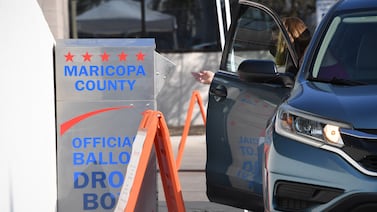
By February 2022, the group was bringing its allegations to state lawmakers. At a legislative hearing, project leaders Reinke and Larry Ortega alleged discrepancies in voter records and raised concerns about people depositing multiple ballots in drop boxes. Election officials, including Republicans, disputed the group’s claims.
“What’s wrong with that?” asked state Sen. Megan Hunt, a left-leaning registered independent, pointing out that Nebraska law allows voters to return ballots on behalf of others, including elderly relatives.
Spurred by the group’s allegations, Sarpy County investigators conducted a monthslong investigation, reviewing 52 complaints and interviewing 54 people. They found no substantiated voter fraud or criminal wrongdoing, although they identified some administrative errors.
The investigation’s findings did not end the group’s campaign. At a February 2023 legislative hearing, Reinke warned that the stakes went far beyond partisan politics: “This isn’t about Democrat or Republican. This is about freedom versus enslavement to these machines.”
The campaign extended across Nebraska. By June 2024, a Flatwater Free Press investigation found that the group had delivered nearly three dozen presentations statewide and maintained two Telegram groups with approximately 800 members, promoting unsupported claims that election results were being manipulated. As recently as 2025, Reinke was telling lawmakers that “fake mail-in ballots” were being delivered to election offices, without presenting substantiated evidence.
But Sarpy County remained a particular target. Ortega lives in Bellevue, a suburban city in the eastern part of Sarpy County, and the sheer volume of complaints generated there suggests a concentrated effort that may help explain the county’s sharper decline in mail voting.
If Ortega’s group has been actively pushing concerns about Sarpy County’s election integrity this year, county Election Commissioner David Jones said he hasn’t heard it. Jones was appointed last year to the post by Republican Gov. Jim Pillen.
Asked whether the group’s efforts led to a drop in mail voting in his county, Jones said he wouldn’t offer an opinion, but stressed that the group’s complaints produced no evidence of voter fraud. Early voting overall, which includes early in-person voting, has remained steady, he said, and is on track to increase this year from the total of about 16,000 early ballots cast in 2022.
“It’s very robust,” Jones said of early voting this year with only days to go before the Nov. 3 election. “I’m predicting we’ll be at 19- to 20,000 early ballots.”

Republicans send mixed messages as mail voting shows signs of a rebound
Despite years of allegations about the security of mail voting, there are early signs that the practice may be regaining ground in Sarpy County.
In 2022, the county had received about 9,330 mail ballot requests for the general election, Jones said. This year, it received around 13,300 requests for mail ballots by the Oct. 23 deadline — a spike of roughly 43%. It remains to be seen how many voters will actually cast their ballots by mail.
The increase comes as local Republicans send conflicting messages about the practice. Sarpy-area Republican state Sen. Rick Holdcroft introduced legislation in 2023 and again last year that would have required voters to provide an excuse to vote absentee, outlawed voter registration online and by mail, and compelled ballots to be counted by hand. Holdcroft said the changes were intended to strengthen confidence in election security.
Meanwhile, the Sarpy County Republican Party has been encouraging mail voting on its website, urging Republicans to “bank your vote” by requesting absentee ballots.
“The method in how you choose to cast your ballot does not matter,” the GOP website says. “What matters is you cast your ballot and you vote RED!”
Email and phone messages left by the Flatwater Free Press for Sarpy County GOP Chairman Michael Tiedeman and Linda Vermooten, the local party’s vice chair, were not returned.
Sarpy County Attorney Lee Polikov, whose office conducted the 2023 fraud investigation, said his investigator took six months to look into each allegation thoroughly and found that “there wasn’t anybody messing with the electronics or anything like that.”
“I think that was important to give confidence to the public that machine counting is valid,” Polikov, a Republican, said. “You can corrupt a machine electronically, but I think you can corrupt hand counters better.”
Jones said he’s highly confident in the mail voting process, including signature verification on the envelopes of mailed ballots, envelope barcodes that ensure against counting duplicate ballots if duplicates were to be submitted, and the oversight of ballot handling by those from both major political parties.
“All that to say, are there forces working against us? Misinformation, disinformation? Sure,” Jones said. “But what we expect is excellence, which I’ve seen from my folks. When you have excellence as a standard and you have policies and procedures and you follow those, that catches errors. That catches mistakes.”
Margery Beck is a reporter for Flatwater Free Press in partnership with Votebeat. Contact Margery at mbeck@flatwaterfreepress.org