Votebeat is a nonprofit news organization reporting on voting access and election administration across the U.S. Sign up for Votebeat Arizona’s free newsletter here.
As they cast their midterm ballots in hotly contested races for governor, Congress, and more, Arizona voters are also weighing in on a measure that, depending on who you ask, would either speed up ballot counting or cripple mail voting in Arizona.
Prop. 144, which state lawmakers referred to the ballot in an eleventh-hour vote earlier this year, would significantly alter voting in the state. If passed, it would amend the state constitution to make various changes to voting procedures — most notably requiring all voters, even those who vote by mail, to provide ID.
The measure has quickly become one of the most controversial ones voters will decide on Election Day — and the latest proxy for a yearslong dispute between those who trust the integrity of the state’s elections and those who have cast doubt on it.
Its proponents say it would introduce new safeguards against voter fraud, close a loophole in the state’s campaign finance law by barring foreign nationals from contributing to ballot measure contests, and hasten election results by requiring counties to allow voters to get their ballots counted at polling sites.
One of those proponents is Republican Alex Kolodin, a state legislator who sponsored the measure and is currently running for secretary of state. In a Sept. 30 debate, he described the proposal — also known as the Fast, Accurate, Secure, Transparent Election Results Act — as ensuring that the state has “election results on election night.”
But the measure has drawn criticism from Democrats and some Republicans who say that’s an unrealistic promise, pointing out that many of the state’s recent elections have simply been too close to call on election night.
Instead, they claim the measure is meant to hurt mail voting, which is wildly popular among Arizonans. At an Oct. 1 debate, Tempe City Councilman Randy Keating, who is leading an effort against the measure, called it “a clever attempt to trick us into surrendering or voting away one of our most fundamental rights.”
What does Prop. 144 do?
State law already mandates that voters casting ballots in person show photo ID or two non-photo documents bearing their name and address, such as a utility bill.
However, the vast majority of the state’s voters cast ballots by mail. Currently, state law does not require these voters to provide ID, although they still must do so when registering to vote and sign their ballot envelopes when voting. Those signatures are then compared against their signatures on file to safeguard against voter fraud.
Under Prop. 144, mail voters would also be required to provide ID — specifically, “valid government-issued proof of identity.”
It’s unclear exactly how that might work. The measure doesn’t prescribe how mail voters might show that ID. It also doesn’t address whether tribal IDs or other nonstandard forms of identification would be considered valid proof of identity.
Proponents have suggested state lawmakers could iron out the details next year if voters approve the measure. Greg Blackie of the Arizona Free Enterprise Club, a conservative group backing the proposal, suggested that one solution could be to require voters to provide their driver’s license number on their ballot envelope. He added at last month’s debate that he believed state lawmakers would “give a menu of options to voters.”
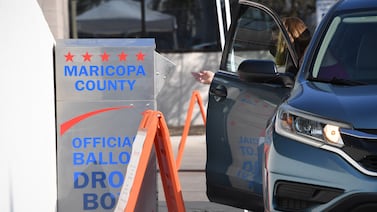
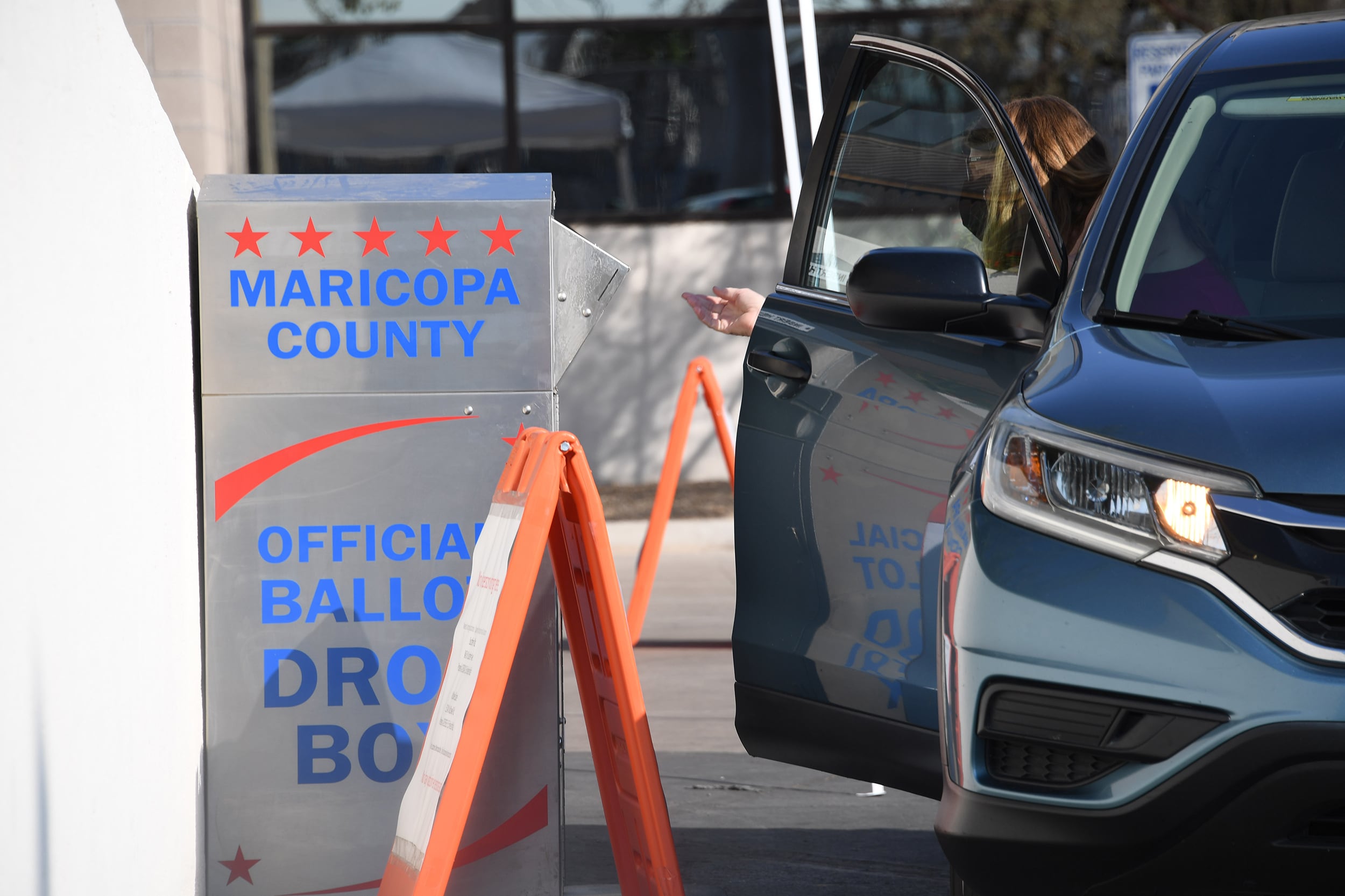
Prop. 144 would also require counties to give voters who drop off their mail ballots at a polling place on Election Day the option to have their ballot counted on site, rather than transported back to a central location for tabulation. Supporters argue that could speed up the reporting of election results without inconveniencing voters.
A similar law, passed in 2024, just took effect this year. That law gives mail voters the option to show ID when dropping off their ballot, eliminating the need to check their signature later. The option proved popular in the state’s major metro areas during the primary.
But unlike Prop. 144, that law does not require counties to physically count those ballots at voting sites. Most counties currently transport all ballots back to a central election office after voting ends to tabulate them.
The proposition would also prohibit noncitizens from contributing money to influence ballot measure contests and prohibit any candidates from knowingly accepting such contributions. It’s already illegal for foreign nationals to contribute to candidates, but courts have said the federal law that bars that doesn’t apply to ballot measures.
Additionally, the measure contains a provision asserting that the state’s elections “shall be decided solely by the votes of eligible citizen voters” — even though state and federal law already specify that only U.S. citizens are eligible to register to vote. Blackie noted that while voting is restricted to citizens in state statute, it isn’t explicitly mentioned in the state constitution.
If voters approve the measure, it would take effect in 2028.
‘It’s a trap’: Why Prop. 144’s opponents are concerned
Some allege that Prop. 144 is intended to harm mail voting.
That includes Republican Gina Swoboda, who ran against Kolodin for the GOP nomination for secretary of state. She said in an interview with KTAR earlier this year that an attorney for Democratic Gov. Katie Hobbs told Kolodin in a private meeting that the measure “looks like a bullet in the head to AEVL,” referencing the state’s list of voters who automatically receive mail ballots every election.
“He laughed in her face and said, ‘That’s because it is,’” Swoboda said. “He wants to kill it.”
Kolodin has repeatedly denied that the measure is intended as an attack on mail voting.
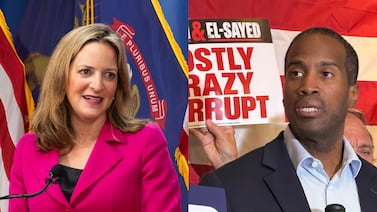
But that’s not the only concern around the proposal. Some worry that the measure’s broad language could have other consequences, giving the legislature wide leeway over election laws independent of the governor and judiciary. Democratic Secretary of State Adrian Fontes, who is running for reelection against Kolodin, described it to Votebeat as “a sneaky lawyer trick.”
Speaking at a Sept. 22 conference hosted by Arizona State University’s Mechanics of Democracy Laboratory, Tom Collins, a former assistant attorney general and executive director of the Arizona Citizens’ Clean Elections Commission, said that Prop. 144 could be interpreted as allowing the legislature to make election law without the governor’s approval. The ballot measure also suggests that state courts should use a lower standard of review to evaluate future election laws’ burden on voters, making it harder to overturn laws that could prevent people from voting.
Opponents are also concerned about the fact that Prop. 144 is an amendment to the state constitution. If voters pass it, changes could be extremely difficult to undo or walk back.
As such, signs against the measure loudly proclaim: “It’s a trap!”
“Prop. 144 forces us to approve a mandate, a constitutional amendment, and then it empowers politicians to make the rules later,” Keating said. He is behind the signs, which reference Admiral Gial Ackbar’s line in “Star Wars: Episode VI —Return of the Jedi.” “Ultimately, this is just another distraction, another culture war fight, designed to divide Arizonans.”
How do election administrators feel about the proposal?
Emails obtained by Votebeat show that the vast majority of the state’s recorders, who manage voter registration and mail voting, were strongly opposed to the measure as it began to move forward at the state capitol in the spring.
Initial drafts of the proposal would’ve posed massive financial and logistical challenges to counties. At the time, the measure would have taken effect immediately after passage, giving counties little to no time to adjust.
The version of the measure that ultimately passed included a delayed effective date and a provision requiring the state to fund new equipment and other costs associated with its implementation.
But records indicate officials’ concerns went far beyond the measure’s timing and costs. For instance, Jen Marson, executive director of the Arizona Association of Counties, wrote in an April 1 email to election officials across the state that she was worried the measure’s broad language could open up the possibility of hand-counting ballots.
In a reply, Maricopa County Recorder Justin Heap, a former GOP state lawmaker who maintains close ties with Prop. 144’s supporters, accused Marson of voicing “supposition and hypotheticals.”
But officials in other parts of the state quickly chimed in to defend her, saying they were also worried about that possible reading of the measure — even if it wasn’t lawmakers’ goal. Yavapai County Recorder Michelle Burchill, a Republican, said she had also assumed that the proposal was “vague enough to open up hand counting.” GOP Recorder Dana Lewis of Pinal County said she agreed with Burchill. And Pima County Recorder Gabriella Cázares-Kelly, a Democrat, chastised Heap for his response.
“Are you an election administrator or are you a legislator?” she asked Heap in a message. “There are 60+ election administrators on this thread and not a single person has said they can make it work.”
Officials also cast doubt on whether the measure would actually speed up results. Some recorders were particularly dismayed when legislators amended the proposal to remove a provision that would’ve created a new deadline for voters to drop off their ballots at polling sites ahead of Election Day, replacing it with a requirement that counties offer voters the option to have their mail ballot counted at the polls.
“The tabulation ‘delay’ wouldn’t change or improve with the extremely expensive cost
that’s proposed,” wrote Mohave County Recorder Lydia Henry, a Republican.
Marson told Votebeat that county recorders remained opposed when legislators voted to refer Prop. 144 to the ballot.
Sasha Hupka is a reporter for Votebeat based in Arizona. Contact Sasha at shupka@votebeat.org.