Votebeat is a nonprofit news organization reporting on voting access and election administration across the U.S. Sign up for Votebeat Arizona’s free newsletter here.
Arizonans will soon weigh in on the future of the state’s elections — and once again, they face a choice between a defender or a skeptic.
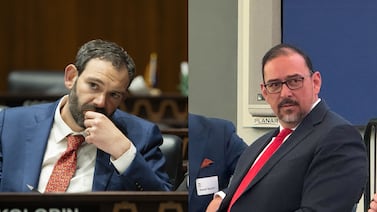
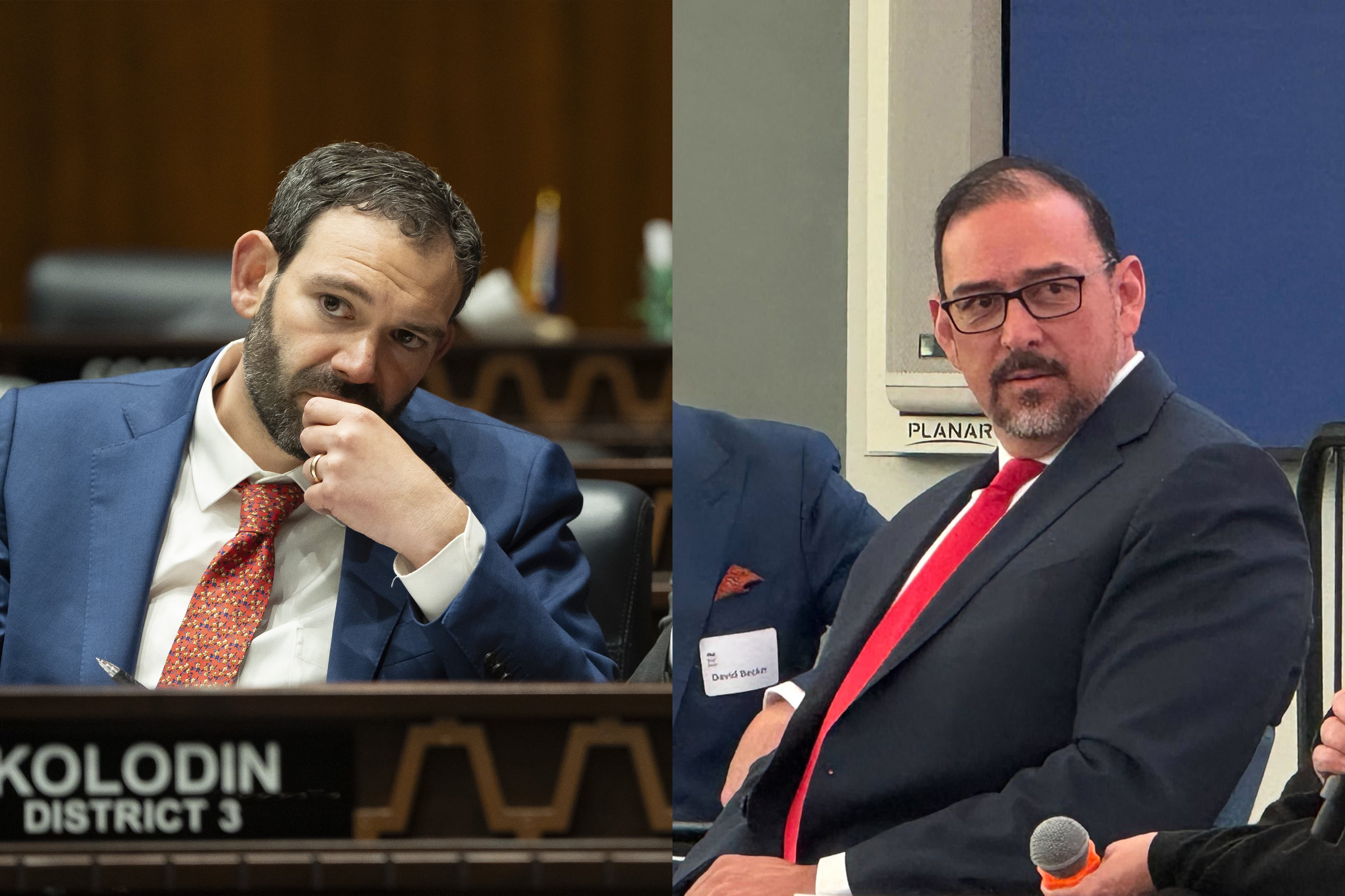
Democrat Adrian Fontes, a lawyer and former county recorder who has spent years championing the state’s voting system, is seeking a second term as secretary of state in this November’s election. But Republican Alex Kolodin, an attorney and state lawmaker who previously brought a lawsuit that falsely alleged the 2020 election was stolen from President Donald Trump, is also vying for the office.
The race is just the latest manifestation of a yearslong struggle between those who trust the integrity of Arizona elections and those who have cast doubt on it, dating back to conspiracy theories about the 2020 election. The winner of this round will oversee the high-stakes 2028 presidential race in the key swing state.
Fontes and Kolodin have run fiery and, at times, ugly campaigns. Both have repeatedly accused each other of lying. Fontes opened a recent debate by announcing his campaign staff had launched a website to fact-check Kolodin throughout the evening. Later, Kolodin repeatedly referred to Fontes as an attorney for the Sinaloa Cartel, a reference to Fontes’ previous work as a federal public defender.
But their disdain for each other — and willingness to voice it — is about where their similarities end. Here’s what to know about the candidates and how they would shape the state’s elections.
The secretary of state matchup has its roots in the 2020 election
Fontes stepped into his position as secretary of state after one term as a top election official in Maricopa County, the state’s most populous voting jurisdiction. There, in his then-little-known position, he presided over the 2020 election — and was unexpectedly launched into the white-hot political spotlight amid efforts by Trump and his allies to overturn the results of that year’s presidential contest.
Kolodin was one of those allies. Now, he’s a member of the Arizona House, where he’s part of the body’s far-right Freedom Caucus. In the legislature, he has supported bills to ban vote centers, shorten the early voting period, and require voters to recertify their address each election cycle to vote by mail.
He also led the charge to put a measure on the November ballot that would require mail voters to provide ID, among other changes to state election law. That proposal has drawn alarm from Democrats and some Republicans who allege it would cripple the state’s culture of mail voting — a claim that Kolodin denies.
Kolodin, who did not agree to an interview for this story, has repeatedly said on the campaign trail that voters don’t trust elections. In his contested primary race, he heavily criticized election officials and has described the state’s existing election systems as dysfunctional.
But he rejects the “election denier” label — and more recently, he has sought to moderate his image. On the campaign trail, he has noted that several of his election reform bills have passed with bipartisan support, though those largely came out of negotiations around must-pass pieces of legislation. He also has pledged faster election results and dodged questions from journalists on whether he is confident in the results of past elections. And he has attacked Fontes, describing him as overreaching the authority of his office.
“Adrian Fontes doesn’t know how to follow the law,” Kolodin said during a televised debate on Sept. 30.
But Fontes, who is now fighting efforts by Trump to exercise more federal control over elections, has cast Kolodin as a danger to voting rights in Arizona. He also described his opponent as a crisis maker and a “bona fide, found-guilty-of-lying liar” in a recent interview with Votebeat, a reference to the Arizona State Bar’s admonishment of Kolodin for making evidence-free claims of massive voting fraud in cases he brought after the 2020 election.
“It appears as though he despises all institutions and despises all ways that we organize as people,” Fontes said of Kolodin, adding that his opponent had a “let’s just tear it all down” mentality. “That distance from reality is dangerous.”
In response, Kolodin told Votebeat that Fontes was “lying to voters because he doesn’t respect them.” He referenced a handful of recent instances in which the courts ordered Fontes to rewrite ballot measure language and an incident in which Maricopa County Recorder Justin Heap, a Republican, accused Fontes of withholding lists of federal felons who aren’t allowed on the county’s voter roll. Fontes’ office said that the holdup was the fault of the U.S. Department of Justice, which wasn’t giving it the information in a usable format.
“His eagerness to look voters in the face and lie is quite frankly disgusting,” Kolodin said. “Let me be crystal clear: I will never lie to the people of Arizona and I will deliver the most transparent secretary of state’s office in the history of Arizona.”
Nuts and bolts: How Fontes and Kolodin would run Arizona’s elections
In Arizona, local officials are in charge of most day-to-day election and voter registration operations in their counties.
But whoever wins the secretary of state post will play a critical role in issuing voluntary guidance to election offices and dictating how voting must be run via the state’s Elections Procedures Manual. They’ll also oversee the state’s voter registration system — called the Arizona Voter Information Database, or AVID — and enjoy a big bully pulpit to suggest election-related changes.
If elected to a second term, Fontes said he would fight for money to build and implement a new statewide voter registration database. The state’s contract for AVID, he said, is at the end of its life and the system itself is unwieldy. He said the state needs a system that will allow officials to “more easily make adjustments” as state law shifts.
Fontes also hopes to get funding to increase salaries for employees in his office, which he said trail other state agencies and are “kind of embarrassing.”
And he intends to again push for the Voters First Act, a series of election changes supported by legislative Democrats. The legislation would require all counties to use vote centers and count early ballots accidentally returned to the wrong jurisdiction, create a new election IT and cybersecurity fund, allow state and county officials to accept privately funded grants supporting elections, and more.
Meanwhile, Kolodin has taken aim at Fontes’ revisions to the Election Procedures Manual, which is reissued every two years and has the force of law in Arizona. At a debate last month, he noted that several of Fontes’ changes to the manual were ultimately struck down in court, including a provision that would have allowed state officials to refuse to include a county’s vote in statewide totals if it failed to certify results on time and a ban on offensive speech at polling places.
But Fontes defended putting those rules into the manual while speaking with reporters after that debate.
“Other courts disagreed on that policy analysis that I had, and that’s it,” he said.
At the capitol, Kolodin previously supported legislation to force a statewide return to precinct-style voting, in which voters are assigned to a polling place instead of casting ballots at any vote center in their counties. He has also sponsored bills to require voters to confirm their address each election cycle to vote by mail and prohibit the state attorney general from prosecuting county supervisors who vote against certifying elections — a response to Democratic Attorney General Kris Mayes, who charged two supervisors in Cochise County with election interference for delaying the canvass of its election results in 2022.
Then, there’s his ballot measure. Kolodin said his Prop. 144 will hasten election results by requiring counties to allow voters to have their ballots counted at polling sites.
“We’re going to have election results on election night,” Kolodin said during a debate last month. “That’s what I’m going to deliver for Arizona voters.”
Fontes has said that’s an unrealistic promise, pointing to the state’s razor-thin race margins in recent election cycles. He and others are also concerned that the measure’s broad language could unintentionally give the legislature wide leeway over election laws, independent of the governor and judiciary.
Where Fontes and Kolodin stand on working with the Trump administration
The secretary of state race is unfolding as the Trump administration attempts to exert unprecedented influence on elections across the nation, including in Arizona. Whoever wins will decide how far to let the federal government step into the state’s processes.
Fontes has resisted the federal government’s efforts to scrutinize Arizona’s voting process, such as by refusing to hand over the state’s voter roll to the Department of Justice. He’s also used his bully pulpit, joining other secretaries of state across the country to publicly oppose an executive order from Trump that sought to impose new restrictions on mail ballots.
Fontes said Trump is “going to continue to try” to intervene in election administration.
“A lot of these proposed rules and executive orders and things like this, we still have to fight against,” Fontes said. “So that role will continue, and we will continue to be as robust in our battles as possible.”
In the meantime, he’s also sought to keep county elected officials in check. Fontes and Mayes sent all 15 of the state’s voting jurisdictions a letter earlier this year warning them against handing their full voter rolls to the feds as they probed the 2020 election in Arizona.
“I think my presence in this office is a moderating factor to some of the radical politicians,” Fontes said, adding that “there’s not a ton of them, but there’s a few of them.”
Kolodin said in radio interviews earlier this year that the Trump administration’s request for Arizona’s unredacted voter rolls was “common sense,” and that he would require county recorders to run their full voter lists through a federal data tool known as Systematic Alien Verification for Entitlements, or SAVE, to check for noncitizens.
“I don’t know why anybody would want to be delaying making sure that we only have U.S. citizens on our voter rolls,” Kolodin said at the time. “That makes no sense to me.”
But at last month’s debate, he changed his tune. Kolodin said wouldn’t simply hand voter information to the feds. Rather, he proposed licensing the SAVE tool so voter information stayed “in-house, here in the great state of Arizona.”
“I understand the system isn’t perfect,” Kolodin said. “You need second checks and balances. But the secretary of state’s responsibility is to make sure that we only have lawful American citizens on the voter rolls.”
After red-meat primary, Kolodin makes his pitch to independent voters
The secretary of state’s race, like most in swing-state Arizona, looks like it will be a competitive one. For now, observers consider Fontes the slight favorite because of Kolodin’s farther-right image and the national political winds favoring Democrats.
Kolodin won the Republican primary 60% to 40% by running to the right of his opponent, former Arizona GOP Chair Gina Swoboda. But since then, he appears to be attempting to moderate his image. In a primary election night statement, he said his campaign was about “protecting every vote, regardless of party.”
“Tonight, Arizona voters spoke up decisively for lawful, transparent, honest, and fair elections,” Kolodin said, adding that he aimed to run “world-class elections that Democrats, Republicans, and Independents alike can be proud of.”
Later, he updated his social media presence. On X, the platform formerly known as Twitter, his pre-primary profile description highlighted his affiliation with the Freedom Caucus. His profile picture was a simple headshot, and his banner featured an abbreviated version of a quote by former U.S. Sen. Barry Goldwater: “Extremism in the defense of liberty is no vice. Moderation in the pursuit of justice is no virtue.”
That changed in the post-primary period. Kolodin’s new profile description touts him as a “civil rights attorney specializing in Arizona election law.” His profile picture is a professional photo of him and his family, and his banner now advertises his campaign.
Fontes said he and his team had long expected Kolodin to shift gears while attempting to woo general election voters — but he doesn’t expect Kolodin will be successful.
“The only difference between him and the last one is that he’s not wearing a goofy cowboy hat,” Fontes said, referring to his 2022 opponent, Republican Mark Finchem, who was known for his belief that the 2020 election was stolen.
Sasha Hupka is a reporter for Votebeat based in Arizona. Contact Sasha at shupka@votebeat.org.