Votebeat is a nonprofit news organization reporting on voting access and election administration across the U.S. Sign up for Votebeat Pennsylvania’s free newsletter here.
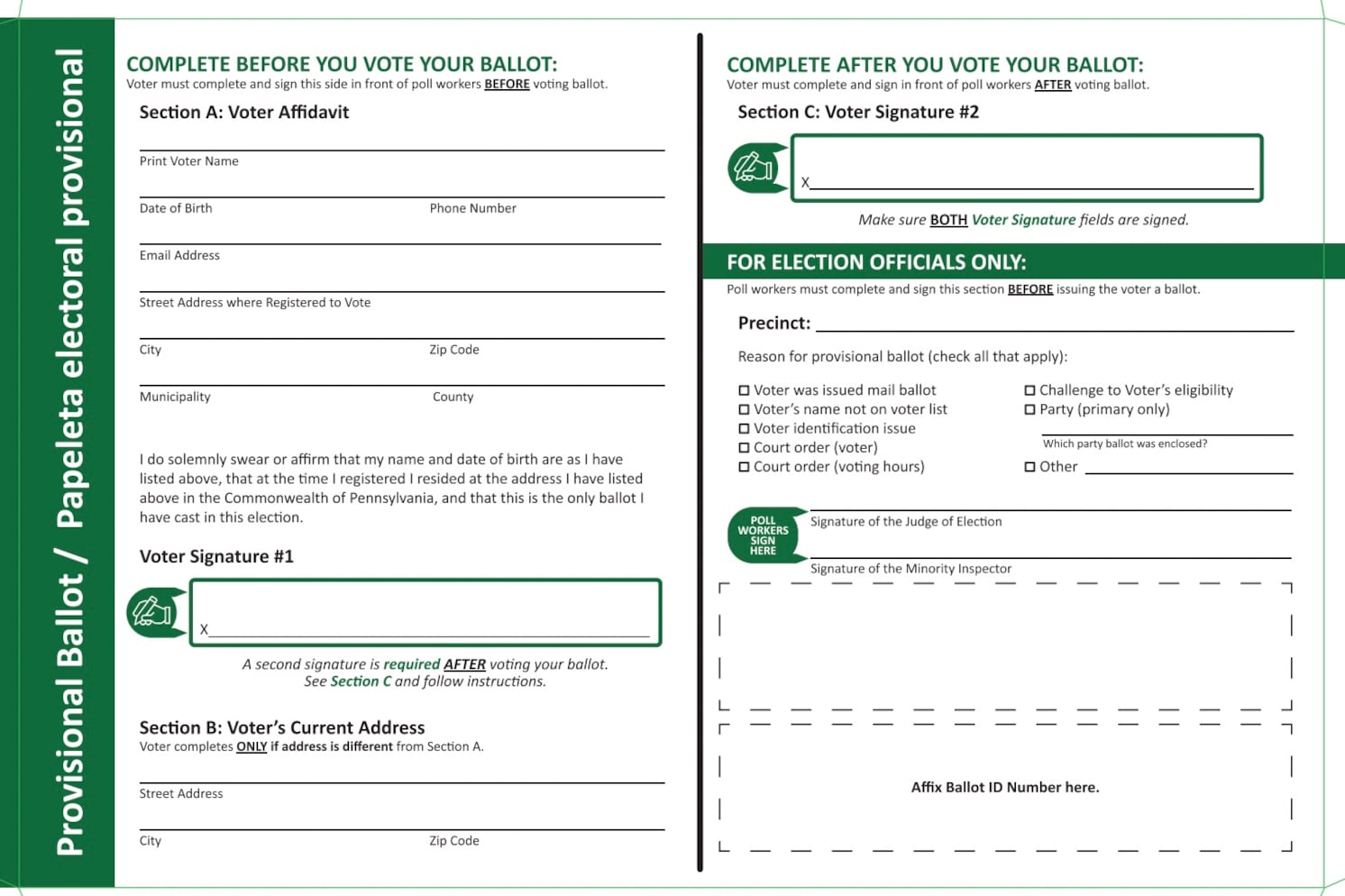
The Pennsylvania Department of State rolled out a redesigned envelope for provisional ballots earlier this year, and it appears to have helped reduce the number of ballots rejected for errors.
The use of provisional ballots, a special type of ballot used when there are questions about a voter’s eligibility, has been on the rise in recent elections, as has the number of ballots rejected because of issues with the outer envelope, known as the affidavit envelope. The redesign was intended to help reduce those rejections.
Data from the Department of State on the number of rejected provisional ballots in the 2025 municipal election suggests that the redesign accomplished its goal. Still, at least one election director questioned whether the state’s limited system for coding issues meant the data could actually be used to come to a firm conclusion.
Fifty-eight counties opted to use the new envelope, and nine didn’t. In the counties that used the new envelope, only 2.9% of provisional ballots were rejected for incomplete envelopes, down from 3.7% in those counties in the 2023 municipal election and 4.2% in the 2021 municipal election. Counties that did not use the new envelope had a 1.8% provisional ballot rejection rate for incomplete envelopes in 2025, but that was little changed from their already low rejection rate of 1.9% in 2023 and 1.8% in 2021.
The Department of State used a different method of analysis but reached the same overall conclusion.
“Our goal remains ensuring every registered voter in our Commonwealth can cast their vote and have it counted in every election,” Al Schmidt, Secretary of the Commonwealth, said. “As with the changes to mail ballot materials two years ago, these improvements resulted in more registered voters being able to make their voices heard in November’s election.”
Provisional ballots are meant as a fail-safe for voters at the polls, a way for them to cast a ballot if they think they are entitled to, and a way for election officials to keep that ballot separate from those of unchallenged voters. There are several reasons why a voter might need to use a provisional ballot. A first-time in-person voter who lacks identification, or a voter who isn’t registered when they think they are, may have to cast a provisional ballot. Absentee and mail voters who lose their ballots and show up to vote in person also must vote a provisional ballot.
Each provisional ballot is placed in a separate envelope, giving election officials a chance to verify that the ballot should be counted before it is added to the tally. But they can also be rejected for technical reasons, such as the voter not signing the affidavit on the envelope or the ballot lacking an inner secrecy envelope.
Since Pennsylvania introduced no-excuse mail voting in 2020, more and more voters have had to cast provisional ballots. A total of 26,468 provisional ballots were cast in the 2016 presidential election, according to data tracked by the Pennsylvania Department of State. In the 2024 election, that number was nearly four times as large at 98,032.
As that number increased, a greater share of those ballots were also being rejected for technical errors on the affidavit envelope. Pennsylvania election officials said this was likely due to a combination of factors, including inadequate poll worker training and voters’ unfamiliarity with a process that was once rarely used.
In the 2024 general election, 4.9% of provisional ballots, or 4,820, were rejected for affidavit envelope errors, up from 0.9% in 2016.
After Pennsylvania introduced redesigned mail ballot return envelopes in 2024, leading to fewer rejected mail ballots, the Pennsylvania Department of State, in consultation with county election officials, announced in July 2025 that they had developed a new design for provisional ballot envelopes. Although the design was optional for counties to adopt, most did.
The new design makes it clearer where voters must sign the envelope, one of the most common reasons for envelope-related rejections. It more clearly delineates which section is to be filled out by the voter or poll workers, and it provides clearer instructions on when to fill out each section.
Nine counties decided not to adopt the new design. One was Lycoming County.
The elections director there, Forrest Lehman, said the state offered only a “paltry” sum to replace his stock of envelopes, an added expense he didn’t feel was justified. Lehman felt better poll worker training could also help lower the rejection rate, and Lycoming County already had a low rate of provisional ballot rejections for envelope errors.
He also said he is skeptical of the data the state, and Votebeat and Spotlight PA, are using to evaluate the envelope change. The state’s ballot management software, SURE, has a limited number of codes that can be used to indicate why a provisional ballot was rejected. For instance, there is no “missing identification” or “missing secrecy envelope” code, so counties often use the “incomplete provisional ballot affidavit envelope” code for these issues, even though they aren’t related to the affidavit envelope.
“The amount of noise in the data, I don’t think you’re likely to see any signal,” he said.
The data said Lycoming rejected two provisional ballots this year for affidavit envelope issues, but Lehman said those rejections had nothing to do with the envelope. He said election directors have raised this issue with the state in the past but received no response.
Asked whether it is or would consider expanding the rejection codes, a spokesperson for the department said it is “constantly evaluating ways to improve the administration of elections.”
Carter Walker is a reporter for Votebeat in partnership with Spotlight PA. Contact Carter at cwalker@votebeat.org.