Votebeat is a nonprofit news organization reporting on voting access and election administration across the U.S. Sign up for Votebeat Arizona’s free newsletter here.
Update, Feb. 9: Gov. Katie Hobbs signed the bill into law on Feb. 5, permanently moving Arizona’s primary date.
Update, Feb. 5: The Arizona Senate has passed this legislative proposal, sending it to Gov. Katie Hobbs. A spokesperson for her office declined to comment on whether she intends to sign the bill.
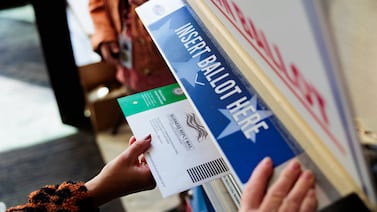
Arizona will permanently move up its state primary election date under a new law that will also give voters more time to fix signature problems on early ballots and codify where party observers may watch election activity.
The Arizona House voted unanimously on Feb. 2 to pass the legislation, which will move the primary from the first Tuesday in August to the second-to-last Tuesday in July. That will ensure that election officials can meet federally mandated deadlines to send out general election ballots to military and overseas voters, even if a statewide recount delays the finalization of the primary results.
The legislation passed the Arizona Senate with a similarly bipartisan vote on Thursday, and was signed by Democratic Gov. Katie Hobbs on Friday. The 2026 primary election date will now move from Aug. 4 to July 21.
This is the second time in recent years that lawmakers have sought to adjust the state’s election timeline on short notice. Arizona faced similar timing challenges in 2024, and after months of fraught negotiations, the state moved that year’s primary election ahead by a week. It also made a number of smaller, temporary changes, such as compressing the period for voters to fix missing and mismatched signatures on early ballots, a process known as ballot curing.
The new law required similar behind-the-scenes dealmaking to gain bipartisan support. Both chambers of the Arizona Legislature are controlled by Republicans, but a two-thirds vote is required to ensure that legislation will take effect immediately if passed. Without this emergency authorization, the law wouldn’t have taken effect until 90 days after the legislative session ends, which will likely be after the primary has already taken place.
The proposal also had to make it past Hobbs, who has set records throughout her first term with her extensive use of the veto pen.
The legislation passed the House after its sponsor — Republican Rep. Alexander Kolodin — offered a floor amendment that would reextend the ballot curing period.
Under the law passed in 2024, voters have five calendar days to cure early ballots. The legislation would change that to five business days starting in 2027. Because Arizona generally holds its elections on Tuesdays, that effectively moves the curing deadline from the Sunday after the election to the Tuesday after the election.
That change got voting access advocates on board. Alex Gulotta, state director for All Voting is Local, told Votebeat that the amendment represented a “significant victory for voters by making sure that the votes of all eligible voters are counted.” His organization had previously opposed the legislation.
Meanwhile, Kolodin framed the changes to observer access as a win for the GOP’s voting integrity efforts. He said the bill “strengthens security by making clear that counties must allow political party observers at every voting location.” Most counties in the state already did so.
The legislation’s changes may not hold for long. Jen Marson, executive director of the Arizona Association of Counties, said the bill permanently addresses timing challenges in non-presidential election years. But it won’t fully fix the issue in 2028, when recounts could still push general election results so late that election officials wouldn’t meet the federal deadline for sending presidential results to the U.S. Congress.
That means state lawmakers will have to address the problem in coming years — for a third time.
“We will have to revisit the cure window conversation,” said Marson, who was one of the chief negotiators on the legislation. “I would prefer to do it in 2027 so the calendar is set and we don’t have this anxious conversation in the year of the election.”
Sasha Hupka is a reporter for Votebeat based in Arizona. Contact Sasha at shupka@votebeat.org.