Votebeat is a nonprofit news organization reporting on voting access and election administration across the U.S. Sign up for our free weekly newsletter to get the latest.
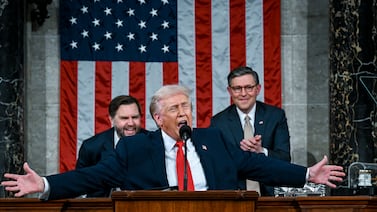
A federal judge on Friday became the third one to block key provisions of President Donald Trump’s executive order aimed at revising election rules nationwide, ruling that the Constitution gives states and Congress —not the president— the authority to exercise power over elections.
The administration signaled it is likely to appeal the decision, the latest blow to Trump’s agenda on elections.
His March executive order sought to require proof of citizenship on the federal voter registration form, mostly ban the use of machine-readable codes when tallying ballots, and prohibit the counting of ballots postmarked Election Day but received afterwards.
The administration has appealed two earlier rulings in other cases against the executive order. The cases could ultimately reach the U.S. Supreme Court, but election law experts told Votebeat the president faces long odds.
The White House has said the president is planning a second executive order on elections, though it’s unclear what will be in it, and federal court rulings so far show the approach has limitations.
“The court is very clear that the Constitution gives no authority to the president to do any of these things, and that federal law doesn’t either,” said Derek Clinger, a senior staff attorney with the University of Wisconsin Law School’s State Democracy Research Initiative.
The president has also pushed for congressional action to change federal election laws, though federal legislation so far has stalled. He’s called on state lawmakers to advance his policy goals and some states, including Ohio, have repealed grace periods for mail ballots postmarked by Election Day but not received until afterwards.
In rulings in the two related elections executive order cases last year, federal judges struck down provisions of the order requiring those who registered to vote using the federal voter registration form to provide documentary proof of citizenship and requiring federal voter registration agencies to “assess” the citizenship of individuals who receive public assistance before providing them a voter registration form.
“It keeps getting worse for him,” David Becker, an election lawyer who worked in the Justice Department’s Civil Rights Division and now leads the nonprofit Center for Election Innovation & Research, said about Trump. “The more courts look at this executive order, the more they come to the conclusion that the president vastly exceeded his constitutional authority.”
Court ruling meant to ‘restore the proper balance of power’
In his Friday ruling, U.S. District Judge John Chun sided with the states of Oregon and Washington in his ruling against provisions of Trump’s order. He ruled against aspects of the order that require documented proof of citizenship on a federal voter form, call on the U.S. Election Assistance Commission to revise certification guidelines to prohibit certain voting machines, and stop absentee ballots arriving after Election Day from being tallied, even if they are postmarked by Election Day.
He also struck down provisions of the executive order tying federal election funding to complying with the proof-of-citizenship provisions and the one banning ballots arriving after Election Day from being processed.
Chun, who was appointed by former President Joe Biden, cited a long history of federal authorities — courts, politicians, and the Founding Fathers — recognizing the potential dangers in giving the president unilateral presidential powers of elections.
The intent of his decision, he said, was to “restore the proper balance of power among the Executive Branch, the states, and Congress envisioned by the Framers.”
Chun specified that his rulings blocking provisions denying election funding and banning ballots arriving after Election Day would apply only to Oregon and Washington, states that primarily rely on mail voting and which brought the lawsuit. But he barred the U.S. EAC from altering the federal voter registration form to require proof of citizenship and altering the agency’s Voluntary Voting System Guidelines to exclude machines that tally ballots using barcodes or quick-response codes.
The Department of Justice didn’t immediately respond to a request for comment.
Executive order fails in court but inspires some action elsewhere
There are just two available constitutional paths for people in the federal government to change election policy in the states, Becker said: an act of Congress or persuading a state Legislature to change state election law.
Outside of some Republican-majority states banning mail-voting grace periods, he added, Trump’s desire to change state-level voting policy has been largely ineffective — states have hardly changed their practices.
Clinger said that the executive order is having a more tangible impact within the federal government.
For example, he said, the order instructed the U.S. Department of Justice to prioritize violations of election laws. The agency has filed 23 lawsuits so far against states unwilling to provide unredacted voter data to the government, which the Justice Department said it needs to make sure federal election laws are properly followed, and many of those lawsuits cited Trump’s executive order.
“Even if the executive order isn’t accomplishing its goals, it does come off as marching orders to the rest of the federal government to pursue related goals,” he said.
Justin Levitt, an election law professor at Loyola Marymount University who advised President Joe Biden’s administration on democracy and voting rights, said Trump’s election agenda boils down to “project power that he doesn’t have,” in hopes that the public will lose confidence in election results “even if the rules don’t change one bit.”
Levitt said doesn’t think the public will buy the hype, mostly because Trump and his allies don’t appear to have an actual plan for advancing their agenda. As he has in the past, he likened it to a South Park episode in which gnomes steal underpants as part of a three-step scheme — except they can’t explain the step between collecting the underpants and turning a profit.
A strategy missing the middle, Levitt said, “encapsulates quite a bit of the Trump administration’s approach to elections.”
Alexander Shur is a reporter for Votebeat based in Wisconsin. Contact Alexander at ashur@votebeat.org.