Votebeat is a nonprofit news organization reporting on voting access and election administration across the U.S. Sign up for our free weekly newsletter to get the latest.
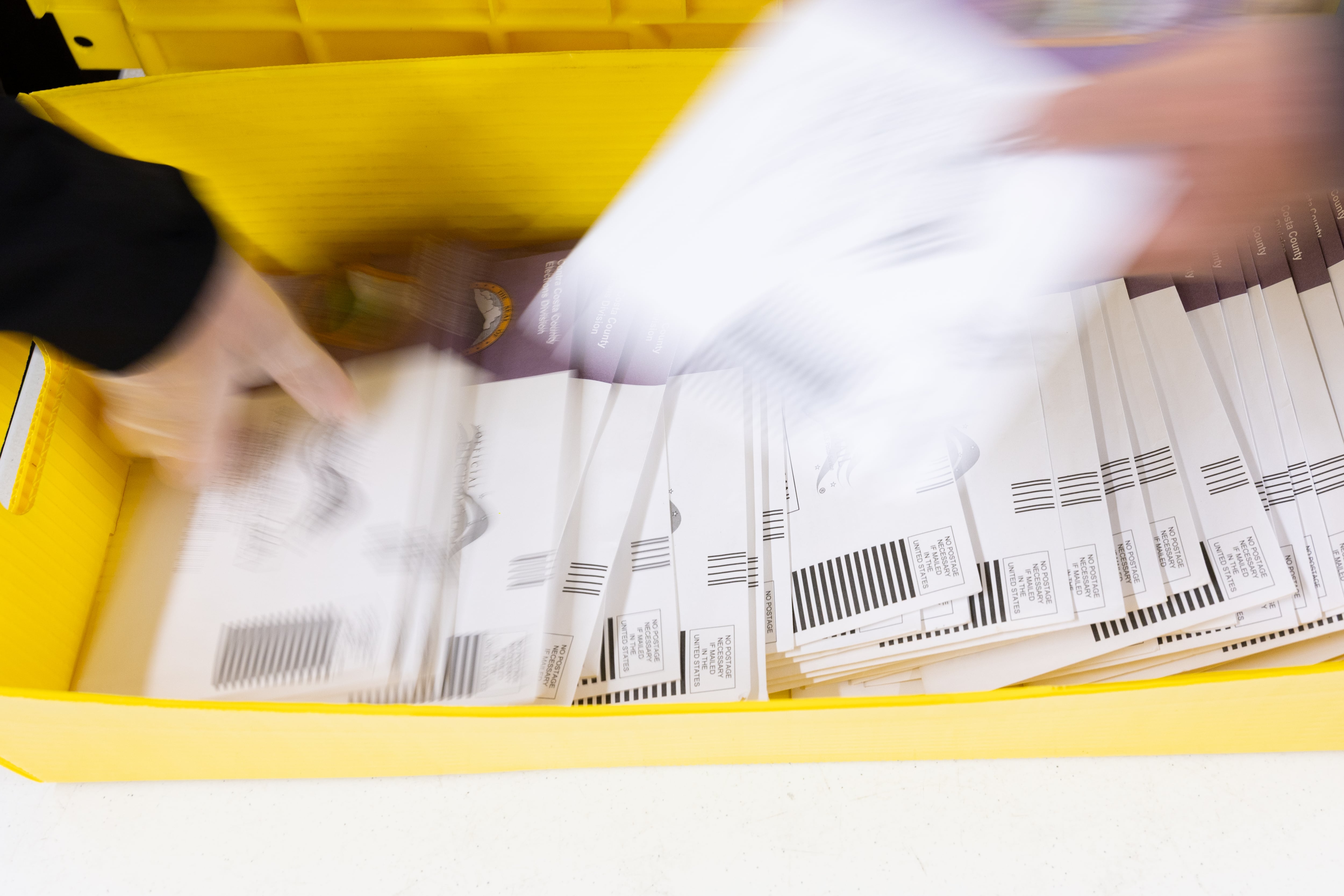
The Supreme Court ruled Monday that states can count mail-in ballots that arrive after Election Day, as long as they are properly postmarked — a key victory for voting rights advocates and another setback to President Donald Trump’s efforts to crack down on absentee voting.
In an uncommon 5-4 ruling, the justices found that nothing in federal law prevents states from enacting grace periods for absentee ballots to be received, as long as they are actually cast and mailed by Election Day. Fourteen states and the District of Columbia currently have such grace periods.
The case, Watson v. Republican National Committee, centered on a Mississippi law that allowed ballots postmarked by Election Day to be counted as long as they arrived up to five business days later. The national and state Republican parties challenged the law in 2024, arguing that, because Election Day is set by federal law, states should not be about to count ballots received after it.
A federal judge initially upheld Mississippi’s law, but an appeals court sided with the Republicans who challenged the ballot rules. Mississippi then brought its case to the Supreme Court in March.
The high court eventually sided with Mississippi. “The electorate’s choice is made when voting is complete, not when ballots are received,” Justice Amy Coney Barrett wrote in the majority opinion. “The election-day statutes say nothing about ballot receipt, and we cannot add to the words Congress chose.”
The ruling crossed ideological lines, with conservatives Barrett and Chief Justice John Roberts joining liberal Justices Ketanji Brown Jackson, Elena Kagan, and Sonia Sotomayor in the majority.
The status-quo ruling was good news for those who worried that eliminating the absentee-ballot grace period would disenfranchise voters. A Votebeat analysis of data from 11 of the 15 jurisdictions with grace periods found that more than 745,000 absentee ballots arrived after Election Day in 2024, representing no more than roughly 3 percent of the total vote in any state.
“The Court’s decision is a direct message to all voters who rely on mail ballots, including military and overseas voters, rural voters, seniors, and people with disabilities: Your voices matter equally to voters who can easily access a polling place,” said Pamela Smith, president of Verified Voting, a nonpartisan voting security group. “This ruling ensures that a postal delay outside of any voter’s control does not erase a lawfully cast ballot and supports election officials’ ability to capture the will of voters.”
Carolina Lopez, executive director of the Partnership for Large Election Jurisdictions, said she was pleasantly surprised by the court ruling. She said the decision would come as a relief to election administrators who weren’t sure when the absentee ballot receipt deadlines would be in their states.
“For election offices, this clarity matters,” she said.
Republicans, however, criticized the ruling. “Democrats are inviting chaos at the ballot box by allowing elections to drag on for days and weeks after voters cast their ballots,” Joe Gruters, chairman of the RNC, said in a statement. “Republicans are not going to be deterred by this decision, and the RNC will keep fighting to have elections end on Election Day as Americans want.”
In a post on social media, Trump called the ruling a “tremendous loss” and said it should be a catalyst for Congress to pass his long-stalled election overhaul, the SAVE America Act.
“There is only one reason to oppose — CHEATING!” Trump wrote. Studies show that mail voting fraud is exceedingly rare, accounting for only 0.000043% of total mail ballots cast, on average, in the 2016, 2018, 2020, and 2022 general elections.
Trump has long criticized mail-in ballots, blaming them for delayed election results and arguing unsuccessfully in court that they cost him the 2020 presidential election.
“We should know the result of the election on Nov. 3, the evening of Nov. 3,” Trump said on the campaign trail in 2020. “That’s the way it’s been and that’s the way it should be.”
As post-Election Day vote tallies in key states that year showed a swing toward Democrat Joe Biden, Trump called for a halt to counting ballots. The late swing reflected timing, not fraud: Studies show misinformation made Republicans more wary of mail voting in 2020, so later-counted mail ballots skewed Democratic.
“STOP THE COUNT!” Trump wrote on social media two days after Election Day. “ANY VOTE THAT CAME IN AFTER ELECTION DAY WILL NOT BE COUNTED!”
Last year, Trump issued an executive order that gave the federal government power to withhold federal funding to states that allowed ballots to be counted if they arrived after Election Day. Several states sued over the order, and federal courts have largely blocked it from taking effect.
On Monday, conservative Justice Samuel Alito embraced Trump’s arguments in his dissent. Alito argued that the ruling “creates a serious risk of further undermining public confidence in our elections and our system of self-government.”
In the wake of the ruling, Mississippi’s Republican attorney general urged the state legislature to eliminate the state’s grace period anyway.
“I am hopeful that the Mississippi Legislature will take this opportunity to amend the law and require absentee ballots be received on the same day ballots are cast at the polling place,” said Attorney General Lynn Fitch. “President Trump is right to prioritize improving public trust in our elections.”
During two hours of oral arguments in March, some conservative Supreme Court justices pressed the lawyers about whether late-arriving ballots could create the perception of voter fraud. At the time, Alito asked whether “confidence in outcomes can be seriously undermined if the apparent outcome of the election on the day after the polls close is radically flipped by the acceptance later of a big stash of ballots that flip the election.”
“We don’t have Election Day anymore,” Alito said. “We have election month, or we have election months.”
The more liberal justices questioned the impact that nullifying Mississippi’s law could have on voting by Americans and soldiers living overseas.
“You believe that absentee voting by the military and overseas voters, the… federal laws under which states have proceeded with respect to those votes are illegal?” asked Sotomayor.
Dion Nissenbaum is a senior national reporter for Votebeat and is based in Houston. Contact Dion at dnissenbaum@votebeat.org.