Votebeat is a nonprofit news organization reporting on voting access and election administration across the U.S. Sign up for Votebeat Arizona’s free newsletter here.
Most Maricopa County voters flagged as potential noncitizens by an error-prone federal system are citizens after all, according to county detectives.
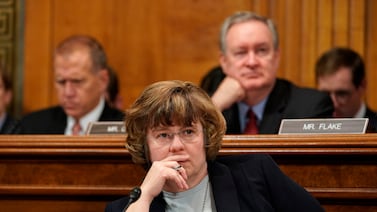
Rachel Mitchell, the county’s top prosecutor, said on Monday her office had completed a monthslong investigation into 60 suspected noncitizens who had cast ballots in prior elections.
Of those, she said 52 were citizens, and eight were not. Mitchell, a Republican, said all but one of the noncitizen voters appeared to have been erroneously registered while renewing their driver’s licenses.
It’s unclear whether those individuals could face formal criminal charges. Mitchell did not announce charges on Monday, but wouldn’t rule out doing so.
Her announcement comes after Maricopa County Recorder Justin Heap, a Republican, referred 207 individuals to county and state prosecutors for review in the spring. He identified the potential noncitizens on the county’s voter roll while attempting to confirm the citizenship status of 61,681 voters impacted by a longstanding state record-keeping error.
The database that flagged the voters as noncitizens — called Systematic Alien Verification for Entitlements, or SAVE — has repeatedly proven to be unreliable. Maintained by the U.S. Department of Homeland Security, SAVE was originally used to check immigrants’ eligibility for public benefits but was revamped and expanded last year to be used as a mass voter verification tool. However, it has produced false positives in several states.
In June, a federal judge blocked the use of the overhauled tool over concerns that it threatened both privacy and voting rights, but the U.S. Supreme Court cleared the way for election officials to resume using the system in a decision last week. However, the ruling is unlikely to have a significant impact on the midterm elections because federal law bars election officials from removing voters en masse in the 90 days leading up to an election.
Heap never addressed whether he attempted to confirm the 207 voters’ citizenship before forwarding them to prosecutors, and his office did not immediately respond to a request for comment on the county attorney’s findings.
So far, Mitchell has only looked at 60 of the 207 voters referred by Heap. The remaining 147 voters are still being investigated by her office and the Arizona Attorney General’s Office.
But her investigation’s preliminary results appear to further confirm research and audits that have consistently shown that voting fraud is extremely rare.
It also represents the continued fallout of the state driver’s license system’s longstanding problem tracking voters’ citizenship. Mitchell called that a “systemic flaw” and urged election officials, policymakers, and legislators to take steps to fix the issue.
“Though our findings today would not change the outcome of any past election, every ineligible voter dilutes the vote of a citizen,” she said. “It’s crucial that we fix this going forward so that there are no doubts cast on the security and the results of our elections.”
Who are the noncitizens identified by the county attorney’s office?
Mitchell said five of the noncitizen voters registered without affiliating with a political party. Two others registered as Republicans, and one registered as a Democrat.
She said the voters had cast ballots sporadically in general elections dating back to 2012. Two voters also cast GOP ballots during the 2020 and 2022 state primaries, and two voters cast ballots in Glendale’s 2025 special election.
Mitchell said she found no evidence that those voters were attempting to sway a specific election.
Of the eight noncitizens identified through county prosecutors’ investigation, Mitchell said seven were registered to vote while updating their driver’s licenses. She said the remaining noncitizen voter registered via a paper form. The individual had marked that they were not a citizen, she said, and it’s unclear why they were registered to vote.
Mitchell called for better training for clerks with the Arizona Department of Transportation’s Motor Vehicles Division.
“They should be asking someone if they want to register to vote before any form is filled out,” she said, adding that the voters interviewed by detectives had no recollection of registering to vote or being asked whether they wanted to do so. “The workers need to make it crystal clear that the information that they are gathering is for voter registration, and that the person must be a U.S. citizen.”
Mitchell said most of the noncitizen voters had been registered to vote while visiting an MVD office in person, but noted investigators couldn’t tell whether that location was an official MVD location or a third-party one. In Arizona, the state contracts with private companies to provide motor vehicle services, including issuing, renewing, and replacing driver’s licenses.
She suggested that lawmakers could help close the loophole in the state’s driver’s license and voter registration databases by requiring a record of who registers each voter — whether that be an MVD clerk, a worker at a third-party site, or a volunteer with a voter registration organization.
Mitchell also noted that officials could try to more strongly bifurcate MVD records from voter registration records. Federal and state law require voters to have the opportunity to register to vote at the same time as they obtain a driver’s license, she said, but statute doesn’t require “that there be an overlapping of data.”
What’s next for the investigated voters?
After using the SAVE tool to identify the 207 voters as potential noncitizens, Heap placed them in “not eligible” status earlier this year. Voters in that status remain on the rolls, but they may not receive mail ballots and are required to show proof that they are a U.S. citizen before being allowed to vote.
In moving the voters to that status, Heap appeared to be using a process outlined in the state’s election rulebook that applies to new registrants suspected of being noncitizens, rather than following requirements in a state law that lays out how to notify and remove potential noncitizens who are already on the voter rolls.
Several election experts and lawyers previously told Votebeat that his use of that process was questionable and may not meet legal requirements for notifying voters.
Since then, records suggest those voters have remained in “not eligible” status. Janine Petty, senior director of voter registration at the county recorder’s office, wrote in an email on Aug. 28 that the voters had been designated as “not eligible” and would remain there pending review by state and county prosecutors, unless they provided documents proving their citizenship.
Heap’s office did not immediately respond to a request for comment from Votebeat on how it would handle the 60 voters already investigated by Mitchell.
Other states, including Texas, have scrambled to reinstate voters in the wake of discovering that citizens were incorrectly flagged by the SAVE system.
It’s unclear which process Heap will use to cancel the eight noncitizen voters identified by Mitchell’s review. The process that led him to put the voters into “not eligible” status requires him to keep them in that status until the November election, and cancel them thereafter if they don’t show proof of citizenship. But the process outlined in state law — the correct one for voters already on the rolls — would require him to send them a notice, wait 35 days for a response, and, if none came, cancel their registration.
Meanwhile, the remaining 147 voters Heap referred to prosecutors are still under investigation.
Mitchell said she split the pool of voters referred for review with Arizona Attorney General Kris Mayes, a Democrat. The county has about 20 individuals to investigate in addition to the 60 voters it has already reviewed, she said. The rest are being handled by state prosecutors.
A source familiar with Mayes’ investigation told Votebeat that it is close to finished — and so far, state investigators are finding lots of citizens, similar to the county attorney’s office.
Sasha Hupka is a reporter for Votebeat based in Arizona. Contact Sasha at shupka@votebeat.org.