
Get insider knowledge about how elections are run across the country. Sign up for Votebeat’s free weekly newsletter and never miss an update.
The unsettled controversy over dueling Dans running for the U.S. Senate seat in Alaska overlooks one underlying truth in the race: there are very few scenarios in which voter confusion over the two candidates with the same name could decide the outcome.
The winner of the Alaska race is expected to be pivotal to which party controls the U.S. Senate. Democrats are looking to flip the seat and topple two-term Republican Sen. Dan Sullivan. Polls show Sullivan in a tight race with Democrat Mary Peltola, the former congresswoman who became the first Alaska Native elected to Congress in 2022.
Republicans assert a third candidate, retired teacher Dan Sullivan, could act as a spoiler and confuse voters who intend to vote for the incumbent with the same name. The Justice Department filed a lawsuit that seeks to block certification of the U.S. Senate race if the incumbent senator loses because of votes cast for the second Dan Sullivan on the ballot. It sought to block certification of the election if the incumbent narrowly lost, and requested a court order requiring the state to segregate ballots cast for the non-incumbent Dan Sullivan and permitting the federal government to investigate the intent of those voters.
A federal judge threw the case out on Sunday and said the federal government had failed to outline a realistic way to address the problems it said existed, or to investigate voter intent without violating ballot secrecy. U.S. District Judge Sharon Gleason also warned that setting aside ballots for a federal investigation just days before Election Day could confuse voters and depress turnout.
The swirl of legal challenges obscures the underlying fact that there are very narrow circumstances in which voter confusion in this race could affect the outcome. Part of that is because Alaska is one of two states, along with Maine, to use a ranked choice voting system in federal races.
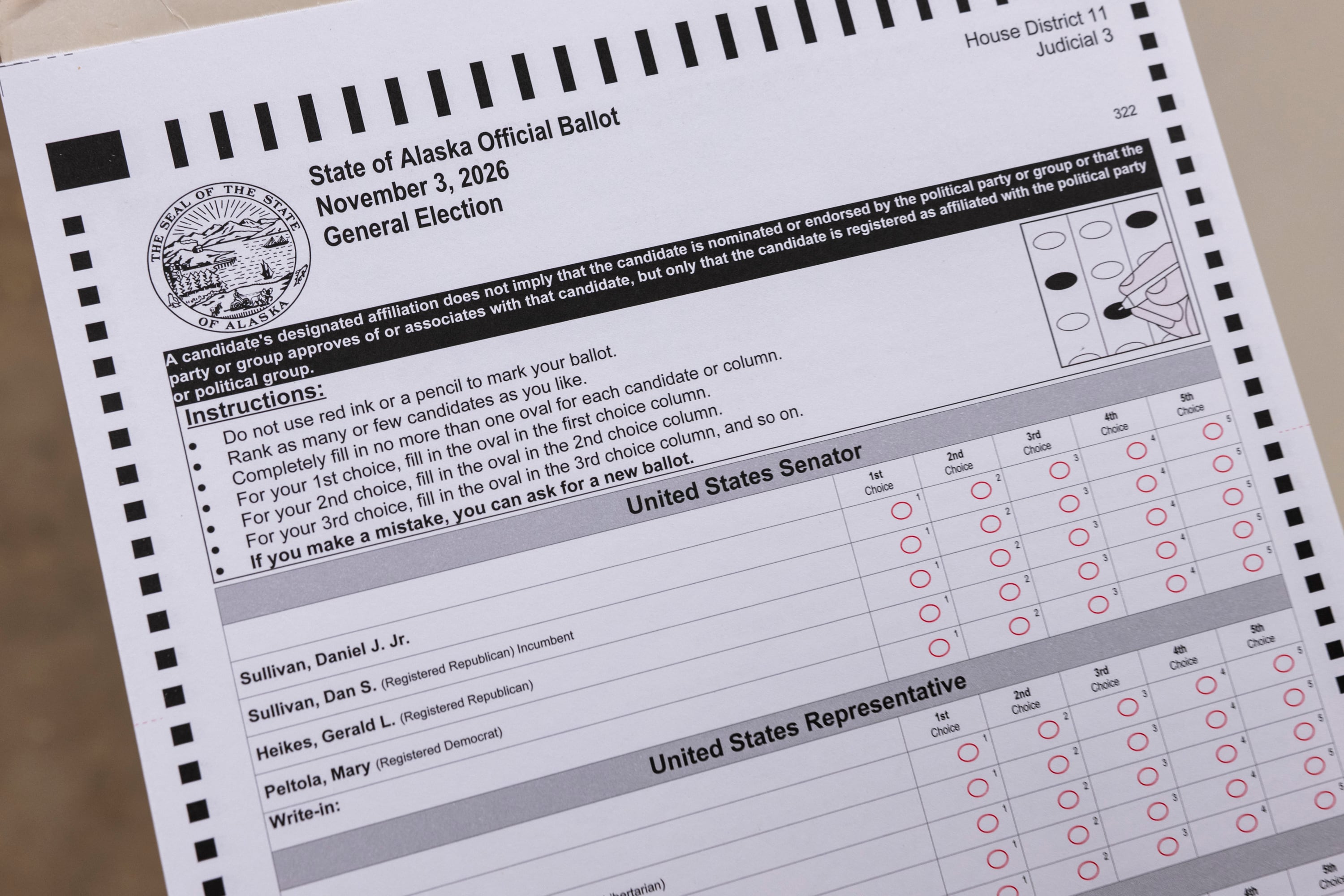
That means voters can rank their preferences. If a candidate wins more than 50% of the vote on the first ballot, they win the election. If no candidate wins an outright majority, Alaska election officials will turn to the ranked choice voting process. In that case, the candidate with the smallest number of votes will be eliminated and their votes will be reapportioned to the other candidates based on the voter rankings. The process continues until one person wins a majority.
The ranked choice process means that if any potentially confused voters rank the Dans as their top two choices, their vote will likely ultimately favor the incumbent senator. The way the non-incumbent Dan has a major impact is if voters decline to use the ranked choice process and he earns more votes than the gap between the incumbent senator and his Democratic challenger — and that assumes voters didn’t intend for that to happen.
Sarah John, a ranked choice voting researcher and executive director of the nonprofit Doctors of Democracy, said it was extremely unlikely that the second Dan Sullivan on the ballot would impact the final outcome.
“I’d say that there’s less than a 1% chance of Decoy Dan being a spoiler” if Republicans rank their preferences, John said.
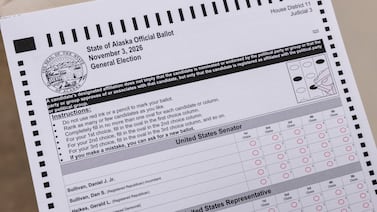
The Alaska ballot seeks to distinguish the two Sullivans. The incumbent is listed on the ballot as Dan S. Sullivan, the Republican incumbent. The second Sullivan is listed as Daniel J. Sullivan Jr., and includes no party affiliation or other identifying information.
Alaska election officials initially threw the retired schoolteacher off the ballot, but the state Supreme Court rejected that effort and put his name back before voters this past summer.
The ranked choice voting process gives voters who may be confused by the two Sullivans on the ballot a chance to make sure their choices aren’t wasted. If voters rank the retired school teacher first and the incumbent senator second, their votes will shift to the two-term Senator if, as expected, the former teacher is eventually eliminated from consideration.
John said the best Republican strategy would be to “encourage their voters to rank candidates and perhaps delight in ranking Peltola last.”
In that case, she said, “if the race is tight, every single exhausted ballot for Daniel J. Jr. that was intended for Dan S. has the potential to flip the result” in the incumbent’s favor.
The scenario where the second Dan Sullivan would make the most difference would be if Republican voters who meant to vote for the incumbent senator mistakenly cast their ballot for the retired schoolteacher without ranking any other candidates.
In the 2024 November general election, 60% of voters chose only one candidate and did not use the ranked choice voting system.
To make a case for voter confusion affecting the outcome, the number of Alaskans who cast a vote only for the retired schoolteacher would have to top the margin of a narrow Peltola victory.
John Lindback, who oversaw elections in Oregon and Alaska, said widespread attention on the two Dans should neutralize most voter confusion.
“I’m not seeing any evidence thus far that the second Dan Sullivan is going to have a big impact on this race, in part because there’s been so much publicity about it,” he said. “All of that just suggests to me that this will be not as great a factor as people suggest it will.”
In addition to the Justice Department lawsuit, Alaska Gov. Mike Dunleavy and federal prosecutors have launched eleventh-hour criminal investigations into Daniel J. Sullivan’s candidacy following a New York Times story last week that reported operatives working with Peltola’s campaign and Democratic leadership worked to recruit the second Dan in an effort to dilute the Republican vote for the incumbent Alaska senator.
“Anyone who tries to illegally deceive voters and interfere with the election will answer for it,” U.S Attorney Michael Heyman, Alaska’s top federal prosecutor, said.
Alaska’s embrace of ranked choice voting created problems for any kind of voter dilution scheme.
“Assuming Republican voters use RCV then, yes, the plan was doomed to fail,” John said.
Efforts to split the Republican votes were premised on key flaws, John said, including a dubious belief that Sullivan voters would be prone to confusion.
“The plan was pretty stupid and risks undermining confidence in elections,” she said.
Dion Nissenbaum is Votebeat’s senior national reporter and is based in Houston. Contact Dion at dnissenbaum@votebeat.org.