Votebeat is a nonprofit news organization reporting on voting access and election administration across the U.S. Sign up for Votebeat Wisconsin’s free newsletter here.
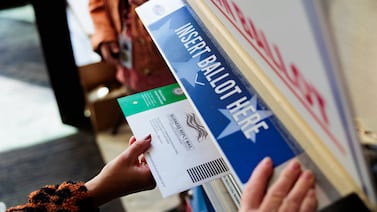
Wisconsin Gov. Tony Evers criticized an argument by Madison and its former city clerk that they shouldn’t be held liable for losing 193 absentee ballots because absentee voting is a “privilege,” writing in a court filing that accepting such an argument would “lead to absurd results.”
The argument is key to the city’s defense against a lawsuit that seeks monetary damages on behalf of the 193 Madison residents whose votes in the November 2024 election weren’t counted. It was first presented by the former clerk, Maribeth Witzel-Behl, citing a provision of state law, and then adopted by the city.
If courts accept the argument that absentee voting is a privilege and not a right, the Democratic governor said in a friend-of-the-court brief, election officials would be free to treat absentee ballots in ways that diminish people’s right to vote. For example, he wrote, they would be under no obligation to send voters replacement ballots if ballots they left in a drop box were damaged, and clerks could effectively disqualify ballots from politically disfavored precincts by intentionally not signing their initials on the ballot envelopes.
Experts say that for a governor to intervene in such a local matter is rare and underscores how seriously Evers views the potential implications. In an earlier communication with the court, the governor said the argument from the city and Witzel-Behl “ignores longstanding state constitutional protections.”
Barry Burden, a political science professor at UW-Madison, said Democrats are likely conflicted by the case, seeking to prevent election administration failures like those in Madison while also resisting arguments that could weaken protections for absentee voting in Wisconsin.
“They’re in a weird place to be criticizing absentee balloting in Madison, one of the most Democratic cities in the state,” he said, adding that he thinks the governor “is speaking for the Democratic Party in getting involved in this case” to convey that it is an “isolated incident,” and that the party does not share the position that “absentee voting should be treated any differently in terms of the protections that are given to voters than people who vote in person.’”
In his filing Friday, the governor noted that about 45% of ballots in the 2024 presidential election were absentee.
“The constitutional right to vote,” Evers wrote, “would mean little if close to half of all voters in Wisconsin were deprived of it because they chose to legally cast an absentee ballot.”
Witzel-Behl, former clerk, stands by the ‘privilege’ defense
The lawsuit against Madison officials is a novel type of case in seeking monetary damages over the loss of voting rights. A liberal law firm called Law Forward filed the case against the city and the clerk’s office, along with Witzel-Behl and Deputy Clerk Jim Verbick in their personal capacities, alleging that through a series of errors that led to 193 absentee ballots getting lost in the November 2024 election, election workers disenfranchised the voters and violated their constitutional rights.
As part of their defense, attorneys for Witzel-Behl argued in a court filing that by choosing to vote absentee, the 193 voters “exercised a privilege rather than a constitutional right,” and that she therefore couldn’t be held financially liable for the lost ballots. Madison later joined that argument.
Law Forward rejected the argument in a response filed in late December, calling it a “shocking proposition.”
Attorneys for the city and the former clerk submitted their own briefs last week.
Attorneys for Witzel-Behl reiterated their argument that absentee voting is a privilege and not a constitutional right, adding that “an error in the handling or delivery of an absentee ballot is not the constitutional equivalent of barring the door to the voting booth.”
While absentee ballots should normally be counted, they argued, not counting them because of an unintentional error isn’t a constitutional violation that they should be financially liable for.
Rather than following court precedent, they said, the plaintiffs seek to create a “new, foundationless doctrine allowing monetary damages for the mishandling of an absentee ballot.”
Other defendants zero in on novel monetary claim
In a separate brief, Verbick, the deputy clerk, said he “does not, of course, dispute that Plaintiffs have a right to vote” but rather alleges that there’s no path for the plaintiffs to seek monetary damages for the city’s error.
The city, in another brief, similarly said that no court case cited by Law Forward allows plaintiffs to seek damages for ballots that are unintentionally mishandled.
Allowing such claims, outside attorneys for the city warned, would push courts into “dangerous, untested waters.”
“As other courts have cautioned,” they said, “exposing local election officials to financial liability for unintentional disenfranchisement would thrust courts into the minutia of any given election, a role for which courts are unsuited.”
In a separate statement, the city said it believes that all forms of voting, including absentee voting, should be “encouraged, promoted and protected.” But it argued against attaching a dollar amount to a mishandled vote.
Doing so, it said, “would end up regularly costing cities, towns and municipalities hundreds, thousands — or in this case millions — of dollars that could otherwise be spent improving voter access and elections processes.”
Absentee voting has changed substantially since law’s enactment
The law cited by Witzel-Behl’s attorneys labeling absentee voting a privilege — one that may require more regulation than in-person voting — dates back to 1985. It was enacted after judges in a series of Wisconsin court cases called for more liberal interpretation of absentee voting rules. While it has previously been used to invalidate absentee ballots on which voters did not follow procedure, it has so far not been used in support of a locality failing to properly count votes.
“Absentee voting has changed so radically in the 40 years since the law was written,” Burden said. “It was used by a very small number of voters, it was more difficult to use, there were more witness requirements at the time, and clerks were not really as amenable to absentee voting as they are today.”
Today, absentee voting is an expected and routine part of elections.
“So to treat it as kind of a special class with different rules or rights, maybe in the 1980s that made more sense,” Burden said. “But now it’s as important as any other kind of voting and so it seems more peculiar, I think, to treat it in some different way.”
Alexander Shur is a reporter for Votebeat based in Wisconsin. Contact Alexander at ashur@votebeat.org.