Votebeat is a nonprofit news organization reporting on voting access and election administration across the U.S.
This news analysis was originally distributed in Votebeat’s free weekly newsletter. Sign up to get future editions, including the latest reporting from Votebeat bureaus and curated news from other publications, delivered to your inbox every Saturday.
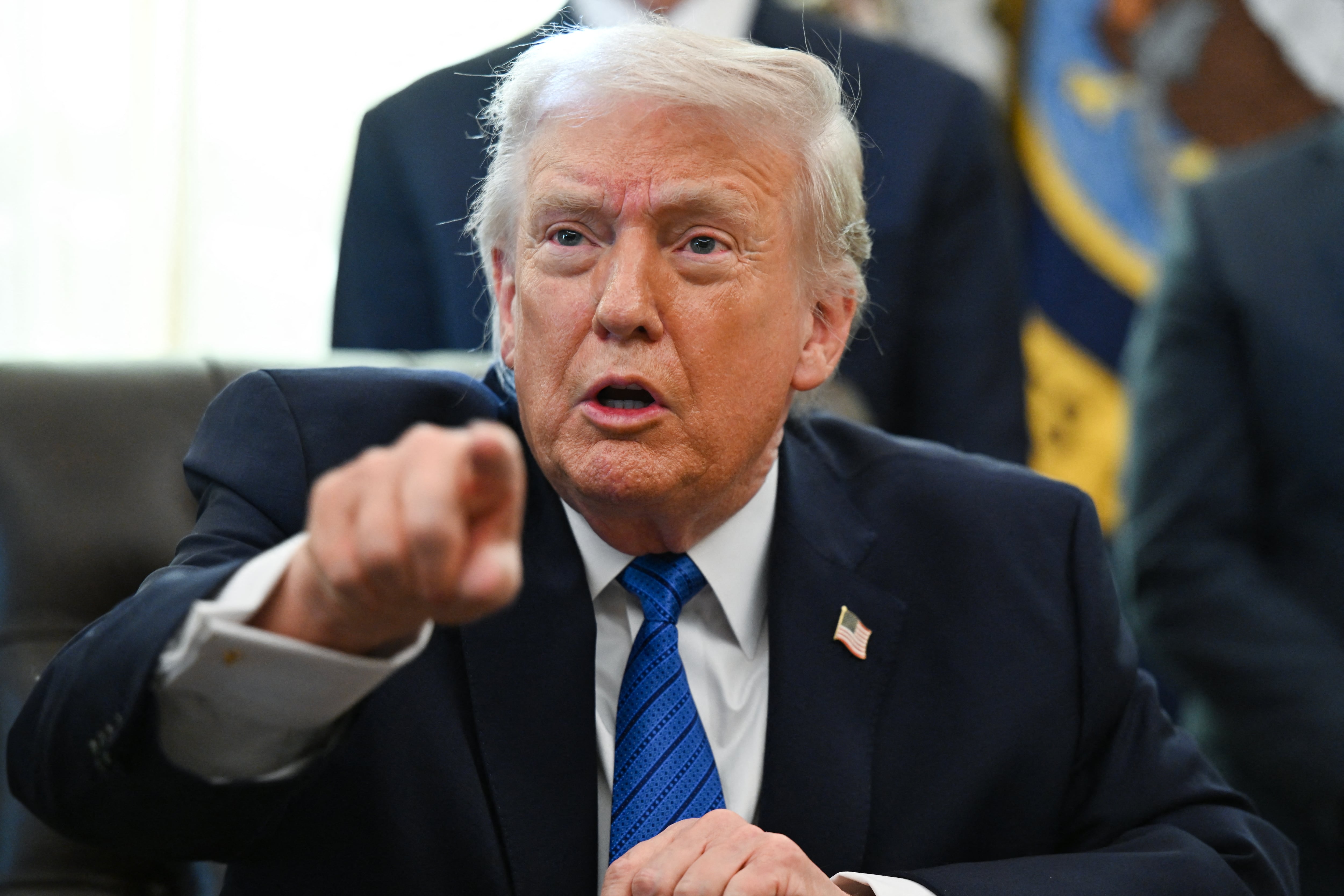
As Votebeat’s readers are well aware, concerns have long been simmering about President Donald Trump potentially interfering in the 2026 midterm elections. Last Monday, in just a few seconds on “The Dan Bongino Show,” Trump turned the heat up to HI.
“The Republicans should say, ‘We want to take over, we should take over the voting in at least — many — 15 places.’ The Republicans ought to nationalize the voting,” Trump told the conservative commentator.
Trump is known for making provocative, over-the-top remarks — but he’s also the president of the United States, so his rhetoric has to be taken seriously. The only problem is, if you ask three different people what Trump meant by these comments, you’ll get five different answers.
Many people assumed he meant that he wants the Republicans in the executive branch to conduct the 2026 elections. Trump himself encouraged this interpretation when he said in the Oval Office on Tuesday, “When you think about it, the state is an agent for the federal government in elections. I don’t know why the federal government doesn’t do them anyway.”
Needless to say, this would be an extraordinary challenge to the power of state and local governments to run their own elections. It’s virtually unprecedented in American history for the federal government to take such an active role in elections, without an act of Congress. But if this is what Trump has in mind, he’ll likely be disappointed: It’s pretty clearly unconstitutional for the executive branch to do that. Article I, Section 4 of the Constitution gives states the power to set the “Times, Places and Manner of holding Elections.”
Another potential interpretation is that Trump wants Republicans on the state and local level — who do have legal authority over elections in states where the GOP holds power — to exercise more power. For instance, a Republican-controlled state could attempt to take over election administration in a Democratic-controlled local jurisdiction.
A lot of news coverage of the podcast interview assumed that Trump wanted to take over the voting in 15 states, but he could have meant 15 counties or cities instead. In his Oval Office remarks, Trump name-checked Detroit, Philadelphia, and Atlanta as places he doesn’t trust to administer their own elections. “If they can’t count the votes legally and honestly, then somebody else should take over,” he said.
Republicans aren’t necessarily in a position to take over elections in those places (though in Michigan, which has a Democratic governor, secretary of state, and attorney general, GOP state lawmakers previously said they wanted federal oversight of the state’s elections), and might not even if they could. In 2020, plenty of GOP election officials resisted Trump’s pressure to interfere in the election on his behalf. That said, his grip on the party today is stronger than it was six years ago, so it’s worth taking this possibility seriously.
Yet another possible interpretation is that Trump wants Congress to “nationalize” elections by passing laws codifying his preferred election policies, such as voter ID, nationwide. Indeed, when White House press secretary Karoline Leavitt was asked about Trump’s comments, she said he was referring to the SAVE Act, which would require Americans to prove their citizenship when registering to vote. And in the Oval Office, Trump reinforced the notion that he was asking Congress to intervene by saying, “If a state can’t run an election, I think the people behind me” — members of Congress — “should do something about it.”
Compared with the federal government taking over the actual administration of the election, Congress passing a law governing it is on much safer legal ground. The Constitution gives Congress the power to “make or alter” state election laws. Trump and conservative activists have been pushing hard for it to do so. Politically speaking, however, none of the proposed Republican election bills have a path to pass the Senate as long as the filibuster remains in place.
Finally, Trump could’ve been referring to his efforts that are already underway to nationalize certain aspects of election administration. For instance, last March, he issued an executive order that sought to require proof of citizenship to register to vote, change certification standards for voting machines, standardize the due date for mail ballots, and more. (Major parts of the executive order have been blocked in court.)
And in another unprecedented move, the Department of Justice has asked most states to send it their unredacted voter lists, which the department hopes to review for potential noncitizens. The administration is suing 24 states, plus Washington, D.C., that have not complied with the request.
We don’t know what exactly Trump had in mind when he went on Bongino’s show. But in a larger sense, Trump’s comments didn’t tell us anything new. We already knew from his actions over the past year that Trump thinks there should be more federal involvement in election administration. Last month’s search of an elections facility in Fulton County, Georgia, reinforced that. Whether you call it nationalization or not, that’s been the theme of his entire second term.
Nathaniel Rakich is Votebeat’s managing editor and is based in Washington, D.C. Contact Nathaniel at nrakich@votebeat.org.