Votebeat is a nonprofit news organization reporting on voting access and election administration across the U.S. Sign up for Votebeat Arizona’s free newsletter here.
At least 50,000 mail ballots never made it to voters during Arizona’s July 21 primary election.
That number, based on information gathered by Votebeat from 11 of the state’s 15 counties, isn’t out of the ordinary. In fact, it appears roughly in line with that of prior major elections. About 71,000 mail ballots went undelivered statewide during the 2024 general election, according to data from the U.S. Election Assistance Commission that represented all of the state’s counties.
Every year, some ballots that are mailed out to voters are returned to election officials because the voter’s address is incorrect or the voter has a forwarding address on file. (In Arizona, ballots legally can’t be forwarded.)
Their return does not necessarily mean those voters were disenfranchised, as they could have voted in person instead. But slowdowns in mail processing and President Donald Trump’s invections against mail voting put voters and advocates nationwide on edge about the U.S. Postal Service’s role in elections. Anxiety is especially acute in Arizona, where the vast majority of voters cast ballots by mail. That has put more attention on the state’s undeliverable ballots.
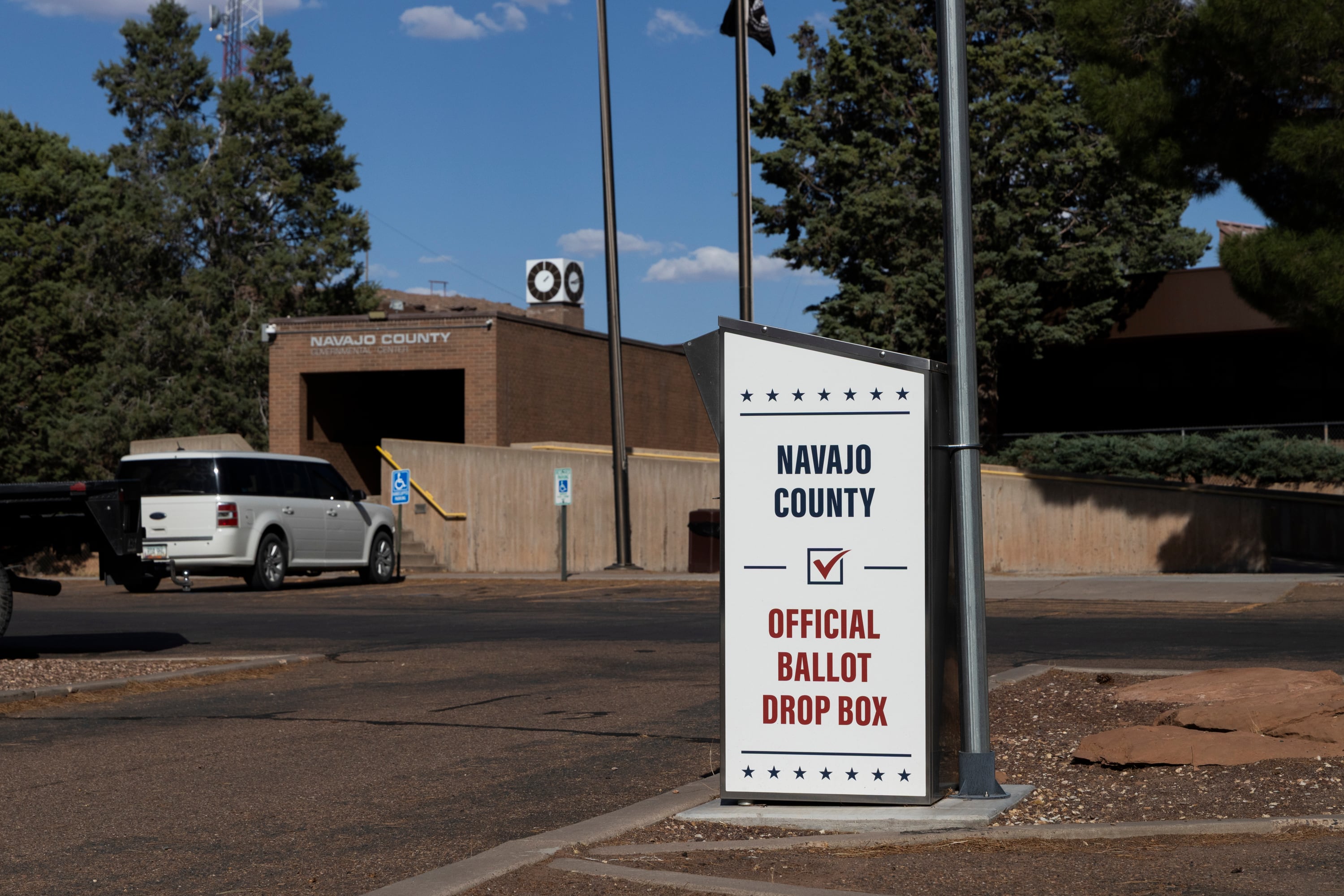
Those fears were on full display last month in Navajo County, a rural county in the northeast quadrant of the state where Recorder David Marshall said just before the primary that his office was experiencing “an issue” with the U.S. Postal Service.
“We have received over 900 returned ballots — over 900,” Marshall, a Republican who was recently appointed to his post, said in a public meeting on July 14. “Why? Don’t know.”
Later, the number of undelivered ballots in the county rose to more than 1,300 — a figure that continues to tick slightly upward as delayed returns from the Postal Service trickle in. The news quickly spread, drawing extensive media coverage and the attention of Trump himself.
This year, more ballots than usual statewide might have been undeliverable because voters were out of town. Some county recorders told Votebeat that they noticed a slightly higher number of ballots returned with postal codes indicating that the intended recipients were temporarily away. Most chalked that up to the state’s earlier-than-usual primary date. In February, state lawmakers shifted the primary from Aug. 4 to July 21.
But in the Navajo County case, data and records suggest nothing nefarious, or even all that unusual, was afoot.
What data and records show about undeliverable ballots in Navajo County
Votebeat found that Navajo County’s rate of undeliverable ballots was indeed higher than that of other jurisdictions across Arizona during this year’s primary. As of Aug. 12, county officials said 1,377 ballots went undelivered in the rural county, or about 3.9% of the total number of ballots mailed out. By contrast, across the other 10 counties where Votebeat was able to collect data, only 2.3% of ballots were returned undelivered.
But data from the EAC shows Navajo County’s undeliverable ballot rate isn’t unheard of historically in Arizona. During the 2024 general election, for instance, La Paz County saw about 4.4% of its mail ballots returned as undeliverable. In 2022, Coconino and Pinal each received thousands of undeliverable ballots from the Postal Service — about 5.5% and 3.8% of the total number of mail ballots sent to voters by officials, respectively. Statewide, undeliverable ballot rates rose as high as 4.7% in the 2016 general election.
Furthermore, undeliverable ballot rates can vary widely from year to year. Navajo County, for instance, has seen its rate fluctuate from as low as 0.6% to as high as 3.3% in recent general elections.
The data isn’t perfect. Some counties told Votebeat they counted undeliverable ballots in the primary election slightly differently than other counties. The EAC collects data on undeliverable ballots after each general election, but not for primary elections. And in some years, not all counties reported undeliverable ballot data to the EAC.
But records obtained by Votebeat also suggest that Navajo County’s high rate of returned ballots wasn’t because something went wrong with their delivery. Following Marshall’s remarks, county officials asked the Postal Service to examine a sampling of the undeliverable ballots. When the Postal Service did so, it found that nine of the 10 ballots submitted by the county had a valid reason for being returned. The remaining ballot required further investigation.
Officials appear to be backing away from undeliverable ballot fears
Federal, state, and local officials have been working to tease out whether there was an identifiable issue connected to the undelivered ballots in Navajo County — or if the number, while not ideal, came from processes operating as usual.
Initially, some officials — including Marshall in his remarks at the public meeting — appeared to suggest that something may have gone awry. But in recent weeks, the county’s tone has gradually shifted.
For instance, the Navajo County Recorder’s Office said in a July 24 statement that it was working with the Postal Service to “identify any issues that may have occurred during the mailing process.”
Later, on July 31, the office issued an updated statement. It said it had sent an expanded sample of 200 undeliverable ballot envelopes to the Postal Service for review. Of those, the Postal Service found that 66% were returned because the recipient had some type of change-of-address order on file. Others were marked undeliverable because they were addressed to vacant homes or closed postal boxes.
“Returns of ballots occurred in other Arizona counties, demonstrating that this is a routine part of election administration statewide,” the statement read.
Calli Jones, a spokesperson for the Arizona Secretary of State’s Office, told Votebeat on July 30 that her office was working to set up meetings with the Postal Service to “learn more about this situation on their end.” And on Aug. 14, Richie Taylor of the Arizona Attorney General’s Office said his office believed the undeliverable ballots were normal after looking into the matter.
“We’ve spoken to the recorder in Navajo County and they’ve verified that the rejection rate is in line with historical rejection rates, so we don’t believe there’s anything nefarious going on there,” Taylor told Votebeat.
Meanwhile, Cathy Purcell, a spokesperson for the Postal Service, told Votebeat on July 24 that mail carriers returned the ballots to the county “in accordance with proper protocol.”
Can Arizona reduce its undeliverable ballots?
Some number of undeliverable ballots may be normal and a sign that the system is working as intended. Still, undeliverable ballots are far from ideal, and officials in Navajo County say they will work to reduce them in the future.
In a statement, officials said they would begin taking more proactive steps to clean up the county’s voter rolls ahead of November. When ballots are returned as undeliverable, the Navajo County Recorder’s Office will begin sending affected voters a mailed notice that can be forwarded by the Postal Service to their current address, if available.
The office will also seek to email, call, and text voters if their contact information is available in their voter record.
“This additional step will provide multiple ways for voters to receive information, respond, and update their registration,” officials said on July 31.
Sasha Hupka is a reporter for Votebeat based in Arizona. Contact Sasha at shupka@votebeat.org.